





Rosacea most commonly affects patients aged 30 to 50 with fair complexions, most notably those of Irish and Northern European descent, but it affects and is probably under-recognized in darker-skinned patients.
Etiology of Rosacea
The etiology of rosacea is unknown, but some proposed associations include
Abnormal vasomotor control
Impaired facial venous drainage
Increased follicle mites (Demodex folliculorum)
Increased angiogenesis, ferritin expression, and reactive oxygen species
Dysfunction of antimicrobial peptides (eg, cathelicidin)

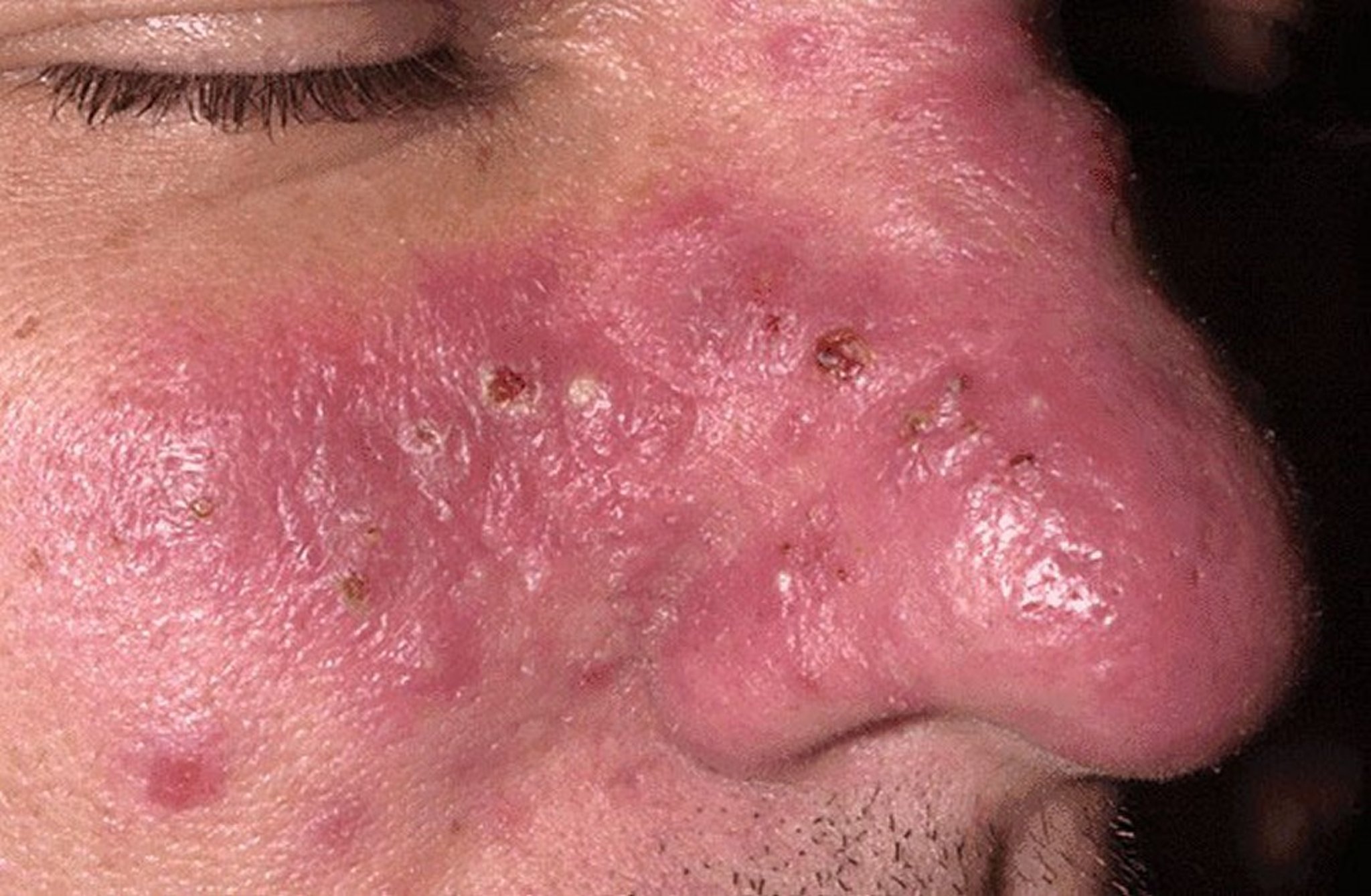
Photo provided by Thomas Habif, MD.
Symptoms and Signs of Rosacea
Rosacea is limited to the face and scalp and manifests in 4 phases:
Pre-rosacea
Vascular
Inflammatory
Late
In the pre-rosacea phase, patients describe embarrassing flushing and blushing, often accompanied by uncomfortable stinging. Common reported triggers for these flares include sun exposure, emotional stress, cold or hot weather, alcohol, spicy foods, exercise, wind, cosmetics, and hot baths or hot drinks. These symptoms persist throughout other phases of the disorder.
In the vascular phase, patients develop facial erythema and edema with multiple telangiectases, possibly as a result of persistent vasomotor instability.


An inflammatory phase often follows, in which sterile papules and pustules (leading to the designation of rosacea as adult acne) develop.


The late phase (developing in some patients), is characterized by coarse tissue hyperplasia of the cheeks and nose (phymatous changes, including rhinophyma causing a large, erythematous, bulbous nose) caused by tissue inflammation, collagen deposition, and sebaceous gland hyperplasia.

The phases of rosacea are usually sequential. However, some patients go directly into the inflammatory stage, bypassing the earlier stages. Treatment may cause rosacea to return to an earlier stage. Progression to the late stage is not inevitable.
Ocular rosacea often precedes or accompanies facial rosacea and manifests as some combination of blepharoconjunctivitis, iritis, scleritis, and keratitis, causing itching, foreign body sensation, erythema, and edema of the eye.


Diagnosis of Rosacea
Clinical evaluation
Diagnosis of rosacea is based on the characteristic appearance; there are no specific diagnostic tests. The age of onset and absence of comedones help distinguish rosacea from acne.
Differential diagnosis of rosacea includes acne vulgaris, systemic lupus erythematosus, sarcoidosis, photodermatitis, drug eruptions (particularly caused by iodides and bromides), granulomas of the skin, and perioral dermatitis.
Treatment of Rosacea
Avoidance of triggers
For rhinophyma, consideration of dermabrasion, laser ablation, and tissue excision
For telangiectasia, consideration of laser or electrocautery treatment
2016 clinical practice guidelines for rosacea.
1). Oral beta-blockers can be effective and should be considered if other treatments are ineffective (2).
Techniques for treatment of rhinophyma include dermabrasion, laser ablation, and tissue excision; cosmetic results are good.
Techniques for treatment of telangiectasia include laser and electrocautery.
Treatment references
1. Baumann L, Goldberg DJ, Stein Gold L, et alJ Drugs Dermatol 17(3):290–298, 2018. PMID: 29537447
2. Logger JGM, Olydam JI, Driessen RJB: Use of beta-blockers for rosacea-associated facial erythema and flushing: A systematic review and update on proposed mode of action. J Am Acad Dermatol 83(4):1088-1097, 2020. doi: 10.1016/j.jaad.2020.04.129
Key Points
Consider rosacea if patients have facial flushing and blushing, with or without stinging, often triggered by sun exposure, emotional stress, cold or hot weather, alcohol, spicy foods, exercise, wind, cosmetics, or hot baths or hot drinks.
Diagnose rosacea by its typical appearance (eg, central facial erythema and edema with or without pustules, papules, or multiple telangiectases).
Dermabrasion, laser ablation, and tissue excision for rhinophyma give good cosmetic results.
Consider laser or electrocautery for telangiectasia.
More Information
The following English-language resource may be useful. Please note that THE MANUAL is not responsible for the content of this resource.


