





Contact dermatitis is inflammation of the skin caused by direct contact with irritants (irritant contact dermatitis) or allergens (allergic contact dermatitis). Symptoms include pruritus and sometimes a burning pain. Skin changes include erythema, scaling, skin swelling, and sometimes blistering and ulceration. The location depends on the site of contact. Diagnosis is by exposure history, examination, and sometimes skin patch testing. Treatment includes topical corticosteroids, antipruritics, and avoidance of irritants and allergens.
(See also Definition of Dermatitis.)
Pathophysiology of Contact Dermatitis
Contact dermatitis is caused by irritants or allergens.
Irritant contact dermatitis (ICD)
ICD is a nonspecific inflammatory reaction to toxic substances contacting the skin. Numerous substances can irritate the skin, including:
Chemicals (eg, acids, alkalis, solvents, metal salts)
Soaps (eg, abrasives, detergents)
Plants (eg, poinsettias, peppers)
Chronic moisture (eg, from body fluids, urine, and saliva)
Properties of the irritant (eg, extreme pH, solubility in the lipid film on skin), environment (eg, low humidity, high temperature, high friction), and patient (eg, very young or old) influence the likelihood of developing ICD. ICD often can be divided into categories:
Acute ICD: Potent irritants, such as caustic chemicals, can damage the skin immediately, typically manifesting with acute burning or stinging pain.
Chronic or cumulative ICD: Less potent irritants require longer (chronic) or repeated (cumulative) periods of skin contact to cause ICD; these forms typically manifest with pruritus.
Occupational ICD is ICD caused by one or more of the many possible work-related skin irritants. It can be acute, chronic, or cumulative.
Atopic disorders increase risk of ICD because of impaired skin barrier function and lower threshold for skin irritation.
Phototoxic dermatitis (see Chemical photosensitivity) is a variant in which a topical (eg, perfumes, coal tar) or ingested (eg, psoralens) agent becomes a skin toxin only after exposure to ultraviolet light, most typically long-wave ultraviolet light (UVA). Phototoxic dermatitis, therefore, occurs only in UV-exposed skin, typically with a sharp demarcation. ) is a variant in which a topical (eg, perfumes, coal tar) or ingested (eg, psoralens) agent becomes a skin toxin only after exposure to ultraviolet light, most typically long-wave ultraviolet light (UVA). Phototoxic dermatitis, therefore, occurs only in UV-exposed skin, typically with a sharp demarcation.
Allergic contact dermatitis (ACD)
ACD is a type IV, T-cell–mediated, delayed-type hypersensitivity reaction to an environmental allergen that has 2 phases:
Sensitization to an antigen
Allergic response after reexposure
In the sensitization phase, allergens are captured by Langerhans cells (dendritic epidermal cells). When activated by innate immunity cascades, these cells migrate to regional lymph nodes, where they process and present the antigen to naive, antigen-specific T cells. When a naive T cell recognizes its antigen via binding to its T-cell receptor, it expands clonally and differentiates into memory/effector T cells. The sensitization phase, which is asymptomatic, may be brief (6 to 10 days for strong sensitizers such as poison ivy) or prolonged (years for weak sensitizers such as sunscreens, fragrances, and glucocorticoids). During differentiation, sensitized T cells become able to express cutaneous homing antigens (eg, cutaneous lymphocyte antigens) that enable them to migrate from cutaneous capillaries to the epidermis. When antigen-presenting cells present the antigen to the sensitized T cells, the T cells can expand and trigger an inflammatory reaction at the location of the skin contact (elicitation phase of ACD), resulting in the characteristic symptoms and signs of ACD.
Multiple allergens can cause ACD (see table Causes of Allergic Contact Dermatitis). Nickel sulfate is the most common contact allergen in most populations. The Toxicodendron species of plant (eg, poison ivy, poison oak, poison sumac) accounts for a large percentage of ACD, including moderate and severe cases. The offending allergen is urushiol.
Causes of Allergic Contact Dermatitis
Cause | Examples |
|---|---|
Chemicals used in shoe or clothing manufacturing | Particularly agents used in leather and rubber processing, tanning agents in shoes, rubber accelerators and antioxidants in apparel (eg, gloves, shoes, underpants), formaldehyde in durable-press finishes, insecticide spray |
Cosmetics | Depilatories, nail polish, deodorant |
Dyes | Paraphenylenediamines (hair and textile dyes) |
Fragrances | Various compounds Ubiquitous in toiletries, soaps, and scented household products |
Industrial agents | Many compounds, including acrylic monomers, epoxy compounds, vat dyes, rubber accelerators, and formaldehyde (in plastics and adhesives) |
Ingredients in topical medications | Antibiotics (eg, bacitracin, neomycin)Antibiotics (eg, bacitracin, neomycin) Antihistamines (eg, diphenhydramine)Antihistamines (eg, diphenhydramine) Anesthetics (eg, benzocaine)Anesthetics (eg, benzocaine) Antiseptics (eg, thimerosal, hexachlorophene) Glucocorticoids Stabilizers (eg, ethylenediamine and derivatives) |
Latex | Latex gloves, condoms, catheters, balloons |
Metal compounds Nickel Chromates Cobalt Mercury | Numerous occupational exposures Personal items (eg, belt buckles, watch buckles, jewelry) |
Plants | Poison ivy, oak, and sumac; primrose; cashew shells; mango peel |
Photoallergic contact dermatitis is a variant of ACD, in which a substance becomes sensitizing only after it undergoes structural change triggered by ultraviolet light. Reactions may extend to non–sun-exposed skin. Typical causes include fragrances (eg, musk ambrette, sandalwood), topical nonsteroidal anti-inflammatory drugs, and sunscreen filters.
Symptoms and Signs of Contact Dermatitis
Irritant contact dermatitis
Acute ICD is more painful than pruritic. Signs range from erythema, scaling, and edema to erosions, crusting, and blistering. Chronic and cumulative ICD is more often pruritic.
Allergic contact dermatitis
ACD is more pruritic than painful. Skin changes range from erythema, scaling, and edema, through vesiculation to severe swelling with bullae. Changes often occur in a pattern, distribution, or combination that suggests a specific exposure, such as linear streaking on an arm or leg (eg, due to brushing against poison ivy) or circumferential erythema (under a wristwatch or waistband). Linear streaks are almost always indicative of an external allergen or irritant.
The site of contact is where the allergen contacted the skin, very often the hands. Although the palms and the palmar sides of the fingers are most exposed, ACD often starts in the web spaces between fingers because the thick stratum corneum on the palms and palmar sides of the fingers (also on the soles) prevents or delays allergen penetration. With airborne exposure (eg, perfume aerosols), areas not covered by clothing are predominantly affected. Although ACD is typically limited to the site of contact, it may later spread because of scratching and autoeczematization (id reaction, a dermatitis at sites remote from the site of the initial inflammatory problem or infection). Because of the time needed to recruit and expand T cells in the epidermis, ACD typically takes ≥ 1 day after exposure to become noticeable and 2 to 3 days to become further aggravated (crescendo reaction). In contrast, ICD typically decreases in intensity [decrescendo reaction] after 1 or 2 days.
Pearls & Pitfalls
|


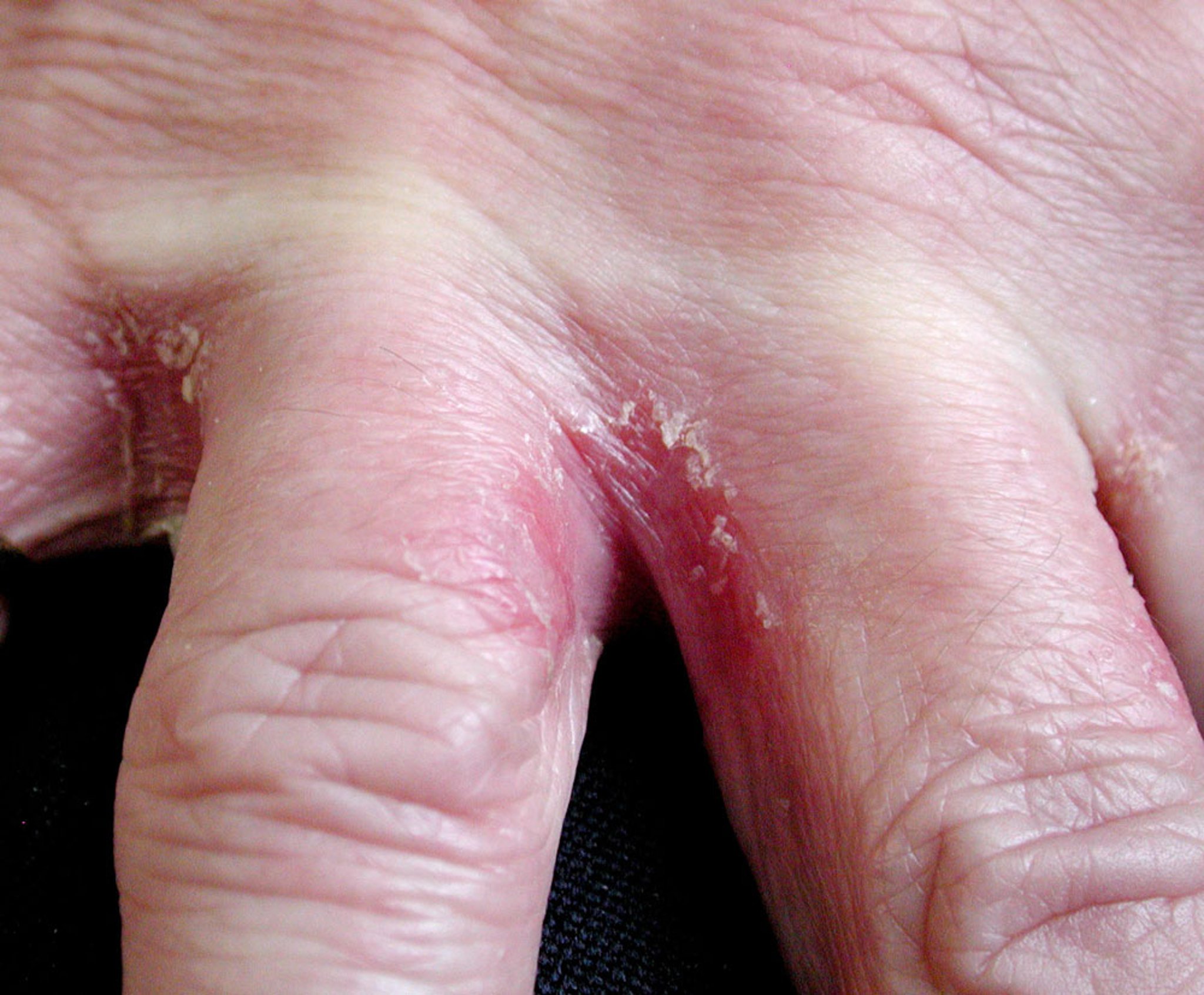
Photo courtesy of Thomas Ruenger, MD, PhD.
Diagnosis of Contact Dermatitis
Clinical evaluation
Sometimes patch testing
Contact dermatitis can often be diagnosed by skin changes and exposure history. The patient’s occupation, hobbies, household duties, recent travel, clothing, topical medication use, and cosmetic use must be considered.
Patch testing is indicated when ACD is suspected and does not respond to treatment, suggesting that the trigger has not been identified. In patch testing, standard contact allergens are applied to the upper back using adhesive-mounted patches containing minute amounts of allergen or plastic chambers containing allergens held in place with porous tape. A standard contact allergen series consists of those allergens shown to be the most common in a particular geographic location (see table Common Allergens Used in Patch Testing). It can be expanded to include additional substances as indicated (eg, a metal worker series, hairdresser series). The thin-layer rapid-use epicutaneous patch testing (T.R.U.E. TEST) is a simple, easy-to-use kit with 36 of the most common contact allergens that can be applied and interpreted by any health care professional. However, it only detects approximately 50% of clinically relevant contact allergens. If available, patch testing with more extensive test panels is therefore recommended.
Allergen patches typically are applied to the skin on the back, left for 48 hours, and then removed. Skin under the patches is evaluated at 48 hours and at 72 or 96 hours after application for degree of erythema, size of the reaction, swelling, and vesiculation/crusting. A crescendo reaction (increase in the reaction from the first to the second reading) is typical for a positive reaction. False-positive results occur when concentrations provoke an irritant rather than an allergic reaction, and typically cause a decrescendo reaction (decrease in the reaction from the first to the second reading). False-positive results can also occur when reaction to one antigen triggers a nonspecific reaction to others or with cross-reacting antigens. False-negative results occur when patch allergens do not include the offending antigen or when patients have recently undergone immunosuppressive treatment. Definitive diagnosis requires a positive test result and a history of dermatits in the area where the tested allergen came in contact with the skin.


Photos courtesy of Thomas Ruenger, MD, PhD.
Common Allergens Used in Patch Testing
Agent | Sources |
|---|---|
BacitracinBacitracin | In topical antibiotic preparations |
Balsam of Peru (myroxylon) | A flavoring agent for drinks and tobacco, as well as a fixative and fragrance in perfumes; also occurs in many topical medications, dental agents, and other products Chief allergens: Esters of cinnamic and benzoic acid, vanillin Cross-reactions with colophony (rosin) and balsam of Tolu, cinnamates, benzoates, styrax, and tincture of benzoin Probably also some phototoxicity |
Black rubber mix | In rubber May cross-react with hair dyes |
Bronopol | A preservative found in cosmetics, shampoos, and skin care products; also in some detergents and cleaning agents |
BudesonideBudesonide | Screens for class B corticosteroid allergy and should initiate search for sensitization to other topical corticosteroids |
Caine mix | Contains 3 topical anesthetics: Benzocaine, dibucaine hydrochloride, and tetracaine hydrochloride Contains 3 topical anesthetics: Benzocaine, dibucaine hydrochloride, and tetracaine hydrochloride Often used in dentistry but also widely found and used in topical preparations to reduce itching, pain, and stinging and widely used in hemorrhoidal preparations and cough syrups |
Carba mix | Used as an accelerator in rubber, rubber glues, vinyl, and some pesticides |
Cl+ Me– isothiazolinone and methylisothiazolinone | Occur in cosmetics and skin care products, some drugs, household cleaning products, and certain industrial fluids and greases |
Cobalt dichloride | Occurs in some paints, cement, metal, and metal-plated objects Coactivity with nickel (which is not cross-sensitivity) |
Colophony (rosin) | Used by string players (violinists are especially prone to rosin allergy), baseball players, and bowlers Derived from several conifer species Occurs in cosmetics, adhesives, lacquers, varnishes, soldering fluxes, paper, and many other industrial products |
Diazolidinyl ureaDiazolidinyl urea | A preservative with broad-spectrum application found in cosmetics, shampoos, skin care products, and cleaning agents |
Disperse blue 106 | A dark blue textile dye found in fabrics colored dark blue, brown, black, purple, and some greens |
Epoxy resin | A low molecular weight (340) epoxy based on bisphenol A and epichlorohydrin Is a sensitizer only when uncured or incompletely cured |
Ethylenediamine | Used as an emulsifier and stabilizer in certain topical medications, eye drops, some industrial solvents, curing agents for certain plastics, and anticorrosion agents |
Formaldehyde and formaldehyde releasers | Released by quaternium-15, a germicidal agent, and occasionally by imidazolidinyl ureaReleased by quaternium-15, a germicidal agent, and occasionally by imidazolidinyl urea Used widely in formulation of plastics, resins for clothing, glues, and adhesives |
Fragrance mixes | Can contain alpha-amyl cinnamic alcohol, cinnamic aldehyde, cinnamic alcohol, oak moss absolute, hydroxycitronellal, eugenol, isoeugenol, geraniol, citral, citronellol, coumarin, farnesol, hexyl cinnamal, hydroxyisohexyl-3-cyclohexene, and carboxaldehyde Occurs in many toiletries, soaps, aftershave lotions, shampoos, and scented household products and in many industrial products (eg, cutting fluids) |
Gold sodium thiosulfateGold sodium thiosulfate | Found in gold or gold-plated jewelry or dental restorations |
Hydrocortisone 17-butyrateHydrocortisone 17-butyrate | A corticosteroid found in creams or lotions used to treat inflammatory skin diseases; also present in some ear and eye drops |
Imidazolidinyl ureaImidazolidinyl urea | A preservative with broad-spectrum application found in cosmetics, shampoos, skin care products, and cleaning agents |
Mercaptobenzothiazole | Occurs in rubber, adhesives, and coolants |
Mercapto mix | Occurs in rubber, glues, coolants, and other industrial products |
Methyldibromo-glutaronitrile | Found in paints, adhesives, and oils |
Neomycin sulfate Neomycin sulfate | Found in topical antibiotics, first-aid creams, ear drops, and nose drops; possible delay (approximately 4‒5 days) in patch test reaction (so reading should be done at 7 days when possible) |
Nickel sulfate | The most common allergen Used in jewelry, dentures, scissors, razors, eyeglass frames, silverware, and foods (eg, canned foods, foods cooked in nickel utensils) |
Paraben mix | Five parabens: Methyl, ethyl, propyl, butyl, and benzyl parahydroxybenzoates, which are the most common preservatives used worldwide and are in numerous creams and cosmetics and in some industrial oils, fats, and glues |
Parthenolide | A sesquiterpene lactone naturally present in the traditional medicine herb, feverfew (Tanacetum parthenium); found in natural medicine and cosmetics Cross-reacts with other genera in Compositae and Magnoliaceae |
Potassium dichromate | Occurs in cement (in minute amounts), in tanning solutions for leather, and in safety matches Used in photography, electroplating solutions, many anticorrosives, paints, glues, pigments, and some detergents |
p-Phenylenediamine (PPD) | Occurs in hair dyes, some inks, photo developers, and textile dyes |
p-Tert-butylphenol formaldehyde resin | A resin formed by condensation between p-tert-butylphenol and formaldehyde Occurs in leather finishes (especially shoes), paper, fabrics, rockwood, furniture, and certain glues |
Quaternium | Common preservative occurring in cosmetics and in some household cleaners and polishes |
Quinolone mix | Contains clioquinol and chlorquinaldol Antimicrobials occurring in certain medicated creams and ointments, medicated bandages, and veterinary products |
Thimerosal | Preservative in contact lens solutions, certain cosmetics, nose and ear drops, and injectables Source often not identified |
Thiuram mix | Common rubber allergen Also occurs in adhesives, certain pesticides, and medications (eg, disulfiram)Also occurs in adhesives, certain pesticides, and medications (eg, disulfiram) |
Tixocortol-21-pivalate | Screens for class A corticosteroid allergy; found in buccal, nasal, throat, and rectal but not topical corticosteroid preparations |
Wool alcohols | Part of lanolin; found in many cosmetics, ointments, sunscreens, and prescription and over-the-counter topical medicationsPart of lanolin; found in many cosmetics, ointments, sunscreens, and prescription and over-the-counter topical medications |
Treatment of Contact Dermatitis
Avoidance of offending agents
Supportive care (eg, cool compresses, dressings, antihistamines)
Corticosteroids (most often topical but sometimes oral)
Contact dermatitis is prevented by avoiding contact with the skin irritant or allergen; patients with photosensitive contact dermatitis should avoid exposure to the sun (eg, by staying out of the sun or wearing sun-protective clothing) (1).
Topical treatment includes cool compresses (saline or Burow solution) and corticosteroids. Patients with mild to moderate ACD are given mid- to high-potency topical corticosteroids (eg, triamcinolone 0.1% ointment or betamethasone valerate cream 0.1%). Topical treatment includes cool compresses (saline or Burow solution) and corticosteroids. Patients with mild to moderate ACD are given mid- to high-potency topical corticosteroids (eg, triamcinolone 0.1% ointment or betamethasone valerate cream 0.1%).
Oral corticosteroids, given as a 7 to 14 day course, can be used for severe blistering or extensive disease.
Systemic antihistamines (eg, hydroxyzine, diphenhydramine) help relieve pruritus; antihistamines with low anticholinergic potency, such as low-sedating H1 blockers, are not as effective. Systemic antihistamines (eg, hydroxyzine, diphenhydramine) help relieve pruritus; antihistamines with low anticholinergic potency, such as low-sedating H1 blockers, are not as effective.
Wet-to-dry dressings can soothe oozing blisters, dry the skin, and promote healing.
Prognosis for Contact Dermatitis
Resolution may take up to 3 weeks after discontinuation of exposure. Reactivity is usually lifelong, so identified allergens must be avoided lifelong.
Patients with photoallergic contact dermatitis can have flare-ups for years when exposed to sun (persistent light reaction); however, this is very rare.
Prognosis reference
1. Fonacier L, Bernstein DI, Pacheco K, et al. Contact dermatitis: a practice parameter-update 2015. J Allergy Clin Immunol Pract. 2015;3(3 Suppl):S1-S39. doi:10.1016/j.jaip.2015.02.009
Key Points
Contact dermatitis can be caused by irritants (eg, plants, soaps, chemicals, body fluids) or by allergens.
Symptoms can include predominantly pain (for irritant contact dermatitis) or pruritus (for allergic contact dermatitis).
Diagnosis is usually clinical.
Patch testing is helpful when allergic contact dermatitis is suspected and the trigger has not been identified.
Treatment commonly includes cool compresses, topical corticosteroids, and systemic antihistamines as needed for pruritus.


