





Pityriasis rubra pilaris is a rare chronic disorder that causes hyperkeratotic yellowing of the skin, including the trunk, extremities, and, particularly, the palms and soles. Red follicular papules typically merge to form red-orange scaling plaques and confluent areas of erythema with islands of normal skin between lesions. Diagnosis is clinical. Treatment is aimed at relieving symptoms.
The cause of pityriasis rubra pilaris is unknown.
The 2 most common forms of the disorder are
Juvenile classic (characterized by autosomal dominant inheritance and childhood onset)
Adult classic (characterized by no apparent inheritance and adult onset)
Atypical (nonclassic) forms exist in both age groups. Sunlight, HIV or another infection, minor trauma, or an autoimmune disorder may trigger a flare-up.
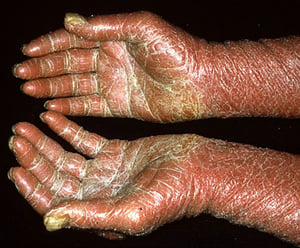
Image provided by Thomas Habif, MD.
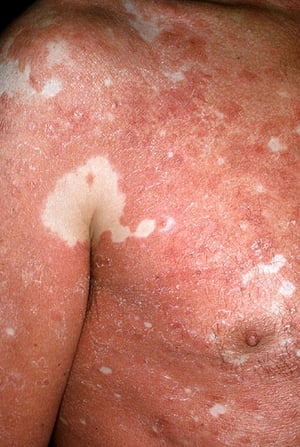
Image provided by Thomas Habif, MD.
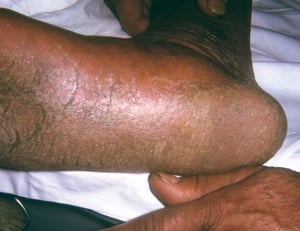
Image courtesy of Karen McKoy, MD.


Image provided by Thomas Habif, MD.


Image provided by Thomas Habif, MD.


Image courtesy of Karen McKoy, MD.
Diagnosis of Pityriasis Rubra Pilaris
Clinical evaluation
Sometimes biopsy
Diagnosis of pityriasis rubra pilaris is by clinical appearance and may be supported by biopsy.
Biopsy is done when the clinical diagnosis is unclear (eg, when the patient is erythrodermic at presentation).
Differential diagnosis of pityriasis rubra pilaris includes the following:
Seborrheic dermatitis (in children)
Psoriasis (when disease occurs on the scalp, elbows, and knees)
Treatment of Pityriasis Rubra Pilaris
Symptom relief (eg, with emollients, topical lactic acid and topical corticosteroids, or oral retinoids)
Treatment of pityriasis rubra pilaris is exceedingly difficult and empiric. The disorder may be ameliorated but almost never cured; classic forms of the disorder resolve slowly over 3 years, whereas nonclassic forms persist.
Scaling may be reduced with emollients or 12% lactic acid under occlusive dressing, followed by topical corticosteroids.
3).
Treatment references
1. Eastham AB, Femia A, Qureshi A, et al: Treatment options for pityriasis rubra pilaris including biologic agents: A retrospective analysis from an academic medical center. JAMA Dermatol 150(1):92–94, 2014. doi: 10.1001/jamadermatol.2013.4773
2. Napolitano M, Abeni D, Didona B: Biologics for pityriasis rubra pilaris treatment: A review of the literature. J Am Acad Dermatol 79(2):353–359.e11, 2018. doi: 10.1016/j.jaad.2018.03.036
3. Engelmann C, Elsner P, Miguel D: Treatment of pityriasis rubra pilaris type I: A systematic review. Eur J Dermatol 29(5):524-537, 2019. doi: 10.1684/ejd.2019.3641


