





Lichen sclerosus is an inflammatory dermatosis of unknown cause, possibly autoimmune, that usually affects the anogenital area. Diagnosis is usually clinical and supported by skin biopsy. Treatment is with potent topical corticosteroids.
The earliest signs are skin fragility, bruising, and sometimes blistering. Lesions typically cause mild to severe itching. When lichen sclerosus manifests in children, the appearance may be confused with sexual abuse. With time, the involved tissue becomes atrophic, thinned, hypopigmented (there may be flecks of postinflammatory hyperpigmentation), fissured, and scaly. Hyperkeratotic and fibrotic forms exist.
Severe and longstanding cases cause scarring and distortion or absorption of normal anogenital architecture. In women, this distortion can even lead to total destruction of the labia minora and clitoris. In men, phimosis or fusion of the foreskin to the coronal sulcus can occur.
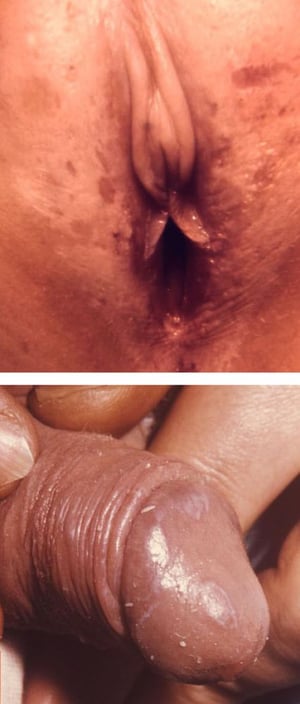
Images courtesy of Joe Miller (top) and Brian Hill (bottom) via the Public Health Image Library of the Centers for Disease Control and Prevention.

Image provided by E. Laurie Tolman, MD.
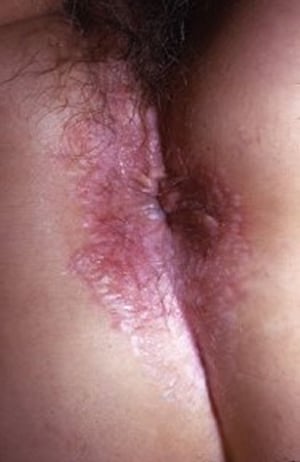
Image provided by E. Laurie Tolman, MD.
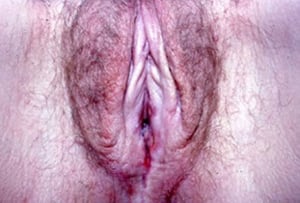
Image provided by E. Laurie Tolman, MD.
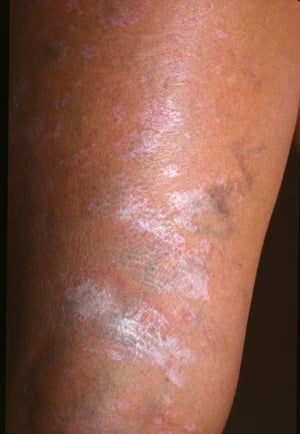
Image courtesy of Karen McKoy, MD.


Images courtesy of Joe Miller (top) and Brian Hill (bottom) via the Public Health Image Library of the Centers for Disease Control and Prevention.


Image provided by E. Laurie Tolman, MD.


Image provided by E. Laurie Tolman, MD.


Image provided by E. Laurie Tolman, MD.


Image courtesy of Karen McKoy, MD.
Diagnosis of Lichen Sclerosus
Clinical evaluation
Sometimes biopsy
Diagnosis reference
1. Leis M, Singh A, Li C, et al: Risk of vulvar squamous cell carcinoma in lichen sclerosus and lichen planus: A systematic review. J Obstet Gynaecol Can 44(2):182–192, 2022. doi: 10.1016/j.jogc.2021.09.023
Treatment of Lichen Sclerosus
Topical corticosteroids
Treatment of lichen sclerosus consists of potent topical corticosteroids (medications that otherwise should be used with extreme caution in this area). The disease is generally intractable, so long-term treatment and follow-up are necessary.
Monitoring for squamous cell carcinoma and sexual dysfunction and providing psychologic support are indicated.
Key Points
Lichen sclerosus can cause anogenital bruising, itching, or blistering early, and atrophy and scarring later.
Consider the diagnosis with any persistent anogenital dermatosis.
Treat with long-term, high-potency topical corticosteroids, close monitoring, and sexual and psychologic support.
Risk of subsequent squamous cell carcinoma is increased.


