





Cellulitis is acute bacterial infection of the skin and subcutaneous tissue most often caused by streptococci or staphylococci. Symptoms and signs are pain, warmth, rapidly spreading erythema, and edema. Fever may occur, and regional lymph nodes may enlarge in more serious infections. Diagnosis is by appearance; cultures may help, but treatment with antibiotics should not be delayed pending those results. Prognosis is excellent with timely treatment.
(See also Overview of Bacterial Skin Infections.)
Etiology of Cellulitis
The most common causes of cellulitis are
Streptococcus pyogenes
Staphylococcus aureus
Cellulitis is most often caused by group A beta-hemolytic streptococci (eg, S. pyogenes) or S. aureus. The skin barrier is usually compromised.
Staphylococcal cellulitis is typically more localized and usually occurs in open wounds or cutaneous abscesses.
© Springer Science+Business Media

© Springer Science+Business Media
© Springer Science+Business Media


© Springer Science+Business Media


© Springer Science+Business Media

© Springer Science+Business Media
Methicillin-resistant S. aureus (MRSA-USA300) is the predominant community strain of MRSA in the United States (community-associated MRSA [CA-MRSA]) (1). If S. aureus is suspected, MRSA infection should now be considered the most probable etiology. Patients who are exposed to MRSA in a hospital or nursing facility may have a MRSA strain that has a different pattern of resistance from that of MRSA-USA300.
Less common causes of cellulitis are
Group B streptococci (eg, S. agalactiae) in older adults with diabetes
Gram-negative bacilli (eg, Haemophilus influenzae) in children
Pseudomonas aeruginosa in patients with diabetes or neutropenia, hot tub or spa users, and patients who are hospitalized
Animal bites may result in cellulitis and are often polymicrobial; Pasteurella multocida is often the cause in cat bites, and Pasteurella or Capnocytophaga species are typically responsible in dog bites.
Immersion injuries in fresh water may result in cellulitis caused by Aeromonas hydrophila. Immersion injuries in warm salt water may result in cellulitis caused by Vibrio vulnificus.
Patients who are immunocompromised may become infected by opportunistic organisms, including gram-negative bacteria (such as Proteus, Serratia, Enterobacter, or Citrobacter), anaerobic bacteria, and Helicobacter and Fusarium species. Mycobacteria may rarely cause cellulitis.
Risk factors include skin abnormalities (eg, trauma, ulceration, fungal infection, other skin barrier compromise due to preexisting skin disease), which are common among patients with chronic venous insufficiency or lymphedema. Scars from saphenous vein removal for cardiac or vascular surgery are common sites for recurrent cellulitis, especially if tinea pedis is present. Frequently, no predisposing condition or site of entry is evident.
Etiology reference
1. Lakhundi S, Zhang K: Methicillin-resistant Staphylococcus aureus: Molecular characterization, evolution, and epidemiology. Clin Microbiol Rev 31:e00020-18, 2018. doi: 10.1128/CMR.00020-18
Symptoms and Signs of Cellulitis
Infection is most common in the lower extremities. Cellulitis is typically unilateral; stasis dermatitis closely mimics cellulitis but is usually bilateral.
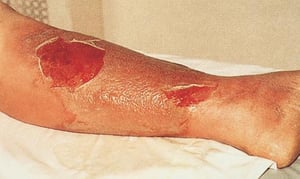
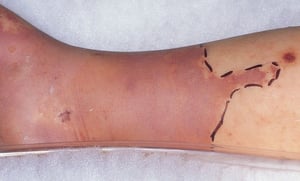
The major findings are local erythema and tenderness and, in more severe infections, often lymphangitis and regional lymphadenopathy. The skin is warm, erythematous, and edematous, often with surface appearance resembling the skin of an orange (peau d’orange). The borders are usually indistinct, except in erysipelas (a type of cellulitis with sharply demarcated margins). Petechiae are common; large areas of ecchymosis are rare.
Vesicles and bullae may develop and rupture, occasionally with necrosis of the involved skin.
Cellulitis may mimic deep venous thrombosis but can often be differentiated by one or more features (see table Differentiating Cellulitis and Deep Venous Thrombosis).


Differentiating Cellulitis and Deep Venous Thrombosis
Feature | Cellulitis | Deep Venous Thrombosis |
|---|---|---|
Skin temperature | Warm | Normal or warm (rarely cool unless limb ischemia present due to extensive venous disease causing arterial insufficiency) |
Skin color | Erythematous | Normal or erythematous but blanchable (infrequently cyanotic) |
Skin surface | Peau d’orange | Smooth |
Lymphangitis and regional lymphadenopathy | Frequent | Nonexistent |
Most cellulitis is nonpurulent. However, cellulitis sometimes is accompanied by one or more pustules, furuncles, or abscesses with or without purulent drainage or exudate and is referred to as purulent.
Fever, chills, tachycardia, headache, hypotension, and delirium (usually indicating severe infection) may precede cutaneous findings by several hours, but many patients do not appear ill. Leukocytosis is common. Cellulitis with rapid spread of infection, rapidly increasing pain, hypotension, delirium, or skin sloughing, particularly with bullae and fevers, suggests life-threatening infection.
Diagnosis of Cellulitis
Examination
Sometimes blood cultures
Sometime tissue cultures
Diagnosis of cellulitis is by examination. Contact dermatitis and stasis dermatitis are often misdiagnosed as cellulitis, thus leading to unnecessary antibiotic use. Contact dermatitis can often be differentiated by the presence of itching, limitation of lesions to the site of contact, absence of systemic signs, and sometimes unilateral location. Stasis dermatitis can sometimes be differentiated by features of dermatitis itself (eg, scaling, eczematous findings, lichenification), evidence of venous stasis, and bilateral location. Other disorders to consider include cutaneous T-cell lymphoma, nummular dermatitis, and tinea infection.
Blood cultures are useful to detect or rule out bacteremia in patients who are immunocompromised and in patients who have signs of systemic infection (eg, fever and leukocytosis).
Culture of involved tissue may be required in patients who are immunocompromised if they are not responding to empiric therapy or if blood cultures do not isolate an organism as well as in patients with cellulitis at the site of certain injuries (eg, animal bite wounds, penetrating injuries).
Skin and wound cultures (when wounds are present) are generally not indicated in cellulitis because they rarely identify the infecting organism.
Abscess should be ruled out based on clinical findings, although bedside ultrasonography may be useful.
Treatment of Cellulitis
Antibiotics
Antibiotics are the treatment of choice, and selection is based on the presence or absence of purulence and other risk factors for serious and/or resistant infection (1). Treatments are usually not given for a fixed interval but are continued until there is satisfactory clinical response—but typically for not less than 1 week.
Immobilization and elevation of the affected area help reduce edema; cool, wet dressings relieve local discomfort.
Compression therapy can help prevent repeat episodes of leg cellulitis in patients with recurrent cellulitis who have chronic lower extremity edema.
Nonpurulent, uncomplicated cellulitis
For most patients with nonpurulent cellulitis, empiric therapy effective against both group A streptococci and S. aureus is used.
Likely infecting organisms tend to be similar in brackish and fresh water (eg, Vibrio species, Aeromonas species, Shewanella species, Erysipelothrix rhusiopathiae, Mycobacterium marinum, Streptococcus iniae).
MRSA and purulent or complicated cellulitis
Purulent cellulitis and other risk factors predispose to complicated (serious, eg, deeper, invasive, systemic) infection. Affected patients should receive coverage for MRSA.
Risk factors for MRSA and complicated infection include the following:
Penetrating trauma
Surgical wounds
Recent hospitalization or nursing home exposure
Illicit IV drug use
Proximity of infection to an implanted medical device such as a prosthetic joint
Previous MRSA infection
Known nasal colonization with MRSA
Clinical features suggestive of serious infection
Clinical features suggestive of MRSA or complicated infection (high-risk symptoms) include the following:
Pain disproportionate to physical findings
Cutaneous hemorrhage
Bullae
Skin sloughing
Skin anesthesia
Rapid progression
Tissue gas
Signs of systemic toxicity (fever or hypothermia, tachycardia, hypotension, delirium)
trimethoprimclindamycin is becoming more prevalent).
Patients who have more serious infections, with high-risk symptoms with suspected or confirmed MRSA, or whose oral therapy failed are hospitalized and typically are given one of the following:
Teicoplanin 6 mg/kg IV every 12 hours for 2 doses, followed by 3 or 6 mg/kg IV or IM once a day to achieve targeted trough concentration (mechanism of action similar to that of vancomycin; commonly used outside the United States to treat MRSA)
The use of alternative medications for severe acute bacterial skin and skin structure infection (ABSSSI) with S. aureus (including MRSA) are based on availability, ease of administration, adverse effect profile, and cost. Alternatives include:
Treatment reference
1. Brindle R, Williams OM, Barton E, Featherstone P: Assessment of antibiotic treatment of cellulitis and erysipelas: A systematic review and meta-analysis. JAMA Dermatol 155(9):1033–1040, 2019. doi: 10.1001/jamadermatol.2019.0884
Prognosis for Cellulitis
Most cellulitis resolves quickly with antibiotic therapy. Local abscesses occasionally form, requiring incision and drainage. Serious but rare complications include severe necrotizing subcutaneous infection and bacteremia with metastatic foci of infection.
Recurrences in the same area are common, sometimes causing serious damage to the lymphatics, chronic lymphatic obstruction, and lymphedema.
Key Points
The most common pathogens causing cellulitis overall are S. pyogenes and S. aureus.
Methicillin-resistant S. aureus (MRSA) should be considered in the presence of certain risk factors (eg, purulent cellulitis, penetrating trauma, wound infection, nasal colonization), particularly if there is a known outbreak or local prevalence is high.
Differentiate leg cellulitis from deep vein thrombosis by the presence of skin warmth, erythema, peau d'orange quality, and lymphadenopathy.
Consider obtaining tissue culture in patients who are immunocompromised if they are not responding to empiric therapy or if blood cultures do not isolate an organism and in patients with cellulitis at the site of certain injuries (eg, animal bite wounds, penetrating injuries).
Direct antibiotic therapy against the most likely pathogens in specific clinical situations.


