





Erysipelas is a type of superficial cellulitis with dermal lymphatic involvement. Diagnosis is clinical. Treatment is with oral or parenteral antibiotics.
(See also Overview of Bacterial Skin Infections.)
Erysipelas should not be confused with erysipeloid, a skin infection caused by Erysipelothrix rhusiopathiae.
Erysipelas is characterized clinically by shiny, raised, indurated, and tender plaques with distinct margins. High fever, chills, and malaise frequently accompany erysipelas.
There is also a bullous form of erysipelas.
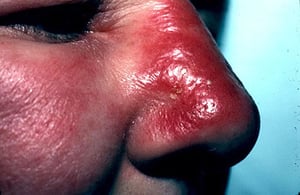
Image provided by Thomas Habif, MD.
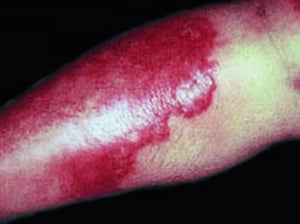
© Springer Science+Business Media
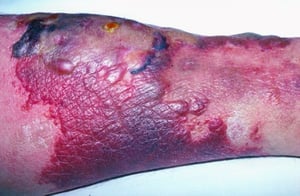
Image courtesy of Karen McKoy, MD.


Image provided by Thomas Habif, MD.


© Springer Science+Business Media


Image courtesy of Karen McKoy, MD.
Erysipelas is most often caused by group A (or rarely group C or G) beta-hemolytic streptococci and occurs most frequently on the legs and face.
Other causes include Staphylococcus aureus (including methicillin-resistant S. aureus [MRSA]), Klebsiella pneumoniae, Haemophilus influenzae, Escherichia coli, Staphylococcus warneri, Streptococcus pneumoniae, Streptococcus pyogenes, and Moraxella species.
Erysipelas may be recurrent and may result in chronic lymphedema.
Complications of erysipelas commonly include thrombophlebitis, abscesses, and gangrene.
Diagnosis of Erysipelas
Clinical evaluation
Blood culture
Diagnosis of erysipelas is by characteristic appearance; blood culture is done in toxic-appearing patients.
Erysipelas of the face must be differentiated from herpes zoster, angioedema, and contact dermatitis. Diffuse inflammatory breast cancer may also be mistaken for erysipelas.
Treatment of Erysipelas
Oral or parenteral antibiotics
First-line oral antibiotics for erysipelas include one the following (1):
The 1st-line parenteral antibiotic
Duration of treatment is based mainly on clinical response rather than a fixed interval.
In Europe, pristinamycin and roxithromycin have been shown to be good choices for erysipelas.
S. aureus
Bed rest and leg elevation are helpful for leg erysipelas. Cold packs and analgesics may relieve local discomfort.
Fungal foot infections may be an entry site for infection and may require antifungal treatment to prevent recurrence.
Compression therapy (using, for example, Unna boots and compression socks) may also be of benefit for lower-extremity erysipelas.
Treatment reference
1. Brindle R, Williams OM, Barton E, Featherstone P: Assessment of antibiotic treatment of cellulitis and erysipelas: A systematic review and meta-analysis. JAMA Dermatol 155(9):1033–1040, 2019. doi: 10.1001/jamadermatol.2019.0884
Key Points
Consider erysipelas with shiny, raised, indurated, and tender plaques that have distinct margins, particularly if there are systemic signs (eg, fever, chills, malaise).
Erysipelas is most often caused by group A (or rarely group C or G) beta-hemolytic streptococci and occurs most frequently on the legs and face.
Treat methicillin-sensitive S. aureus


