





Necrotizing soft-tissue infection is typically caused by a mixture of aerobic and anaerobic organisms that cause necrosis of subcutaneous tissue, usually including the fascia. This infection most commonly affects the extremities and perineum. Affected tissues become erythematous, warm, and swollen, resembling severe cellulitis, and pain develops out of proportion to clinical findings. During surgical exploration, there is a gray exudate, friable superficial fascia, and absence of pus. Without timely treatment, the area becomes gangrenous. Patients are acutely ill. Diagnosis is by history and examination and is supported by evidence of overwhelming infection. Treatment involves antibiotics and surgical debridement. Prognosis is poor without early, aggressive treatment.
(See also Overview of Bacterial Skin Infections.)
Etiology of Necrotizing Soft-Tissue Infection
There are two subtypes of necrotizing soft-tissue infection (NSTI):
Type I
Type II
Type I NSTI, typically involving the torso and perineum, results from a polymicrobial infection usually including group A streptococci (eg, Streptococcus pyogenes) and a mixture of aerobic and anaerobic bacteria (eg, Bacteroides species). These organisms typically extend to subcutaneous tissue from a contiguous ulcer or infection, or after trauma. Streptococci can arrive from a remote site of infection via the bloodstream. Perineal involvement (also called Fournier gangrene) is usually a complication of recent surgery, perirectal abscess, periurethral gland infection, or retroperitoneal infection resulting from perforated abdominal viscera. Patients with diabetes are at particular risk of type I NSTI. Type I infections often produce gas in the soft tissue, making its manifestation similar to that of gas gangrene (clostridial myonecrosis), which is a monomicrobial infection (1).
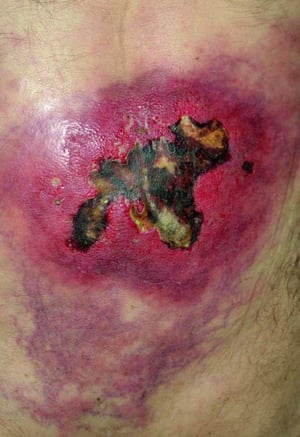
© Springer Science+Business Media
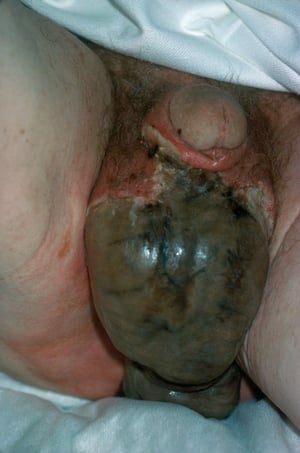
LIVING ART ENTERPRISES, LLC/SCIENCE PHOTO LIBRARY
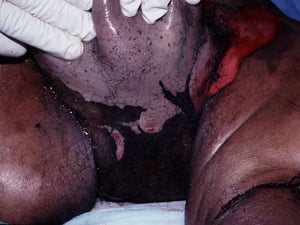
Image courtesy of Noel Armenakas, MD.
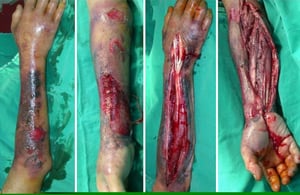
© Springer Science+Business Media


© Springer Science+Business Media


LIVING ART ENTERPRISES, LLC/SCIENCE PHOTO LIBRARY


Image courtesy of Noel Armenakas, MD.


© Springer Science+Business Media
Type II NSTI is monomicrobial and is most commonly caused by group A beta-hemolytic streptococci; Staphylococcus aureus is the second most common pathogen. Patients tend to be younger with few documented health problems but may have a history of IV illicit drug use, trauma, or recent surgery. The infection has the potential for rapid local spread and systemic complications such as toxic shock. A subgroup of type II NSTI usually occurs with aquatic injuries sustained in warmer coastal areas. Vibrio vulnificus is the usual pathogen.
Clostridial myonecrosis (gas gangrene) may develop spontaneously or after a deep, traumatic injury. Similar to type I NSTI, gas often develops in the tissue; however, as in type II NSTI, clostridial myonecrosis is typically a monomicrobial infection.

© Springer Science+Business Media
Etiology reference
1. Stevens DL, Bryant AE: Necrotizing soft-tissue infections. N Engl J Med 377(23):2253–2265, 2017. doi: 10.1056/NEJMra1600673
Pathophysiology of Necrotizing Soft-Tissue Infection
NSTI causes tissue ischemia by widespread occlusion of small subcutaneous vessels. Vessel occlusion results in skin infarction and necrosis, which facilitates the growth of obligate anaerobes (eg, Bacteroides) while promoting anaerobic metabolism by facultative organisms (eg, Escherichia coli), resulting in gangrene. Anaerobic metabolism produces hydrogen and nitrogen, relatively insoluble gases that may accumulate in subcutaneous tissues.
Symptoms and Signs of Necrotizing Soft-Tissue Infection
The primary symptom of NSTI is intense pain. In patients with normal sensation, pain out of proportion to clinical findings may be an early clue. However, in areas denervated by peripheral neuropathy, pain may be minimal or absent.
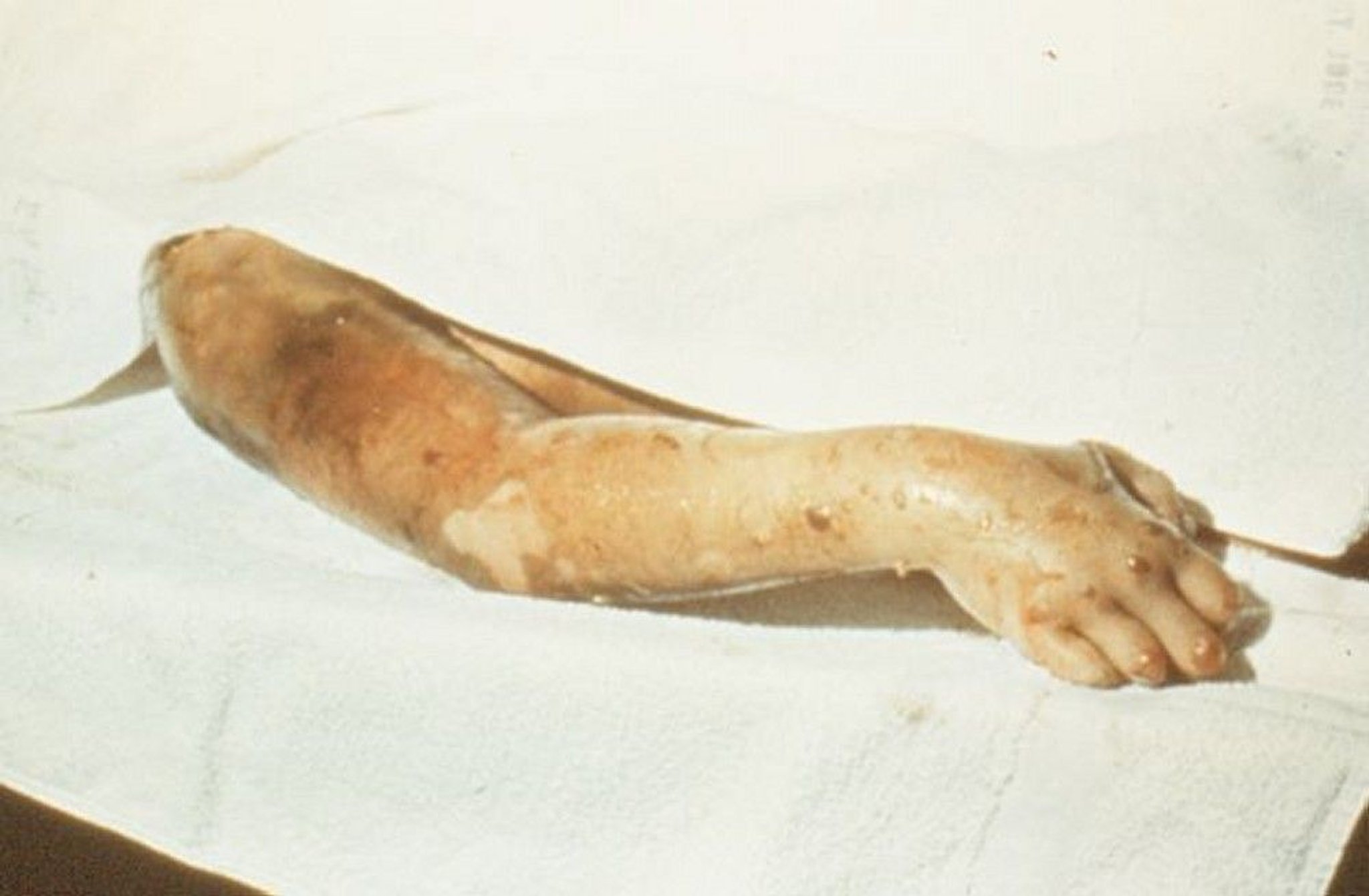
Affected tissue is warm, erythematous, and swollen and rapidly becomes discolored. Bullae, crepitus (resulting from soft-tissue gas), and gangrene may develop. Subcutaneous tissues (including adjacent fascia) necrose, with widespread undermining of surrounding tissue. Muscles may be spared initially but can be involved as the disorder progresses.
Patients are acutely ill, with high fever, tachycardia, altered mental status ranging from confusion to obtundation, and hypotension. Patients may be bacteremic or septic and may require aggressive hemodynamic support.
Streptococcal toxic shock syndrome may develop.
Diagnosis of Necrotizing Soft-Tissue Infection
Clinical examination
Blood and wound cultures
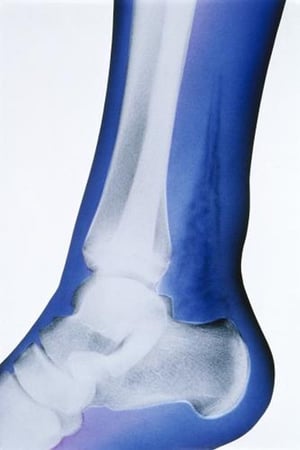
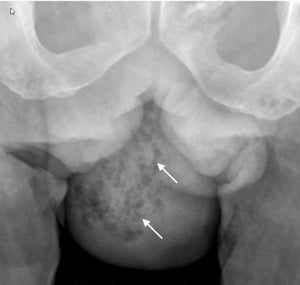
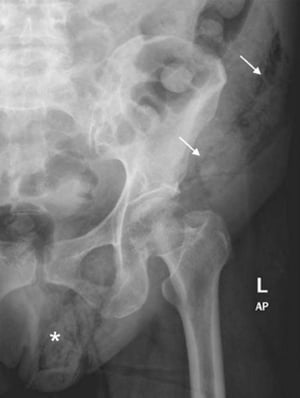
Diagnosis of NSTI, made by history and examination, is supported by leukocytosis, elevated C-reactive protein, soft-tissue gas on x-ray, positive blood cultures, and deteriorating metabolic and hemodynamic status.
CT and MRI can be used to delineate disease, but treatment should not be delayed while awaiting imaging results.
During surgical exploration, there is a gray exudate, friable superficial fascia, and absence of pus.
Differentiation from clostridial myonecrosis is made using microbiologic testing, but because treatment should occur immediately, it is aimed at both NSTI and clostridial myonecrosis.
CHRIS BJORNBERG/SCIENCE PHOTO LIBRARY
© Springer Science+Business Media
© Springer Science+Business Media


CHRIS BJORNBERG/SCIENCE PHOTO LIBRARY


© Springer Science+Business Media


© Springer Science+Business Media
Treatment of Necrotizing Soft-Tissue Infection
Surgical debridement
Antibiotics
Amputation if necessary
Treatment of early NSTI and clostridial myonecrosis is primarily surgical, which should not be delayed by diagnostic studies.
Evidence of bullae, ecchymosis, fluctuance, crepitus, and systemic spread of infection requires immediate surgical exploration and debridement. The initial incision should be extended until an instrument or finger can no longer separate the skin and subcutaneous tissue from the deep fascia. The most common error is insufficient surgical intervention; repeat operation every 1 to 2 days, with further incision and debridement as needed, should be carried out routinely. Negative-pressure wound therapy (NPWT, also called vacuum-assisted closure, or VAC), which applies suction to the wound, has been used as an adjunct for care between debridements.
Amputation of an extremity may be necessary.
2014 practice guidelines for the diagnosis and management of skin and soft-tissue infections.)
IV fluids may be needed in large volumes before and after surgery.
IV immune globulin has been suggested as adjunctive therapy for streptococcal toxic shock syndrome with NSTI.
Pearls & Pitfalls
|
Prognosis for Necrotizing Soft-Tissue Infection
All-cause mortality rate in treated patients is about 20 to 30% (1).
Old age, underlying medical problems, delayed diagnosis and therapy, and insufficient surgical debridement worsen prognosis.
Prognosis reference
1. Hua C, Urbina T, Bosc R, et al: Necrotising soft-tissue infections. Lancet Infect Dis 23(3):e81–e94, 2023. doi: 10.1016/S1473-3099(22)00583-7
Key Points
Necrotizing soft-tissue infection (NSTI) can develop from a contiguous ulcer or infection, hematogenous spread, or after trauma.
Consider NSTI in patients with characteristic findings or pain out of proportion to clinical findings, particularly patients with diabetes or other risk factors.
Arrange surgical therapy while instituting IV fluid and antibiotic therapy and without delaying for testing.


