





Warts are common, benign, epidermal lesions caused by human papillomavirus infection. They can appear anywhere on the body in a variety of morphologies. Diagnosis is by examination. Warts are usually self limited but may be treated by destructive methods (eg, excision, cautery, cryotherapy, liquid nitrogen) and topical or injected agents.
Warts are almost universal in the population; they affect patients of all ages but are most common among children and are uncommon among older adults.
Etiology of Warts
Warts are caused by human papillomavirus (HPV) infection; there are over 100 HPV subtypes (1).
Trauma and maceration facilitate initial epidermal inoculation. Spread may then occur by autoinoculation. Local and systemic immune factors appear to influence spread; immunosuppressed patients (especially those with HIV infection or a kidney transplant) are at particular risk of developing generalized lesions that are difficult to treat.
Humoral immunity provides resistance to HPV infection; cellular immunity helps established infection to regress.
Etiology reference
1. Haley CT, Mui UN, Vangipuram R, et al: Human oncoviruses: Mucocutaneous manifestation, pathogenesis, therapeutics, and prevention. Papillomaviruses and Merkel cell polyomavirus. J Am Acad Dermatol 81:1–21, 2019. doi: 10.1016/j.jaad.2018.09.062
Symptoms and Signs of Warts
Warts are named by their clinical appearance and location; different forms are linked to different HPV types (for unusual manifestations, see table Wart Variants and Other HPV-Related Lesions). Most types are usually asymptomatic. However, some warts are tender, so those on weight-bearing surfaces (eg, bottom of the feet) may cause mild pain.
Common warts
Common warts (verrucae vulgaris) are caused by HPV types 1, 2, 4, and 7 and occasionally other types in immunosuppressed patients (eg, 75 to 77).
They are usually asymptomatic but sometimes cause mild pain when they are located on a weight-bearing surface (eg, bottom of the feet).
Common warts are sharply demarcated, rough, round or irregular, firm, and light gray, yellow, brown, or gray-black nodules 2 to 10 mm in diameter. They appear most often on sites subject to trauma (eg, fingers, elbows, knees, face) but may spread elsewhere. Variants of unusual shape (eg, pedunculated or resembling a cauliflower) appear most frequently on the head and neck, especially the scalp and beard area.


Palmar warts and plantar warts
These warts are caused by HPV types 1, 2, and 4. They occur on the palms and soles.
Palmar and plantar warts are flattened by pressure and surrounded by cornified epithelium. They are often tender, and plantar warts can make walking and standing uncomfortable. They can be distinguished from corns and calluses by their tendency to pinpoint bleeding when the surface is pared away.


Flat warts (plane warts)
Flat warts are caused by HPV types 3 and 10 and occasionally 26 to 29 and 41. They are more common among children and young adults and develop by autoinoculation.
These warts are smooth, flat-topped, yellow-brown, pink, or skin-colored papules, most often located on the face and along scratch marks.
They generally cause no symptoms but are usually difficult to treat.


Mosaic warts
Mosaic warts are plaques formed by the coalescence of myriad smaller, closely set plantar warts. As with other plantar warts, they are often tender.
Filiform warts
These warts are long, narrow, frondlike growths, usually located on the eyelids, face, neck, or lips. They are usually asymptomatic.
This morphologically distinct variant of the common wart is benign and easy to treat.


Periungual warts
Periungual warts are caused by HPV types 1, 2, 4, and 7.
These warts appear as thickened, fissured, cauliflower-like skin around the nail plate. They are usually asymptomatic, but the fissures cause pain as the warts enlarge. Patients frequently lose the cuticle and are susceptible to paronychia.
Periungual warts are more common among patients who bite their nails or who have occupations where their hands are chronically wet such as dishwashers and bartenders.
Genital warts
Genital warts are caused by HPV type 6 or 11 (most commonly) and by types 1a, 2, 4, 7, 16, 18, 27b, 27, 33, 38, 40, 42, 43, 44, 54, 57b, 57c, 61, 72, 81, and 89 (1).
These warts manifest as discrete flat to broad-based smooth to velvety papules to rough and pedunculated excrescences on the perineal, perirectal, labial, and penile areas. They are usually asymptomatic, but perirectal warts often itch.
Infection with high-risk HPV types (most notably types 16 and 18 but also types 31, 33, 35, and 39) is the main cause of cervical cancer.
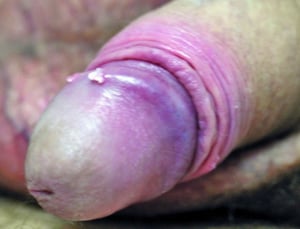
© Springer Science+Business Media
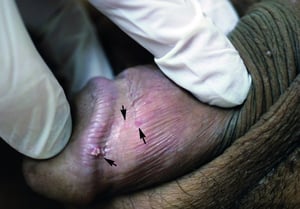
© Springer Science+Business Media
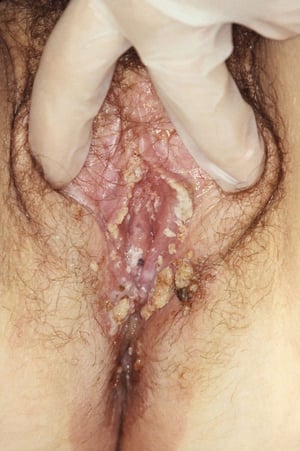
Image courtesy of Joe Millar via the Public Health Image Library of the Centers for Disease Control and Prevention.


© Springer Science+Business Media


© Springer Science+Business Media


Image courtesy of Joe Millar via the Public Health Image Library of the Centers for Disease Control and Prevention.
Genital warts reference
1. Al-Awadhi R, Al-Mutairi N, Albatineh AN, Chehadeh W: Association of HPV genotypes with external anogenital warts: A cross sectional study. BMC Infect Dis 19(1):375, 2019. doi: 10.1186/s12879-019-4005-4
Diagnosis of Warts
Clinical evaluation
Rarely biopsy
Diagnosis of warts is based on clinical appearance; biopsy is rarely needed.
A cardinal sign of warts is the absence of skin lines crossing their surface and the presence of pinpoint black dots (thrombosed capillaries) or bleeding when warts are shaved. Shaving is typically done without anesthesia.
Pearls & Pitfalls
|
Differential diagnosis of warts includes the following:
Corns (clavi): May obscure skin lines but do not have thrombosed capillaries when shaved
Lichen planus: May mimic flat warts but may be accompanied by lacy oral lesions and Wickham striae and may be symmetrically distributed
Seborrheic keratosis: May appear more stuck on, be pigmented, and include keratin-filled horn cysts
Skin tags (achrocordon): May be pedunculated and smoother and more skin-colored than warts
Squamous cell carcinoma: May be ulcerated, persistent, and grow irregularly
DNA typing of the virus is available in some medical centers but is generally not needed.
Treatment of Warts
Topical irritants (eg, salicylic acidpodophyllum resin)
Destructive methods (eg, cryosurgery, electrocautery, curettage, excision, laser)
Other topical therapies, intralesional injection therapies, or combinations
There are no firm indications for treatment of warts.
Treatment should be considered for warts that are cosmetically unacceptable, in locations that interfere with function, or painful. Patients should be motivated to adhere to treatment, which may require a prolonged course and can be unsuccessful. Treatments are less successful in patients with immunocompromise.
Candida antigen) have been used to treat warts. Warts can first be soaked in hot water at 113° F for 30 minutes ≥ 3 times/week. After soaking, the skin is more permeable to topical agents. Candida antigen can also be injected directly into the lesions.
These drugs can be used in combination with a destructive method (eg, cryosurgery, electrocautery, curettage, excision, laser) because even though a wart may be physically removed by a destructive method, virus may remain in the tissues and cause recurrence.
Intralesional injections can be used to treat warts that are refractory, multiple, or in sensitive areas (1).
For treatment of anogenital warts, see also treatment of human papillomavirus infection.
Common warts
In immunocompetent patients, common warts usually spontaneously regress within 2 to 4 years, but some linger for many years. Numerous treatments are available. Destructive methods include electrocautery, cryosurgery with liquid nitrogen, and laser surgery. Salicylic acid preparations are also commonly used.
Which method is used depends on the location and severity of involvement.
podophyllum is removed in 2 hours. The longer these agents are left in contact with the skin, the more brisk the blistering response.
Cryosurgery is painful but extremely effective. Electrodesiccation with curettage, laser surgery, or both is effective and indicated for isolated lesions but may cause scarring.
Recurrent or new warts occur in about 35% of patients within 1 year; therefore, methods that scar should be avoided as much as possible so that multiple scars do not accumulate. When possible, scarring treatments are reserved for cosmetically unimportant areas and recalcitrant warts.
Filiform warts
Treatment of filiform warts is removal with scalpel, scissors, curettage, or liquid nitrogen. Liquid nitrogen should be applied so that up to 2 mm of skin surrounding the wart turns white. Damage to the skin occurs when the skin thaws, which usually takes 10 to 20 seconds. Blisters can occur 24 to 48 hours after treatment with liquid nitrogen.
Care must be taken when treating cosmetically sensitive sites, such as the face and neck, because hypopigmentation or hyperpigmentation frequently occurs after treatment with liquid nitrogen. Patients with darkly pigmented skin can develop permanent depigmentation.
Flat warts
Treatment of flat warts is difficult, and flat warts are often longer-lasting than common warts, recalcitrant to treatments, and, in cosmetically important areas, make the most effective (destructive) methods less desirable.
Plantar warts
Other destructive treatments (eg, CO2 laser, pulsed-dye laser, various acids) are often effective.
Periungual warts
Using liquid nitrogen and cautery to treat periungual and lateral finger warts should be done carefully because overly aggressive treatment can cause permanent nail deformity and rarely nerve injury.
Pearls & Pitfalls
|
Recalcitrant warts
Several methods are available for the treatment of recalcitrant warts, but long-term value and risks are not fully known.
Raynaud syndrome or vascular damage may develop in injected digits, especially when the solution is injected at the base of the digit, so caution is warranted.
Intralesional injection of Candida antigen has also been reported to be moderately effective for recalcitrant warts.
Interferon, especially interferon alfa, given intralesionally (3 times/week for 3 to 5 weeks) or intramuscularly, has also cleared recalcitrant skin and genital warts.
The 9-valent HPV vaccine has been reported as useful for recalcitrant warts in children, but efficacy of this intervention is not proved (2).
Treatment references
1. Muse ME, Stiff KM, Glines KR, et al: A review of intralesional wart therapy. Dermatol Online J 26(3):13030/qt3md9z8gj, 2020.
2. Kost Y, Zhu TH, Blasiak RC: Clearance of recalcitrant warts in a pediatric patient following administration of the nine-valent human papillomavirus vaccine. Pediatr Dermatol 37(4):748–749, 2020. doi: 10.1111/pde.14150
Prognosis for Warts
Many warts regress spontaneously (particularly common warts); others persist for years and recur at the same or different sites, even with treatment. Factors influencing recurrence appear to be related to the patient’s overall immune status as well as local factors. Patients subject to local trauma (eg, athletes, mechanics, butchers) may have recalcitrant and recurrent HPV infection.
Genital HPV infection has malignant potential, but malignant transformation is rare in HPV-induced skin warts, except among immunosuppressed patients.
Prevention of Warts
HPV vaccines protect against some of the types of HPV that cause warts and cancer.
Key Points
Cutaneous warts are caused by human papillomaviruses, are very common, and have multiple forms.
Spread is usually by autoinoculation and is facilitated by trauma and maceration.
Most warts are asymptomatic but can be mildly painful with pressure.
Most warts resolve spontaneously, particularly common warts.
Recalcitrant warts can be treated with other intralesional and oral agents as well as the 9-valent HPV vaccine.


