





Moles are flesh- to brown-colored macules, papules, or nodules composed of nests of melanocytes or nevus cells. Their main significance (other than cosmetic) is their resemblance to melanoma. Pigmented lesions are assessed for characteristics of concern (new or changing appearance, irregular borders, multiple colors within one lesion, bleeding, ulceration, or itching) that could suggest atypical nevi or melanoma.
Almost everyone has a few moles, which usually appear in childhood or adolescence. There are different types of moles (see table Classification of Moles). During adolescence, more moles often appear, and existing ones may enlarge or darken. Nevus cells may be eventually replaced with fat or fibrous tissue. Moles typically change consistency, becoming softer and boggy, or firmer, and less pigmented over the decades. Moles may darken during pregnancy.
An individual mole is unlikely to become malignant (lifetime risk is approximately 1 in 3,000 for men and to 10,000 for women) (1); however, patients with large numbers of benign moles (> about 50) have an increased risk of developing melanoma. These patients should be taught to self-monitor for warning signs and have skin surveillance as part of their primary care (see diagnosis of moles).
Blue nevi are benign moles that appear as bluish gray macules or thin papules. The depth and density of pigment in the skin account for the apparent blue color.
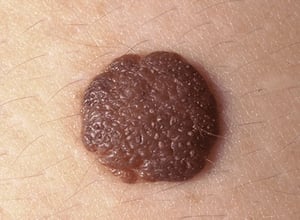
Image provided by Thomas Habif, MD.
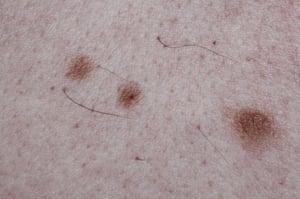
Image courtesy of Marie Schreiner, PA-C.
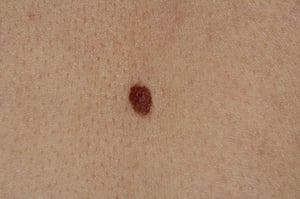
Image courtesy of Marie Schreiner, PA-C.
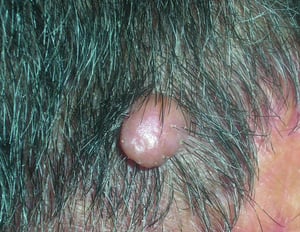
© Springer Science+Business Media
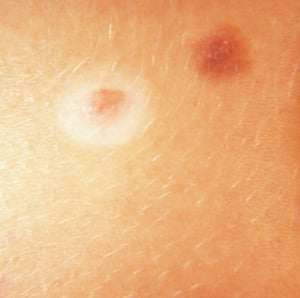
DermPics/SCIENCE PHOTO LIBRARY
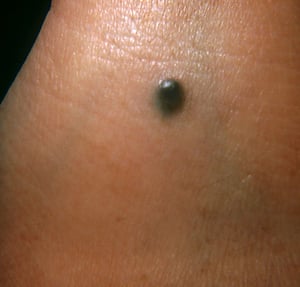
DermPics/SCIENCE PHOTO LIBRARY


Image provided by Thomas Habif, MD.


Image courtesy of Marie Schreiner, PA-C.

Image courtesy of Marie Schreiner, PA-C.


© Springer Science+Business Media


DermPics/SCIENCE PHOTO LIBRARY


DermPics/SCIENCE PHOTO LIBRARY
General reference
1. Tsao H, Bevona C, Goggins W, et al: The transformation rate of moles (melanocytic nevi) into cutaneous melanoma: A population-based estimate. Arch Dermatol139(3):282-288, 2003. doi: 10.1001/archderm.139.3.282
Diagnosis of Moles
Clinical evaluation
Sometimes biopsy
Because moles are extremely common and melanomas are uncommon, prophylactic removal is not justifiable. However, biopsy and histologic evaluation should be considered if moles have certain characteristics of concern (known as the ABCDEs of melanoma):
A: Asymmetry—asymmetric appearance
B: Borders—irregular borders (ie, not round or oval)
C: Color—color variation within the mole, unusual colors, or a color significantly different or darker than the patient's other moles
D: Diameter—> 6 mm
E: Evolution—a new mole in a patient > 30 years of age or a changing mole
If a mole becomes painful or itchy or bleeds or ulcerates, biopsy can also be considered.
The biopsy specimen must be deep enough for accurate microscopic diagnosis and should contain the entire lesion if possible, especially if the concern for cancer is strong. However, wide primary excision should not be the initial procedure, even for highly abnormal-appearing lesions. Many such lesions are not melanomas and, even with melanoma, the proper treatment margin and recommendation for lymph node sampling is determined based on histopathologic features. Excisional biopsy does not increase the likelihood of metastasis if the lesion is malignant, and it avoids extensive surgery for a benign lesion.
Treatment of Moles
Sometimes excision
Moles can be removed by shaving or excision for cosmetic purposes, and all moles removed should be examined histologically. If hair growth is a concern for the patient, a hairy mole should be adequately excised rather than removed by shaving. Otherwise, hair will regrow.
Key Points
Almost everyone has moles, but people with > about 50 are at increased risk of melanoma.
Consider biopsy if moles have ABCDE characteristics: Asymmetry; irregular Borders; high-risk Colors (variations within or between moles or unusual colors); Diameter > 6 mm; Evolution (new moles after age 30 or changes in existing moles).
Consider excision if a mole is a significant cosmetic problem.


