





Adrenal virilism is a syndrome in which excessive adrenal androgens cause virilization. Diagnosis is clinical and confirmed by elevated androgen levels; determining the cause may involve adrenal imaging. Treatment depends on the cause.
(See also Overview of Adrenal Function.)
Adrenal virilism is caused by
Androgen-secreting adrenal tumors
Adrenal hyperplasia
Malignant adrenal tumors may secrete excess androgens, estrogens, cortisol, mineralocorticoids (or combinations of the four). If there is cortisol hypersecretion, Cushing syndrome results, with suppression of adrenocorticotropic hormone (ACTH) secretion and atrophy of the contralateral adrenal as well as hypertension. Adrenal tumors that secrete androgens cause virilization.
Adrenal hyperplasia is usually congenital; delayed virilizing adrenal hyperplasia is a variant of congenital adrenal hyperplasia. Both are caused by a defect in hydroxylation of cortisol precursors, most commonly 21-hydroxylase deficiency or the much milder 11beta-hydroxylase deficiency. The most common form of adrenal hyperplasia is 21-hydroxylase deficiency. In adrenal hyperplasia, cortisol precursors accumulate and are shunted into the production of androgens. The defect is only partial in delayed virilizing adrenal hyperplasia, so clinical disease may not develop until adulthood.
Symptoms and Signs of Adrenal Virilism
Effects depend on the patient’s sex and age at onset and are more noticeable in females than in males.
Female infants with congenital adrenal hyperplasia may have fusion of the labioscrotal folds and clitoral hypertrophy resembling male external genitalia, thus presenting as a disorder of sexual differentiation.
In prepubertal children, growth may accelerate. If untreated, premature epiphyseal closure and short stature in adulthood occur. Affected prepubertal males may experience premature sexual maturation.
Adult females may have amenorrhea, atrophy of the uterus, clitoral hypertrophy, decreased breast size, acne, hirsutism, deepening of the voice, baldness, increased libido, and increased muscularity.

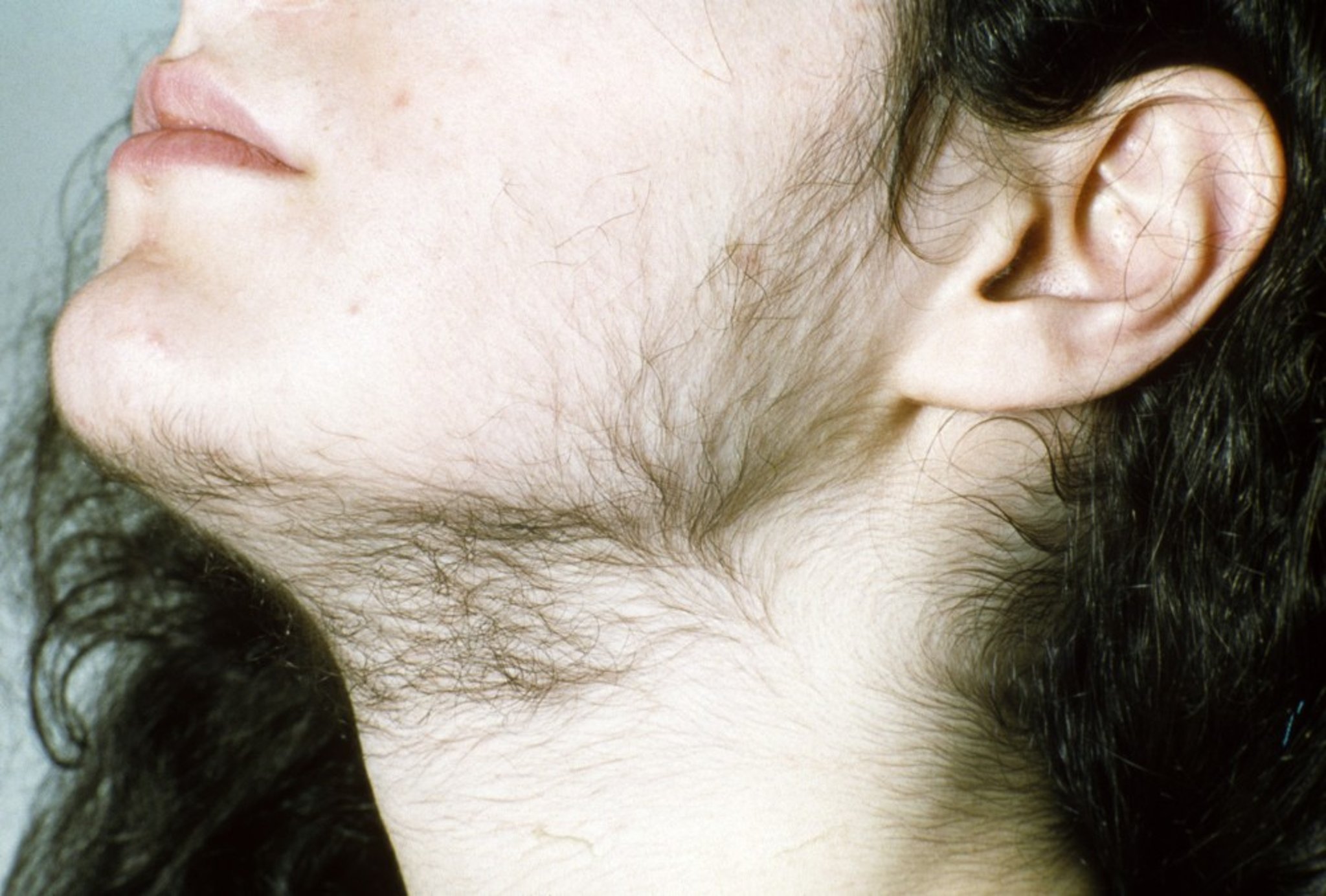
JOHN RADCLIFFE HOSPITAL/SCIENCE PHOTO LIBRARY
In adult males, the excess adrenal androgens may suppress gonadal function and cause infertility. Ectopic adrenal tissue in the testes may enlarge and simulate tumors.
Diagnosis of Adrenal Virilism
Testosterone
Other adrenal androgens (dehydroepiandrosterone [DHEA] and its sulfate [DHEAS], androstenedione)
17-hydroxyprogesterone
Dexamethasone suppression test
Sometimes adrenocorticotropic hormone (ACTH) stimulation test
Adrenal imaging
Adrenal virilism is suspected clinically, although mild hirsutism and virilization with hypomenorrhea and elevated plasma testosterone may also occur in polycystic ovary syndrome (Stein-Leventhal syndrome). Adrenal virilism is confirmed by showing elevated levels of adrenal androgens.
In adrenal hyperplasia, urinary dehydroepiandrosterone (DHEA) and its sulfate (DHEAS) are elevated, pregnanetriol (a metabolite of 17-hydroxyprogesterone) excretion is often increased, and urinary free cortisol is normal or diminished. Plasma DHEA, DHEAS, 17-hydroxyprogesterone, testosterone, and androstenedione may be elevated. A 17-hydroxyprogesterone level of > 30 nmol/L (>21-hydroxylase deficiency.
Treatment of Adrenal Virilism
Oral glucocorticoids for hyperplasia
Removal of tumors
Cushing syndrome; therefore, dexamethasonehydrocortisone may provide better biochemical control.
Although most symptoms and signs of virilism disappear with treatment, hirsutism and baldness disappear slowly, the voice may remain deep, and fertility may be impaired.
Tumors require adrenalectomy. For patients with cortisol
Key Points
Adrenal virilism is due to an androgen-secreting adrenal tumor or to adrenal hyperplasia.
Virilization is more noticeable in females; males may be infertile due to suppressed gonadal function.
Urinary and plasma dehydroepiandrosterone (DHEA) and its sulfate (DHEAS) and often plasma testosterone are elevated.
Do dexamethasone suppression testing and adrenal imaging to look for androgen-producing adrenal tumors.
Measure adrenal hormone intermediate metabolites and do adrenocorticotropic hormone (ACTH) stimulation testing to look for congenital adrenal hyperplasia.
Hyperplasia is treated with corticosteroid therapy; tumors require adrenalectomy.


