





Body fluid volume and electrolyte concentration are normally maintained within very narrow limits despite wide variations in dietary intake, metabolic activity, and environmental stresses. Homeostasis of body fluids is preserved primarily by the kidneys.
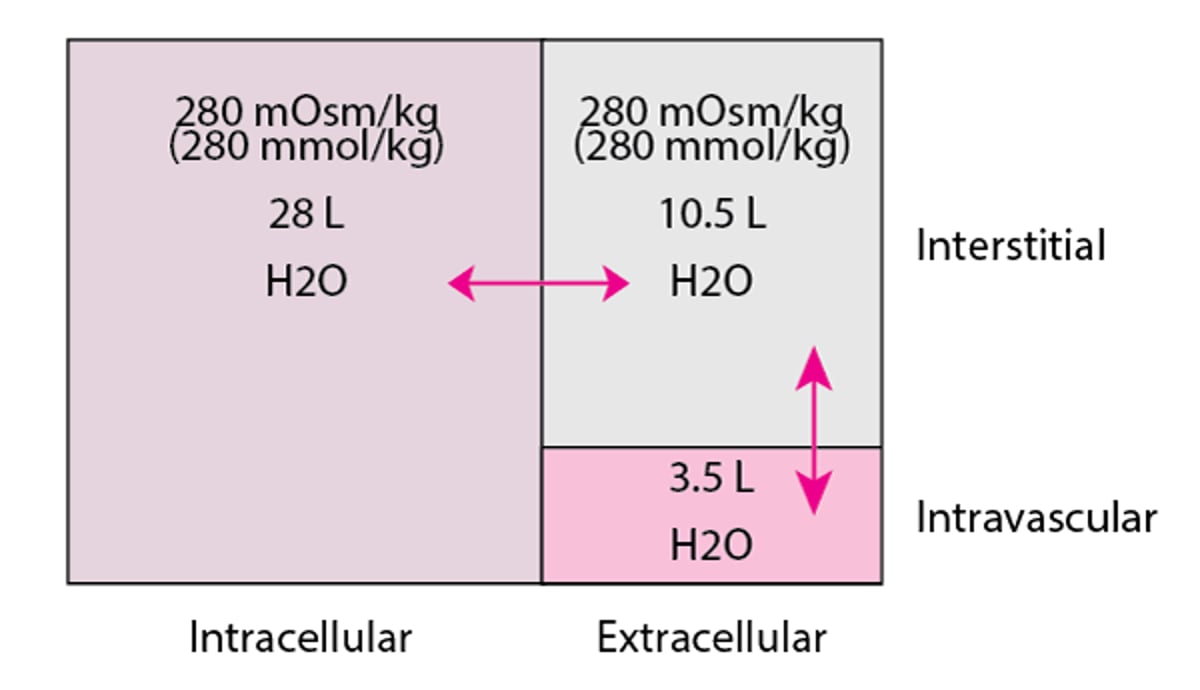
Water and sodium balance are closely interdependent. Total body water (TBW) is about 60% of body weight in men (ranging from about 50% in obese people to 70% in lean people) and about 50% in women. Almost two thirds of TBW is in the intracellular compartment (intracellular fluid, or ICF); the other one third is extracellular (extracellular fluid, or ECF). Normally, about 25% of the ECF is in the intravascular compartment; the other 75% is interstitial fluid (see figure Fluid compartments in an average 70-kg man).
Fluid compartments in an average 70-kg man
Total body water = 70 kg × 0.60 = 42 L (280 mOsm/kg [280 mmol/kg]). |

The major intracellular cation is potassium. The major extracellular cation is sodium. Concentrations of intracellular and extracellular cations are as follows:
Intracellular potassium concentration averages 140 mEq/L (140 mmol/L).
Extracellular potassium concentration is 3.5 to 5 mEq/L (3.5 to 5 mmol/L).
Intracellular sodium concentration is 12 mEq/L (12 mmol/L).
Extracellular sodium concentration averages 140 mEq/L (140 mmol/L).
Osmotic forces
The concentration of combined solutes in water is osmolarity (amount of solute per L of solution), which, in body fluids, is similar to osmolality (amount of solute per kg of solution). Plasma osmolality can be measured in the laboratory or estimated according to the formula
Estimated plasma osmolality in conventional units (mOsm/kg ) =


Osmolality of body fluids is normally between 275 and 290 mOsm/kg (275 and 290 mmol/kg). Sodium is the major determinant of plasma osmolality. Apparent changes in calculated osmolality may result from errors in the measurement of sodium, which can occur in patients with hyperlipidemia or extreme hyperproteinemia because the lipid or protein occupies space in the volume of serum taken for analysis; the concentration of sodium in serum itself is not affected. Newer methods of measuring serum electrolytes with direct ion-selective electrodes circumvent this problem. An osmolar gap is present when measured osmolality exceeds estimated osmolality by ≥
Tonicity, or effective osmolality, reflects osmotic activity and determines the force drawing water across fluid compartments (the osmotic force). Osmotic force can be opposed by other forces. For example, plasma proteins have a small osmotic effect that tends to draw water into the plasma; this osmotic effect is normally counteracted by vascular hydrostatic forces that drive water out of the plasma.
Water intake and excretion
The average daily fluid intake is about 2.5 L. The amount needed to replace losses from the urine and other sources is about 1 to 1.5 L/day in healthy adults. However, on a short-term basis, an average young adult with normal kidney function may ingest as little as 200 mL of water each day to excrete the nitrogenous and other wastes generated by cellular metabolism. More is needed in people with any loss of renal concentrating capacity. Renal concentrating capacity is lost in
Older people
People with diabetes insipidus, certain kidney disorders, hypercalcemia, severe salt restriction, chronic overhydration, or hyperkalemia
People with osmotic diuresis (eg, due to high-protein diets or hyperglycemia)
Other obligatory water losses are mostly insensible losses from the lungs and skin, averaging about 0.4 to 0.5 mL/kg/hour or about 650 to 850 mL/day in a 70-kg adult. With fever, another 50 to 75 mL/day may be lost for each degree Celsius of temperature elevation above normal. Gastrointestinal losses are usually negligible, except when marked vomiting, diarrhea, or both occur. Sweat losses can be significant during environmental heat exposure or excessive exercise.
Water intake is regulated by thirst. Thirst is triggered by receptors in the anterolateral hypothalamus that respond to increased plasma osmolality (as little as 2%) or decreased body fluid volume. Rarely, hypothalamic dysfunction decreases the capacity for thirst.
Water excretion by the kidneys is regulated primarily by vasopressin (antidiuretic hormone [ADH]). Vasopressin is released by the posterior pituitary and results in increased water reabsorption in the distal nephron. Vasopressin release is stimulated by any of the following:
Increased plasma osmolality
Decreased blood volume
Decreased blood pressure
Stress
Vasopressin
Water intake decreases plasma osmolality. Low plasma osmolality inhibits vasopressin secretion, allowing the kidneys to produce dilute urine. The diluting capacity of healthy kidneys in young adults is such that maximum daily fluid intake can be as much as 25 L; greater amounts quickly lower plasma osmolality.


