





Streptococci are gram-positive aerobic organisms that cause many disorders, including pharyngitis, pneumonia, wound and skin infections, sepsis, and endocarditis. Symptoms vary with the organ infected. Sequelae of infections due to group A beta-hemolytic streptococci may include rheumatic fever and glomerulonephritis. Most strains are sensitive to penicillin, but macrolide-resistant strains have recently emerged.
(See also Pneumococcal Infections, Rheumatic Fever, and Tonsillopharyngitis.)
Classification of Streptococci
Three different types of streptococci are initially differentiated by their appearance when they are grown in culture on sheep blood agar:
Beta-hemolytic streptococci produce zones of clear hemolysis around each colony.
Alpha-hemolytic streptococci (commonly called viridans streptococci) are surrounded by green discoloration resulting from incomplete hemolysis.
Gamma-hemolytic streptococci are nonhemolytic.
Subsequent classification, based on carbohydrates in the cell wall, divides streptococci into 20 Lancefield groups A through H and K through V (see table Lancefield Classification*). In the Lancefield classification, enterococci were initially included among the group D streptococci but are now classified as a separate genus even though they do express Lancefield group D antigens. Lancefield groups K through V are streptococcal species of limited virulence that can cause infections in people who are immunocompromised.
Viridans streptococci form a separate group that is difficult to classify. Some streptococci such as Streptococcus pneumoniae are alpha-hemolytic, ie, they are a type of viridans streptococci and do not express Lancefield antigens.
Virulence Factors
Diseases Caused by Streptococci
The most significant streptococcal pathogen is S. pyogenes, which is beta-hemolytic and in Lancefield group A and is thus denoted as group A beta-hemolytic streptococci (GABHS).
The most common acute diseases due to GABHS are
In addition, delayed, nonsuppurative complications (rheumatic fever, acute glomerulonephritis) sometimes occur ≥ 2 weeks after infection.
GABHS can spread through the affected tissues and along lymphatic channels (causing lymphangitis) to regional lymph nodes (causing lymphadenitis). GABHS can also cause local suppurative complications, such as peritonsillar abscess, otitis media, sinusitis, and bacteremia. Suppuration depends on the severity of infection and the susceptibility of tissue.
Other serious GABHS infections include septicemia, puerperal sepsis, endocarditis, pneumonia, and empyema.
Disease caused by other streptococcal species is less prevalent and usually involves soft-tissue infection or endocarditis (see table Lancefield Classification*). Some non-GABHS infections occur predominantly in certain populations (eg, group B streptococci in neonates and postpartum women).
Streptococcal pharyngitis
GABHS are the most common cause of acute-onset bacterial pharyngitis. Other bacterial causes include groups C and G streptococci and Fusobacterium necrophorum. Most patients with GABHS pharyngitis are children between 3 years and 14 years of age who present with acute onset of sore throat, fever, beefy-red pharynx, and purulent tonsillar exudate. GABHS pharyngitis is rare in children younger than 3 years of age.
The cervical and submaxillary nodes may enlarge and become tender. Streptococcal pharyngitis can lead to peritonsillar abscess. Cough, laryngitis, and stuffy nose are not characteristic of streptococcal pharyngeal infection; their presence suggests another cause (usually viral or allergic).
Humans are the primary reservoir for group A streptococci, which spread person-to-person via saliva or nasal secretions from an infected person. An asymptomatic carrier state may exist in as many as 20% of people.


Scarlet fever
Scarlet fever, a predominantly childhood disease, usually follows a pharyngeal streptococcal infection; less commonly, it follows streptococcal infections at other sites (eg, the skin). Scarlet fever is caused by group A streptococcal strains that produce an erythrogenic toxin, leading to a diffuse pink-red cutaneous flush that blanches with pressure.
The rash is seen best on the abdomen or lateral chest and as dark red lines in skinfolds (Pastia lines) or as circumoral pallor. The rash consists of characteristic numerous small (1- to 2-mm) papular elevations, giving a sandpaper quality to the skin. The upper layer of the previously reddened skin often desquamates after fever subsides. The rash usually lasts 2 to 5 days.
Transmission of scarlet fever is enhanced in environments that result in close contact among people (eg, in schools or day care centers).
Scarlet fever is not as common as it was in the past, but in recent years there have been a number of significant outbreaks in the United States, Europe, and China. For example, since 2014 there has been an unprecedented and persistent increase in scarlet fever in England with the highest incidence for nearly 50 years. Over a century ago, scarlet fever was feared as a potentially lethal disease. Its mortality and morbidity waned, however, well before antibiotics became available. Since the advent of antibiotic therapy, the mortality rate of treated scarlet fever is < 1% (1).


A strawberry tongue (inflamed papillae protruding through a bright red coating) also occurs and must be differentiated from that seen in toxic shock syndrome and Kawasaki disease.


Other symptoms are similar to those in streptococcal pharyngitis, and the course and management of scarlet fever are the same as those of other group A infections.
Scarlet fever reference
1. Lamagni T, Guy R, Chand M, et al: Resurgence of scarlet fever in England, 2014-16: A population-based surveillance study. Lancet Infect Dis 18(2):180–187, 2018. doi: 10.1016/S1473-3099(17)30693-X
Streptococcal skin infections
Skin infections include
Impetigo is a superficial skin infection that causes crusting or bullae.


Erysipelas is a superficial cellulitis that also involves the lymphatics. Patients have shiny, red, raised, indurated lesions with distinct margins. It is most often caused by GABHS, but other streptococcal and nonstreptococcal organisms are sometimes involved.


Cellulitis involves the deeper layers of skin and may spread rapidly because of the numerous lytic enzymes and toxins produced mainly by group A streptococci.
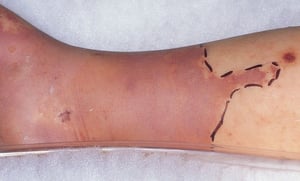
© Springer Science+Business Media

© Springer Science+Business Media
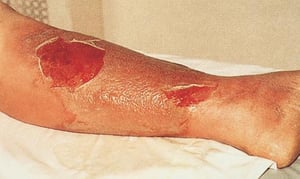
© Springer Science+Business Media


© Springer Science+Business Media

© Springer Science+Business Media


© Springer Science+Business Media
Necrotizing fasciitis
Necrotizing fasciitis due to S. pyogenes is a severe dermal (and sometimes muscle) infection that spreads along fascial planes. Inoculation originates through the skin or bowel.
Necrotizing fasciitis is prevalent among people who use injection drugs.
Formerly known as streptococcal gangrene and popularized as the flesh-eating bacteria, the same syndrome may also be polymicrobial, involving a host of aerobic and anaerobic flora, including Clostridium perfringens. Polymicrobial infection is likely when the source is the bowel (eg, after intestinal surgery, bowel perforation, diverticulitis, or appendicitis).
Symptoms of necrotizing fasciitis begin with fever and exquisite localized pain out of proportion to physical findings; pain increases rapidly over time and is often the first (and sometimes only) manifestation. Diffuse or local erythema may be present. Thrombosis of the microvasculature causes ischemic necrosis, leading to rapid spread and disproportionally severe toxicity. In 20 to 40% of patients, adjacent muscles are invaded. Shock and renal dysfunction are common. Mortality is high, even with treatment.


Streptococcal toxic shock syndrome
Streptococcal toxic shock syndrome (TSS), similar to that caused by S. aureus, may result from toxin-producing strains of GABHS and occasionally from other streptococci.
Patients are usually otherwise healthy children or adults with skin and soft-tissue infections. Predisposing risk factors for TSS in patients infected with these toxin-producing strains include diabetes, alcohol use disorder, penetrating and nonpenetrating trauma, surgical procedures, and varicella infection.
An initial influenza-like prodrome is followed by high fever, tachycardia, tachypnea, and severe pain. Tissue necrosis, shock, disseminated coagulation, and multisystem organ failure follow.
Delayed complications of streptococcal infection
The mechanism by which certain strains of GABHS cause delayed complications is unclear but may involve cross-reactivity of streptococcal antibodies against host tissue.
Rheumatic fever, an inflammatory disorder, occurs in < 3% of patients in the weeks after untreated GABHS pharyngitis. It has become much less common in developed countries, but incidence is still high in resource-limited regions.
Diagnosis of a first episode is based on a combination of arthritis, carditis, chorea, specific cutaneous manifestations, and laboratory test results (Jones criteria—see table Modified Jones Criteria for a First Episode of Acute Rheumatic Fever).
One of the most important reasons for treating GABHS pharyngitis (strep throat) is to prevent rheumatic fever.
Poststreptococcal acute glomerulonephritis is an acute nephritic syndrome following pharyngitis or skin infection due to a certain limited number of nephritogenic strains of GABHS (eg, M protein serotypes 12 and 49). After a throat or skin infection with one of these strains, about 10 to 15% of patients develop acute glomerulonephritis. It is most common among children, occurring 1 to 3 weeks after infection. Nearly all children, but somewhat fewer adults, recover without permanent renal damage. Antibiotic treatment of GABHS infection has little effect on the development of glomerulonephritis.
PANDAS syndrome (pediatric autoimmune neuropsychiatric disorder associated with streptococcal infections) refers to a subset of obsessive disorders in children or tic disorders in children that is thought to be exacerbated by GABHS infection.
Certain forms of psoriasis (eg, guttate) may also be related to beta-hemolytic streptococcal infections.
Diagnosis of Streptococcal Infections
Culture
Sometimes rapid antigen tests or antibody titers
Streptococci are readily identified by culture on a sheep blood agar plate.
Rapid antigen-detection tests that can detect GABHS directly from throat swabs are available (ie, for point-of-care use). Many tests use enzyme immunoassay, but more recently, tests using optical immunoassay have become available. These rapid tests have high specificity (> 95%) but vary considerably in sensitivity (55% to 80 to 90% for the newer optical immunoassay test) (1). Thus, positive results can establish the diagnosis, but negative results, at least in children, should be confirmed by culture. Because streptococcal pharyngitis is less common among adults and adults are unlikely to have poststreptococcal complications, many clinicians do not confirm a negative rapid screening result in adults by culture unless use of a macrolide is being considered; in such cases, culture with susceptibility testing to detect macrolide resistance should be done.
The Centor criteria can be used to guide decisions about testing for GABHS or selecting empiric antibiotic treatment for patients with pharyngitis. The criteria are age, presence of tonsillar exudate, anterior cervical lymphadenopathy, fever > 40° C, and absence of cough.
Demonstrating antistreptococcal antibodies in serum during convalescence provides only indirect evidence of infection. Antistreptococcal antibody tests are not useful in diagnosing acute GABHS infection because antibody first develops several weeks after GABHS infection begins and a single high antibody titer is more likely to reflect a long antecedent infection. Antibodies are most useful in diagnosis of poststreptococcal diseases, such as rheumatic fever and glomerulonephritis.
Antistreptolysin O (ASO) and antideoxyribonuclease B (anti-DNase B) titers begin to increase about 1 week after the GABHS infection and peak about 1 to 2 months after the infection. Both titers may remain elevated for several months, even after uncomplicated infections. The ASO titer increases in only 75 to 80% of infections. For completeness in difficult cases, any one of the other tests (antihyaluronidase, antinicotinamide adenine dinucleotidase, antistreptokinase) can also be used.
Titers are measured in the acute phase and in the convalescent phase 2 to 4 weeks later; a positive result is defined as a ≥ 2-fold increase in the titer. A single titer greater than the upper limit of normal suggests an antecedent streptococcal infection or high streptococcal endemicity in the community.
Penicillin given within the first 5 days for symptomatic streptococcal pharyngitis may delay the appearance and decrease the magnitude of the ASO response.
Patients with streptococcal pyoderma usually do not have a significant ASO response but may have a response to other antigens (ie, anti-DNAase, antihyaluronidase).
Diagnosis reference
1. Plainvert C, Duquesne I, Touak G, et al: In vitro evaluation and comparison of 5 rapid antigen detection tests for the diagnosis of beta-hemolytic group A streptococcal pharyngitis. Diagn Microbiol Infect Dis 83(2):105–111, 2015. doi: 10.1016/j.diagmicrobio.2015.06.012
Treatment of Streptococcal Infections
Usually penicillin
Pharyngitis
(See also the Infectious Diseases Society of America’s 2012 Practice Guidelines for the Diagnosis and Management of Group A Streptococcal Pharyngitis and the American Heart Association's 2020 Contemporary Diagnosis and Management of Rheumatic Heart Disease statement.)
Ordinarily, pharyngeal GABHS infections, including scarlet fever, are self-limited. Antibiotics shorten the course in young children, especially those with scarlet fever, but have only modest effect on symptoms in adolescents and adults. However, antibiotics help prevent local suppurative complications (eg, peritonsillar abscess), otitis media, and rheumatic fever.
Penicillin is the drug of choice for pharyngeal GABHS infections. No isolate of GABHS has shown penicillin resistance clinically. However, some streptococcal strains appear to have in vitro tolerance to penicillin (ie, significantly decreased bactericidal effect of penicillin); the clinical significance of such strains is unclear.
< 27 kg) or 1.2 million units IM for children weighing ≥ 27 kg, adolescents, and adults usually suffices.
Oral medications may be used if the patient can be trusted to maintain the regimen for the required 10 days. Choices include
Oral narrow-spectrum cephalosporins (eg, cephalexin, cefadroxilFusobacterium necrophorum, a common cause of pharyngitis in adolescents and adults. Delaying treatment 1 to 2 days until laboratory confirmation increases neither the duration of disease nor the incidence of complications.
When penicillin and a beta-lactam are contraindicated, choices include
Because resistance of GABHS to macrolides has been detected, some authorities recommend in vitro confirmation of susceptibility if a macrolide is to be used and there is macrolide resistance in the community. Clindamycin 7 mg/kg orally every 8 hours is preferred in children who have relapses of chronic tonsillitis, possibly because of the following:
Clindamycin
It appears to halt exotoxin production more rapidly than other medications.
Skin infection
Cellulitis is often treated without doing a culture because isolating organisms can be difficult. Thus, regimens effective against both streptococci and staphylococci are used; for example, one of the following may be used:
Staphylococcus aureus (MRSA) is not likely
Necrotizing fasciitis
Other streptococcal infections
For treating groups B, C, and G infections, antibiotics of choice are
Penicillin
Cephalosporins or macrolides are usually effective, but susceptibility tests must guide therapy, especially in very ill, immunocompromised, or debilitated people and in people with foreign bodies at the infection site. Surgical wound drainage and debridement as adjuncts to antimicrobial therapy may be lifesaving.
S. gallolyticus (formerly S. bovisS. gallolyticus isolates have been reported, the organism remains susceptible to penicillin and aminoglycosides.
Most viridans streptococci
Key Points
The most significant streptococcal pathogen is S. pyogenes, which is denoted as group A beta-hemolytic streptococci (GABHS).
The 2 most common acute diseases due to GABHS are pharyngitis and skin infections.
Delayed nonsuppurative complications, including rheumatic fever and poststreptococcal glomerulonephritis, can occur.
Rapid antigen tests (ie, for point-of-care use) are very specific but not highly sensitive; confirm negative results using culture, at least in children.
A penicillin or cephalosporin is preferred for pharyngitis; because macrolide resistance is increasing, susceptibility testing is recommended if that class of antibiotic is used.
Treat groups B, C, and G streptococcal infections with the same antibiotics used for treating GABHS.
More Information
The following English-language resources may be useful. Please note that THE MANUAL is not responsible for the content of these resources.
Infectious Diseases Society of America: Practice Guidelines for the Diagnosis and Management of Group A Streptococcal Pharyngitis (2012)
American Heart Association: Contemporary Diagnosis and Management of Rheumatic Heart Disease: Implications for Closing the Gap: A Scientific Statement From the American Heart Association (2020)


