





(See also Approach to Parasitic Infections.)
Pathophysiology of Toxocariasis
The eggs of Toxocara canis, T. cati, and other animal ascarid helminths mature in soil and infect dogs, cats, and other animals. Humans may accidentally ingest eggs in soil contaminated by stool from infected animals or may ingest undercooked infected transfer hosts (eg, rabbits). The eggs hatch in the human intestine. Larvae penetrate the bowel wall and may migrate through the liver, lungs, central nervous system (CNS), eyes, or other tissues. Tissue damage is caused by the parasite and the local immune response it elicits.
The larvae usually do not complete their development in the human body but can remain alive for many months.

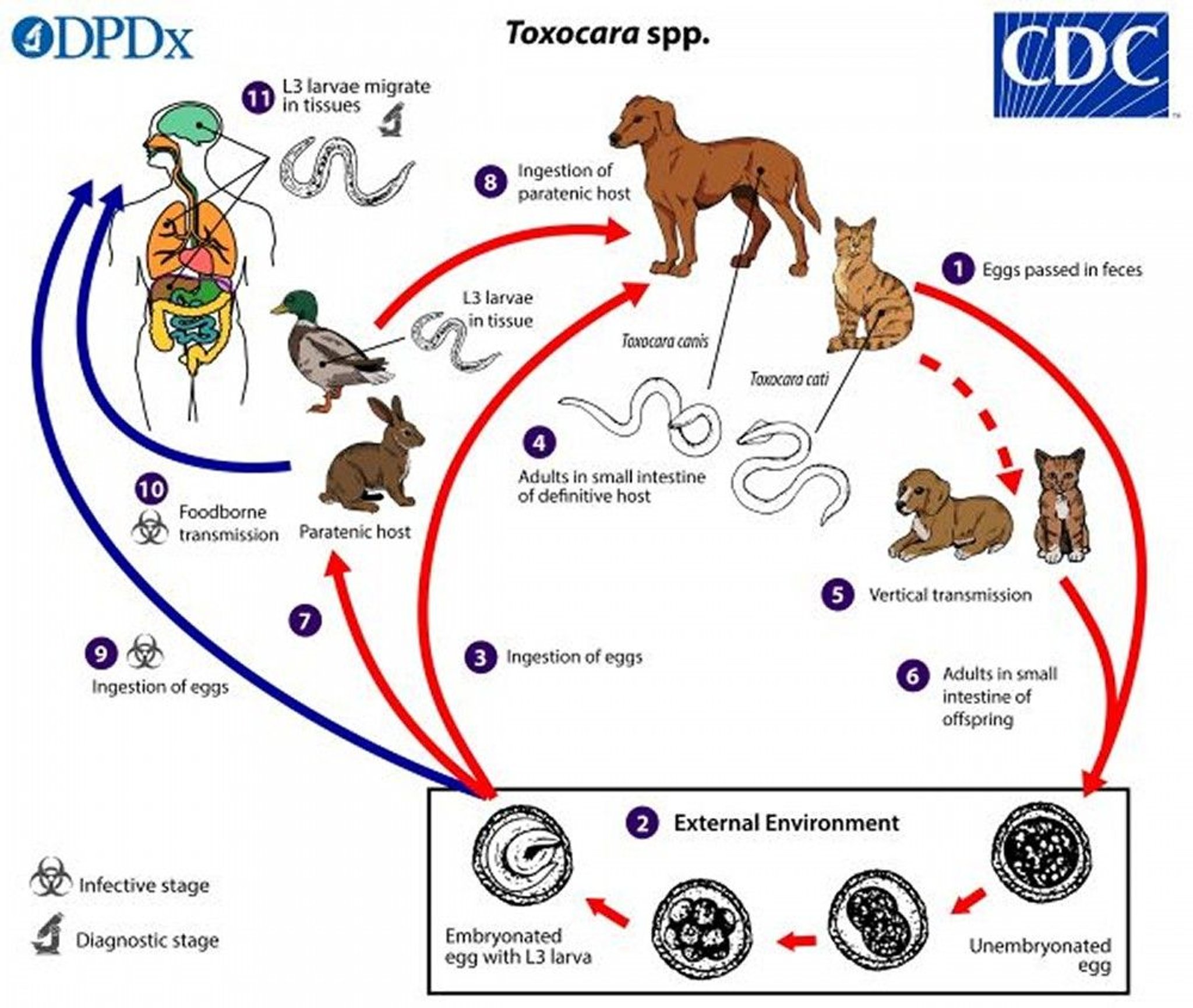
Image from the Centers for Disease Control and Prevention, Global Health, Division of Parasitic Diseases and Malaria.
Symptoms and Signs of Toxocariasis
Visceral larva migrans
Visceral larva migrans (VLM) consists of fever, anorexia, hepatosplenomegaly, rash, pneumonitis, and asthmatic symptoms, depending on the affected organs. Larvae of other helminths including Baylisascaris procyonis, Strongyloides species, and Paragonimus species can cause similar symptoms and signs when they migrate through tissue.
VLM occurs mostly in 2- to 5-year-old children with a history of geophagia or in adults who ingest clay.
The syndrome is self-limiting in 6 to 18 months if egg intake ceases. Deaths due to invasion of the brain or heart occur rarely.
Ocular larva migrans
Ocular larva migrans (OLM), also called ocular toxocariasis, is usually unilateral and has no or very mild systemic manifestations. OLM lesions consist mostly of granulomatous inflammatory reactions to a larva, resulting in uveitis and/or chorioretinitis. As a result, vision can be impaired or lost.
OLM occurs in older children and less commonly in young adults. The lesion may be confused with retinoblastoma or other intraocular tumors.
Diagnosis of Toxocariasis
Enzyme immunoassay for antibodies against Toxocara plus clinical findings
Diagnosis of toxocariasis is based on clinical, epidemiologic, and serologic findings.
For visceral larva migrans (VLM), enzyme immunoassay (EIA) for antibodies against Toxocara is recommended to confirm the diagnosis. Isoagglutinins may be elevated, but the finding is nonspecific. CT or MRI can show multiple, ill-defined, 1.0- to 1.5-cm oval lesions scattered in the liver or poorly defined subpleural nodules in the chest.
Hypergammaglobulinemia, leukocytosis, and marked eosinophilia are common in VLM.
Biopsies of the liver or other affected organs may show eosinophilic granulomatous reactions, but larvae are difficult to find in tissue sections and biopsies are low yield. Stool examinations are worthless.
For ocular larva migrans (OLM), ophthalmologic expertise is essential for diagnosis. Granulomatous reactions appear as oval, white lesions in the posterior pole or periphery of the retina. Some patients present with endophthalmitis manifesting as a red, painful eye with diffuse intraocular inflammation.
The presence of anti-Toxocara antibodies and characteristic ophthalmologic findings are helpful in differentiating OLM from retinoblastoma and preventing unnecessary surgical enucleation of the eye. Unfortunately anti-Toxocara antibody titers can be low or undetectable in patients with OLM.
Treatment of Toxocariasis
Symptomatic treatment
Asymptomatic patients and patients with mild visceral larva migrans (VLM) symptoms do not require anthelmintic therapy because infection is usually self-limited.
Laser photocoagulation has been used to kill larvae in the retina. Cryosurgery or surgical vitrectomy have been used in some circumstances.
Prevention of Toxocariasis
Infection with T. canis in puppies is common in the United States; infection with T. cati in cats is less common. Both animals should be dewormed regularly. Contact with dirt or sand contaminated with animal feces should be minimized. Sandboxes should be covered.
Key Points
The Toxocara canis life cycle normally involves dogs; humans are infected only accidentally, when they ingest eggs in soil contaminated by stool from infected animals or ingest undercooked infected transfer hosts (eg, rabbits).
In humans, toxocariasis causes 2 main syndromes: visceral larva migrans (which causes various symptoms depending on the organ infected) and ocular larva migrans (which usually causes no or mild symptoms but can result in impaired or lost vision).
Diagnose based on clinical evaluation and enzyme immunoassay for Toxocara antigens.
Deworming dogs and cats can help prevent toxocariasis.


