





Clonorchiasis is infection with the liver fluke Clonorchis sinensis
Flukes are parasitic flatworms that infect various parts of the body (eg, blood vessels, gastrointestinal tract, lungs, liver) depending on the species.
Clonorchis is endemic in East Asia (China, South Korea, northern Vietnam, Taiwan, and parts of Russia), and infection occurs elsewhere among immigrants and people eating raw or undercooked fish, or sometimes shrimp, from endemic areas. The number of people infected with C. sinensis is growing, from an estimated 7 million in the 1990s to 15 to 20 million worldwide in the 2010s (1, 2).
See also the World Health Organization (WHO) and Centers for Disease Control and Prevention (CDC) information on clonorchiasis.
References
1. Fürst T, Keiser J, Utzinger J: Global burden of human food-borne trematodiasis: a systematic review and meta-analysis. Lancet Infect Dis 12(3):210-221, 2012. doi:10.1016/S1473-3099(11)70294-8
2. Tang ZL, Huang Y, Yu XB: Current status and perspectives of Clonorchis sinensis and clonorchiasis: epidemiology, pathogenesis, omics, prevention and control. Infect Dis Poverty 5(1):71, 2016. Published 2016 Jul 6. doi:10.1186/s40249-016-0166-1
Pathophysiology of Clonorchiasis

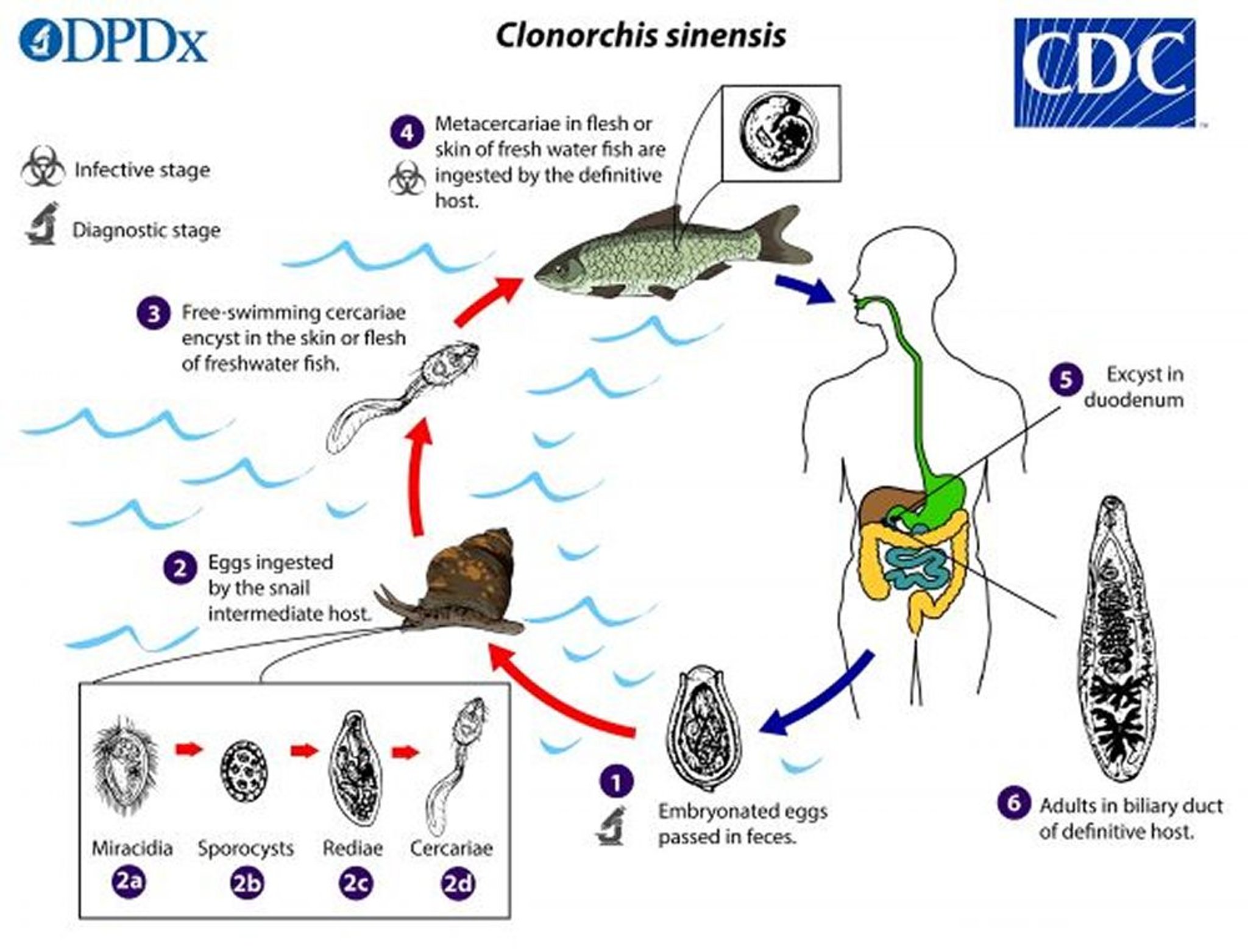
Image from the Centers for Disease Control and Prevention, Global Health, Division of Parasitic Diseases and Malaria.
Adult forms of C. sinensis live in the bile ducts. Eggs are passed in the stool and ingested by snails. Cercariae (free-swimming larvae) released from infected snails subsequently infect a variety of freshwater fish and shrimp. Humans become infected by eating raw, undercooked, dried, salted, or pickled fish, or less commonly freshwater shrimp, containing encysted metacercariae (resting or maturing stage). Metacercariae are released in the duodenum, enter the common bile duct through the ampulla of Vater, and migrate to smaller intrahepatic ducts (or occasionally the gallbladder and pancreatic ducts), where they mature into adults in about 1 month. The adults may live ≥ 25 years and grow to about 10 to 25 mm by 3 to 5 mm. For example, some U.S. Vietnam veterans have had serologic evidence of exposure to liver fluke infection when tested 5 decades after the war ended, but none had detectable liver fluke parasites by fecal examination (1).
Pathophysiology reference
1. Psevdos G, Ford FM, Hong S-T: Screening US Vietnam veterans for liver fluke exposure 5 decades after the end of the war. Infectious Diseases in Clinical Practice 26(4):208–210, 2018. doi: 10.1097/IPC.0000000000000611
Symptoms and Signs of Clonorchiasis
Light infections are usually asymptomatic; symptoms typically occur in patients with a greater worm burden and longer duration of infection. In the acute phase, heavier infections can cause fever, chills, epigastric pain, tender hepatomegaly, mild jaundice, and eosinophilia. Later, diarrhea may occur. Symptoms usually last for 2 to 4 weeks.
Chronic cholangitis in heavy infections may progress to atrophy of liver parenchyma and portal fibrosis. Jaundice may occur if a mass of flukes obstructs the biliary tree.
Other complications include suppurative cholangitis, cholelithiasis, pancreatitis, and, late in the course, cholangiocarcinoma (bile duct cancer [1]). Vietnam veterans who develop cholangiocarcinoma may have been infected with Clonorchis sinensis or Opisthorchis viverrini while they served in Southeast Asia (2). The risk of cholangiocarcinoma is increased in parts of South East Asia and mortality is more common in men aged 40 to 65 years.
Symptoms and signs references
1. Xia J, Jiang SC, Peng HJ: Association between liver fluke infection and hepatobiliary pathological changes: A systematic review and meta-analysis. PLoS One 10 (7):e0132673, 2015. doi: 10.1371/journal.pone.0132673
2. Psevdos G, Ford FM, Hong S-T: Screening US Vietnam veterans for liver fluke exposure 5 decades after the end of the war. Infectious Diseases in Clinical Practice 26(4):208–210, 2018. doi: 10.1097/IPC.0000000000000611
Diagnosis of Clonorchiasis
Microscopic examination of stool
Diagnosis of clonorchiasis is by finding eggs in the feces or duodenal contents. Eggs typically become detectable in the stool only 3 to 4 weeks after infection. The eggs are difficult to distinguish from those of Opisthorchis. Eggs cannot be detected in feces during biliary obstruction. Occasionally, the diagnosis is made by identifying adult flukes in surgical specimens or by doing percutaneous transhepatic cholangiography.
Other tests are nondiagnostic but may be abnormal; alkaline phosphatase and bilirubin may be elevated. High levels of circulating eosinophils and serum IgE are also common. Eosinophilia distinguishes liver fluke infection from acute viral hepatis.
A plain abdominal x-ray occasionally shows intrahepatic calcification. Hepatic ultrasonography, CT, MRI, endoscopic retrograde cholangiopancreatography (ERCP), or cholangiography may show ductal irregularities and evidence of scarring.
Ultrasound screening for periductal fibrosis in high risk patients (male, >50 years old) in endemic areas can improve early detection of cholangiocarcinoma and thus survival rate (1).
Diagnosis reference
1. Chamadol N, Khuntikeo N, Thinkhamrop B, et al: Association between periductal fibrosis and bile duct dilatation among a population at high risk of cholangiocarcinoma: a cross-sectional study of cholangiocarcinoma screening in Northeast Thailand [published correction appears in BMJ Open 9(5):e023217corr1, 2019]. BMJ Open 9(3):e023217, 2019. Published 2019 Mar 20. doi:10.1136/bmjopen-2018-023217
Treatment of Clonorchiasis
Treatment of clonorchiasis is with one of the following:
Biliary obstruction may require surgery.
1). Family members of infected people should be evaluated for infection with stool microscopy and blood count for eosinophilia.
Treatment reference
1. Choi MH, Park SK, Li Z, et al: Effect of control strategies on prevalence, incidence and re-infection of clonorchiasis in endemic areas of China. PLoS Negl Trop Dis 4(2):e601, 2010. doi:10.1371/journal.pntd.0000601


