





Fascioliasis is infection with the liver fluke Fasciola hepatica
Flukes are parasitic flatworms that infect various parts of the body (eg, blood vessels, gastrointestinal tract, lungs, liver) depending on the species.
F. hepatica is the sheep and cattle liver fluke. Incidental human fascioliasis, acquired by eating watercress contaminated by sheep or cattle dung, occurs in Europe, Africa, China, and South America but is rare in the United States.

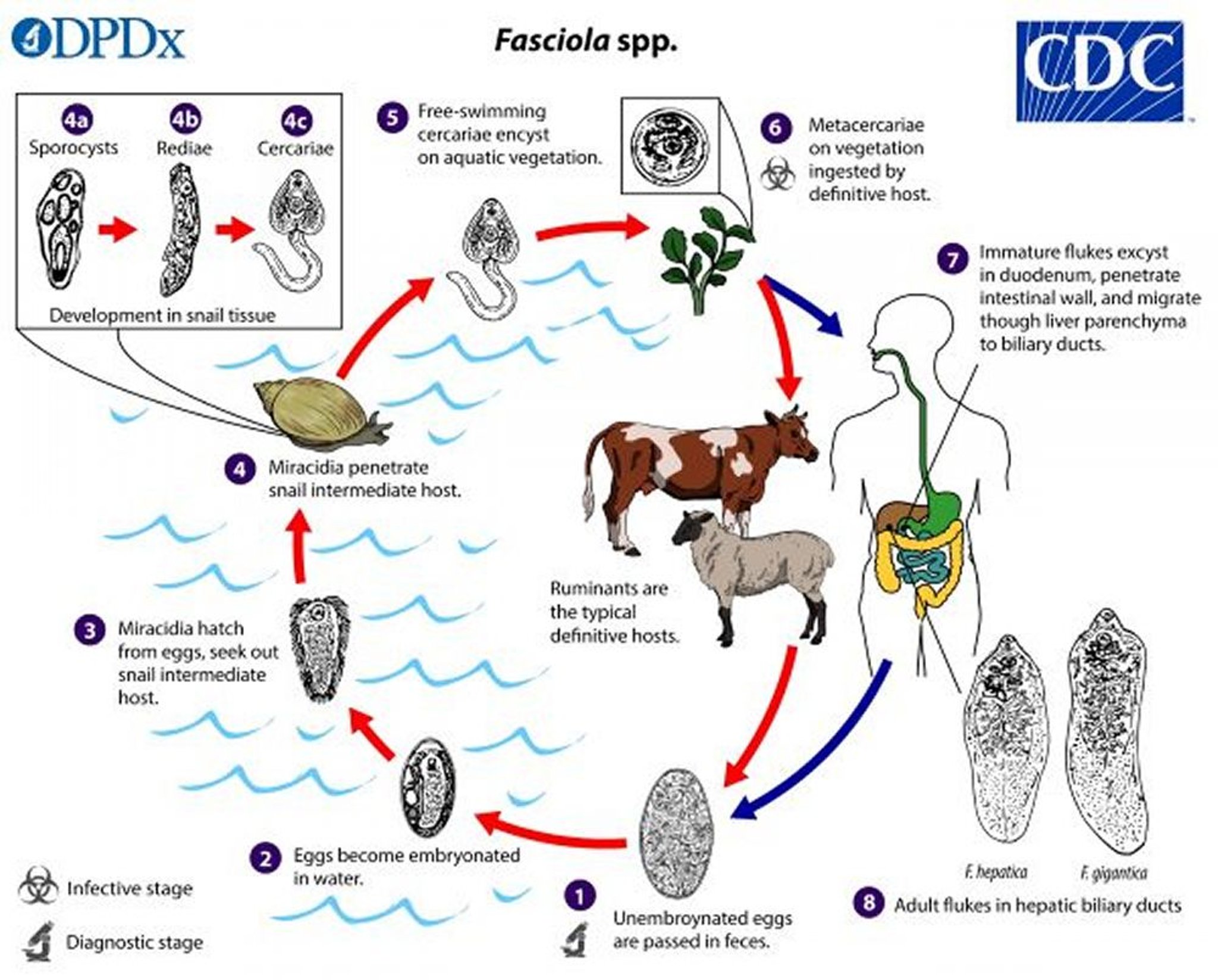
Image from the Centers for Disease Control and Prevention, Global Health, Division of Parasitic Diseases and Malaria.
In acute infection, immature flukes migrate through the intestinal wall, the peritoneal cavity, the liver capsule, and the parenchyma of the liver before entering the biliary ducts where they mature to adulthood in about 3 to 4 months. The adults lay eggs, which are passed through the bile ducts into the duodenum and then out in the stool.
See also the World Health Organization (WHO) and Centers for Disease Control and Prevention (CDC) information on fascioliasis.
Symptoms and Signs of Fascioliasis
Acute fascioliasis infection can cause abdominal pain, hepatomegaly, nausea, vomiting, intermittent fever, urticaria, malaise, and weight loss due to liver damage.
Chronic infection may be asymptomatic or lead to intermittent abdominal pain, cholelithiasis, cholangitis, obstructive jaundice, or pancreatitis.
Heavy infection can cause sclerosing cholangitis and biliary cirrhosis. Ectopic lesions may occur in the intestinal wall, lungs, or other organs.
Pharyngeal fascioliasis that results in dysphagia has been reported after consumption of infected raw liver in the Middle East; this syndrome is called halzoun. Halzoun is not well characterized, and other pathogens have also been proposed as the etiology (1).
Symptoms and signs reference
1. Khalil G, Haddad C, Otrock ZK, et al: Halzoun, an allergic pharyngitis syndrome in Lebanon: the trematode Dicrocoelium dendriticum as an additional cause. Acta Trop 125(1):115-118, 2013. doi:10.1016/j.actatropica.2012.09.013
Diagnosis of Fascioliasis
Microscopic examination of stool or duodenal or biliary material for eggs
Antibody assays
Fascioliasis should be considered in patients with abdominal pain and/or hepatomegaly, and a dietary history of watercress ingestion or consumption of raw vegetables exposed to contaminated water.
When fascioliasis is suspected, patients should have stool examination for eggs and serum antibody assay. Supportive findings on blood and imaging tests done for evaluation of abdominal complaints include anemia, eosinophilia, abnormal liver tests, elevated erythrocyte sedimentation rate, and hypergammaglobulinemia, and hypodense lesions in the liver on CT scan during the acute stage of fascioliasis.
If stool examination and antibody testing are negative or equivocal but fascioliasis is still suspected (ie, based on numerous supportive findings, particularly eosinophilia), then endoscopy with duodenal and biliary aspiration should be done. Eggs and sometimes adult worms may be detected in specimens obtained during endoscopy.
Antibody detection assays are particularly useful in
The early stages of infection before eggs are produced (egg production typically begins at least 3 to 4 months after exposure)
Chronic infection when egg production is sporadic or low
Loss of detectable antibodies occurs 6 to 12 months after cure.
In chronic infections, eggs may be recovered from the stool or from duodenal or biliary materials. The eggs are indistinguishable from those of Fasciolopsis buski.
In endemic areas, eggs can also be seen in stool after ingestion of infected animal livers, which are not infective for humans, resulting in a misdiagnosis of fascioliasis. Thus, patients should be asked to follow a liver-free diet for several days before their stool is examined.
Ultrasonography, CT, MRI, endoscopic retrograde cholangiopancreatography (ERCP), or cholangiography can detect biliary tract abnormalities in chronic disease.
Treatment of Fascioliasis
In some patients, extraction of adult flukes from the biliary tract by ERCP may be useful.
Prevention involves not eating watercress or other freshwater plants in regions where F. hepatica is endemic. Family members of infected people should be evaluated for fascioliasis.


