





Horner syndrome is ptosis, miosis, and anhidrosis due to dysfunction of cervical sympathetic output.
(See also Overview of the Autonomic Nervous System.)
Etiology of Horner Syndrome
Horner syndrome results when the cervical sympathetic pathway running from the hypothalamus to the eye is disrupted. The causative lesion may be primary (including congenital) or secondary to another disorder.
Lesions are usually divided into the following:
Central (eg, brain stem ischemia, syringomyelia, brain tumor)
Peripheral (eg, Pancoast tumor, cervical adenopathy, neck and skull injuries, aortic or carotid dissection, thoracic aortic aneurysm)
Peripheral lesions may be preganglionic or postganglionic in origin.
Symptoms and Signs of Horner Syndrome
Symptoms of Horner syndrome include ptosis, miosis, anhidrosis, and hyperemia of the affected side.

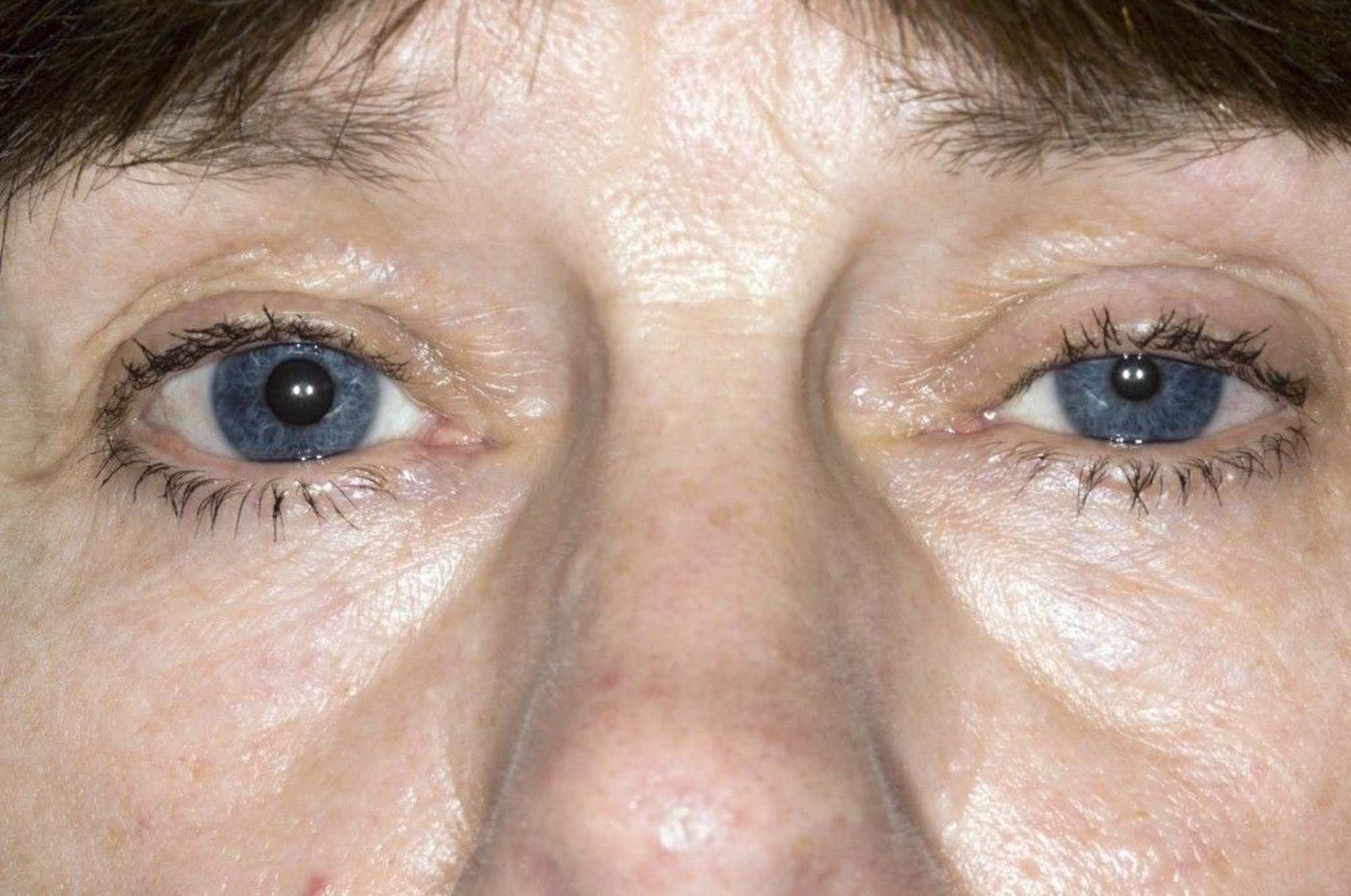
DR P. MARAZZI/SCIENCE PHOTO LIBRARY
In the congenital form, the iris does not become pigmented and remains blue-gray.
Diagnosis of Horner Syndrome
MRI or CT to diagnose cause
Instilling eyedrops can help confirm and characterize Horner syndrome.
If results suggest Horner syndrome, hydroxyamphetamine (1%) can be put in both eyes 48 hours later to help locate the lesion. Hydroxyamphetamine works by causing norepinephrine to be released from the presynaptic terminals. It has no effect if postganglionic lesions are present because these lesions cause postganglionic terminals to degenerate. Thus, when hydroxyamphetamine is applied, the following occur:
Postganglionic lesion: The pupil of the affected eye does not dilate, but the pupil of the unaffected eye dilates, resulting in increased anisocoria.
Central or preganglionic lesion: The pupil of the affected eye dilates normally or more than it normally does, and the pupil of the unaffected eye dilates normally, resulting in decreased or unchanged anisocoria. (However, postganglionic lesions sometimes produce the same results.)
hydroxyamphetamine tends to be available less often. For results to be valid, hydroxyamphetamine
Patients with Horner syndrome require MRI or CT of the brain, spinal cord, chest, or neck (depending on clinical suspicion) to localize the abnormality.
Treatment of Horner Syndrome
Treatment of the cause
The cause of Horner syndrome, if identified, is treated; there is no treatment for primary Horner syndrome.
Key Points
Horner syndrome causes ptosis, miosis, and anhidrosis.
It results from a central or peripheral lesion (preganglionic or postganglionic) that disrupts the cervical sympathetic pathway, which runs from the hypothalamus to the eye.
Do MRI or CT of the brain, spinal cord, chest, or neck, depending on clinical suspicion.
Treat the cause, if identified; there is no treatment for primary Horner syndrome.


