|
(See also Hearing Loss; see also Nose and Paranasal Sinus Disorders; see also Optic Nerve Disorders; and see also Approach to the Neurologic Patient). (See also Autonomic Nervous System: Horner's Syndrome.)
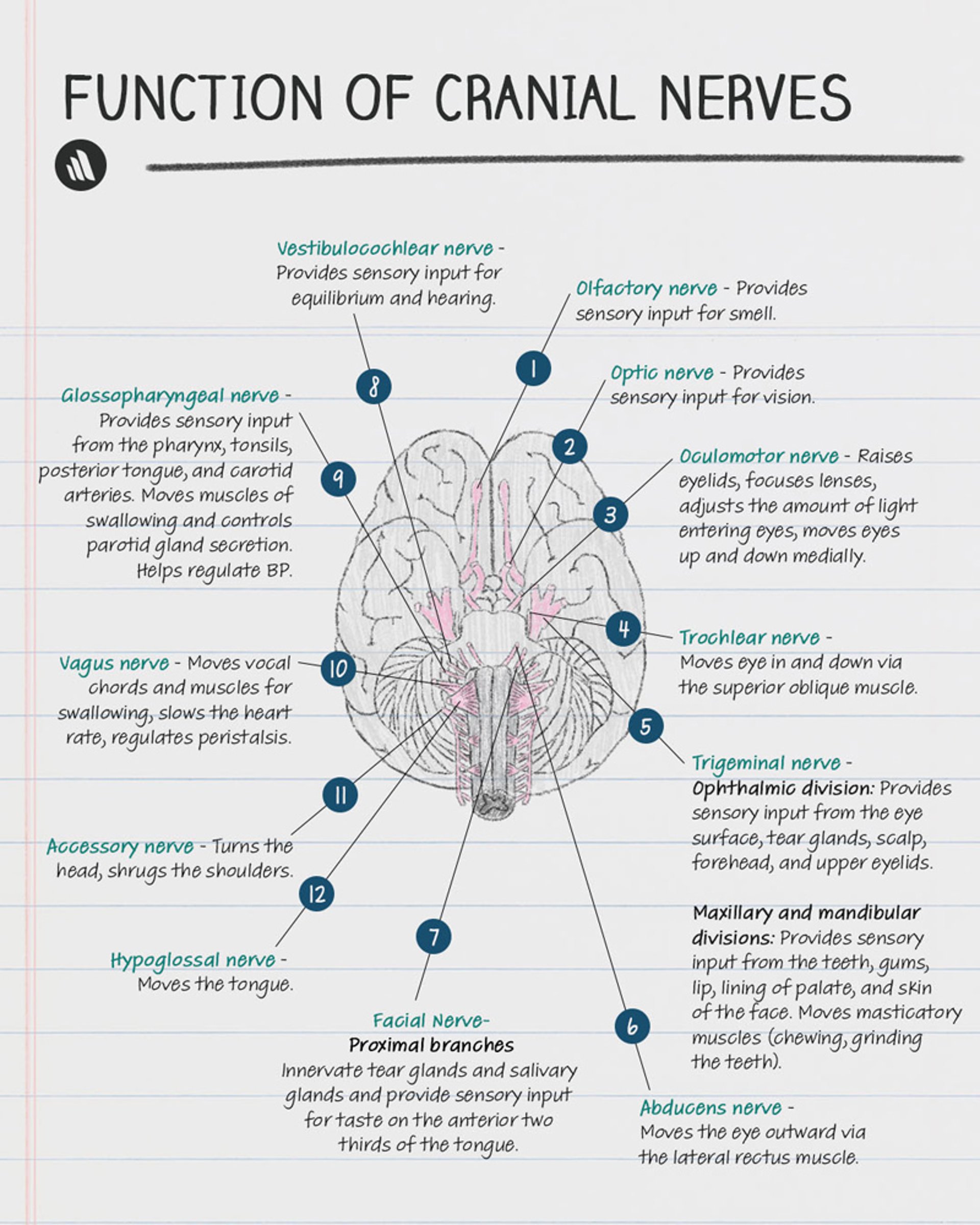
Dysfunction of certain cranial nerves may affect the eye, pupil, optic nerve, or extraocular muscles and their nerves; thus, they can be considered cranial nerve disorders, neuro-ophthalmologic disorders, or both. Neuro-ophthalmologic disorders may also involve dysfunction of the central pathways that control and integrate ocular movement and vision. Cranial nerve disorders can also involve dysfunction of smell, vision, chewing, facial sensation or expression, taste, hearing, balance, swallowing, phonation, head turning and shoulder elevation, or tongue movements (see Table 1: Neuro-ophthalmologic and Cranial Nerve Disorders: Cranial Nerves ). One or more cranial nerves may be affected.
Causes and symptoms of neuro-ophthalmologic and cranial nerve disorders overlap. Both types of disorders can result from tumors, inflammation, trauma, systemic disorders, and degenerative or other processes, causing such symptoms as vision loss, diplopia, ptosis, pupillary abnormalities, periocular pain, facial pain, or headache.
Diagnosis and Treatment
Evaluation includes the following:
Visual system examination includes ophthalmoscopy and testing of visual acuity, visual fields (see Table 3: Approach to the Ophthalmologic Patient:Anisocoria ), pupils (see Table 2: Neuro-ophthalmologic and Cranial Nerve Disorders: Common Pupillary Abnormalities ), and eye movements (ocular motility—see Table 3: Neuro-ophthalmologic and Cranial Nerve Disorders: Common Disturbances of Ocular Motility ). As part of this testing, the 2nd, 3rd, 4th, and 6th cranial nerves are examined (see also Approach to the Neurologic Patient: Cranial nerves). Neuroimaging with CT or MRI is also usually required.
The following parts of the visual examination are of particular interest in diagnosing neuro-ophthalmologic and cranial nerve disorders:
Pupils are inspected for size, equality, and regularity. Normally, the pupils constrict promptly (within 1 sec) and equally during accommodation and during exposure to direct light and to light directed at the other pupil (consensual light reflex). Testing pupillary response to consensual light via a swinging flashlight test can determine whether a defect is present. Normally, the degree of pupillary constriction does not change as the flashlight is swung from eye to eye.
Eye
movements are checked by having the patient hold the head steady, while tracking the examiner's finger as it moves to the far right, left, upward, downward, diagonally to either side, and inward toward the patient's nose (to assess accommodation). However, such examination may miss mild paresis of ocular movement sufficient to cause diplopia.
Diplopia may indicate a defect in bilateral coordination of eye movements (eg, in neural pathways) or in the 3rd (oculomotor), 4th (trochlear), or 6th (abducens) cranial nerve. If diplopia persists when one eye is closed (monocular diplopia), the cause is probably a nonneurologic eye disorder (see Approach to the Ophthalmologic Patient: Diplopia). If diplopia disappears when either eye is closed (binocular diplopia), the cause is probably a disorder of ocular motility. The 2 images are furthest apart when the patient looks in the direction served by the paretic eye muscle (eg, to the left when the left lateral rectus muscle is paretic). The eye that, when closed, eliminates the more peripheral image is paretic. Placing a red glass over one eye can help identify the paretic eye. When the red glass covers the paretic eye, the more peripheral image is red (see also Approach to the Ophthalmologic Patient: Physical examination).
Treatment of neuro-ophthalmologic and cranial disorders depends on the cause.
|
Table 2
|
 |  |  |
|
Common Pupillary Abnormalities
|
|
Finding
|
Explanation
|
|
Asymmetry of 1–2 mm between pupils, preserved light responses, and no symptoms (physiologic anisocoria)
|
Normal variant
|
|
Asymmetry, impaired light responses, and preserved response to accommodation (light-near dissociation or Argyll Robertson pupil)
|
Neurosyphilis (possibly)
|
|
Bilateral constriction
|
Opioids
Organophosphate or cholinergic toxins
Pontine hemorrhage
Miotic eye drops for glaucoma (most common; causing unilateral constriction if single eye is dosed)
|
|
Bilateral dilation with preserved light reflexes
|
Hyperadrenergic states (eg, withdrawal syndromes, drugs such as sympathomimetics or cocaine, thyrotoxicosis)
|
|
Bilateral dilation with impaired light response
|
Mydriatic eye drops such as sympathomimetics (eg, phenylephrine ) and cycloplegics (eg, cyclopentolate , tropicamide , homatropine , atropine )
Brain herniation
Hypoxic or ischemic encephalopathy
|
|
Unilateral dilation with afferent pupillary defect
|
Lesions of the eye, retina, or 2nd cranial (optic) nerve
|
|
Unilateral dilation with efferent pupillary defect
|
Third cranial (oculomotor) nerve palsies, often due to compression (eg, due to aneurysm of the posterior communicating artery or to transtentorial herniation)
Iris trauma (also irregular pupil)
Mydriatic eye drops*
|
|
Unilateral dilation with minimal or slow direct and consensual light reflexes and pupil constriction in response to accommodation
|
Tonic (Adie's) pupil†
|
|
*Transtentorial herniation and use of mydriatic eye drops can often be distinguished by instilling a drop of pilocarpine ocular solution into the dilated pupil; no constriction in response suggests mydriatic eye drops.
|
|
†Tonic pupil is permanent but nonprogressive abnormal dilation of the pupil due to damage of the ciliary ganglion. It typically occurs in women aged 20 to 40. Onset is usually sudden. The only findings are slight blurring of vision, impaired dark adaptation, and sometimes absent deep tendon reflexes.
|
|
|
Table 3
|
 |  |  |
|
Common Disturbances of
Ocular Motility
|
|
Clinical Finding
|
Syndrome
|
Common Causes
|
|
Pareses
|
|
Paresis of horizontal gaze in one direction
|
Conjugate horizontal gaze palsy
|
Lesion in the ipsilateral pontine horizontal gaze center or in the contralateral frontal cortex
|
|
Paresis of horizontal gaze in both directions
|
Complete (bilateral) horizontal gaze palsy
|
Wernicke's encephalopathy
Large bilateral pontine lesion affecting both horizontal gaze centers
|
|
Bilateral paresis of all horizontal eye movements except for abduction of the eye contralateral to the lesion; convergence unaffected
|
One-and-a-half syndrome
|
Lesion in the medial longitudinal fasciculus and ipsilateral pontine horizontal gaze center
|
|
Unilateral or bilateral paresis of eye adduction in horizontal lateral gaze but not in convergence
|
Internuclear ophthalmoplegia
|
Lesion in the medial longitudinal fasciculus
|
|
Bilateral paresis of upward eye movement with dilated pupils, loss of the pupillary light response despite preservation of pupillary accommodation and constriction with convergence, downward gaze preference, and downbeating nystagmus
|
Parinaud's syndrome (a type of conjugate vertical gaze palsy)
|
Pineal tumor
Midbrain infarct
|
|
Bilateral paresis of downward eye movements
|
Conjugate downward gaze palsy
|
Progressive supranuclear palsy
|
|
Unilateral eye deviation (resting position is down and out); unilateral paresis of eye adduction, elevation, and depression; ptosis; and often a dilated pupil
|
3rd cranial nerve palsy
|
Aneurysms
Oculomotor nerve or midbrain ischemia
Trauma
Transtentorial herniation
|
|
Unilateral paresis of downward and inward (nasal) eye movement, which may be subtle, causing symptoms (difficulty looking down and inward)
Head tilt sign (patient tilts head opposite the side of the affected eye)
|
4th cranial nerve palsy
|
Idiopathic
Head trauma
Ischemia
Congenital
|
|
Unilateral paresis of eye abduction
|
6th cranial nerve palsy
|
Idiopathic
Infarct
Vasculitis
Increased intracranial pressure
Wernicke's encephalopathy
Multiple sclerosis
|
|
Skew deviation (vertical misalignment of the eyes)
|
Partial and unequal involvement of 3rd cranial nerve nuclei, vertical gaze center, or median longitudinal fasciculus
|
Brain stem lesion anywhere from midbrain to medulla
|
|
Weakness or restriction of all extraocular muscles
|
External ophthalmoplegia
|
Dysfunction of eye muscles or of neuromuscular junction
Usual causes include the following:
|
|
Involuntary or abnormal movements
|
|
Rythmic involuntary movements, usually bilateral
|
Nystagmus
|
see Sidebar 1: Approach to the Patient With Ear Problems: Nystagmus
|
|
Fast downward jerk and slow upward return to midposition
|
Ocular bobbing
|
Extensive pontine destruction or dysfunction
|
|
Gaze overshoot followed by several oscillations
|
Ocular dysmetria
|
Cerebellar pathway disorders
|
|
Burst of rapid horizontal oscillations about a point of fixation
|
Ocular flutter
|
Many causes:
|
|
Rapid, conjugate, multidirectional, chaotic movements, often with widespread myoclonus
|
Opsoclonus
|
Many causes (same as for ocular flutter, above)
|
|
Last full review/revision October 2007 by Michael Jacewicz, MD
Content last modified October 2007
|  |