





Intracranial tumors may involve the brain or other structures (eg, cranial nerves, meninges). The tumors usually develop during early or middle adulthood but may develop at any age; they are becoming more common among older people. Brain tumors are found in about 2% of routine autopsies.
Some tumors are benign, but because the cranial vault allows no room for expansion, even benign tumors can cause serious neurologic dysfunction or death.
(See also Overview of Central Nervous System Tumors in Children.)
Classification of Intracranial Tumors
There are 2 types of brain tumors:
Primary brain tumors: Originate in the brain in the brain parenchyma (eg, gliomas, which include astrocytomas, oligodendrogliomas, and ependymomas; medulloblastomas; primary central nervous system [CNS] lymphomas) or in extraneural structures (eg, meningiomas, vestibular schwannomas)
Secondary brain tumors (brain metastases): Originate in tissues outside the brain and spread to the brain
Brain metastases are about 10 times more common than primary tumors.
Pearls & Pitfalls
|

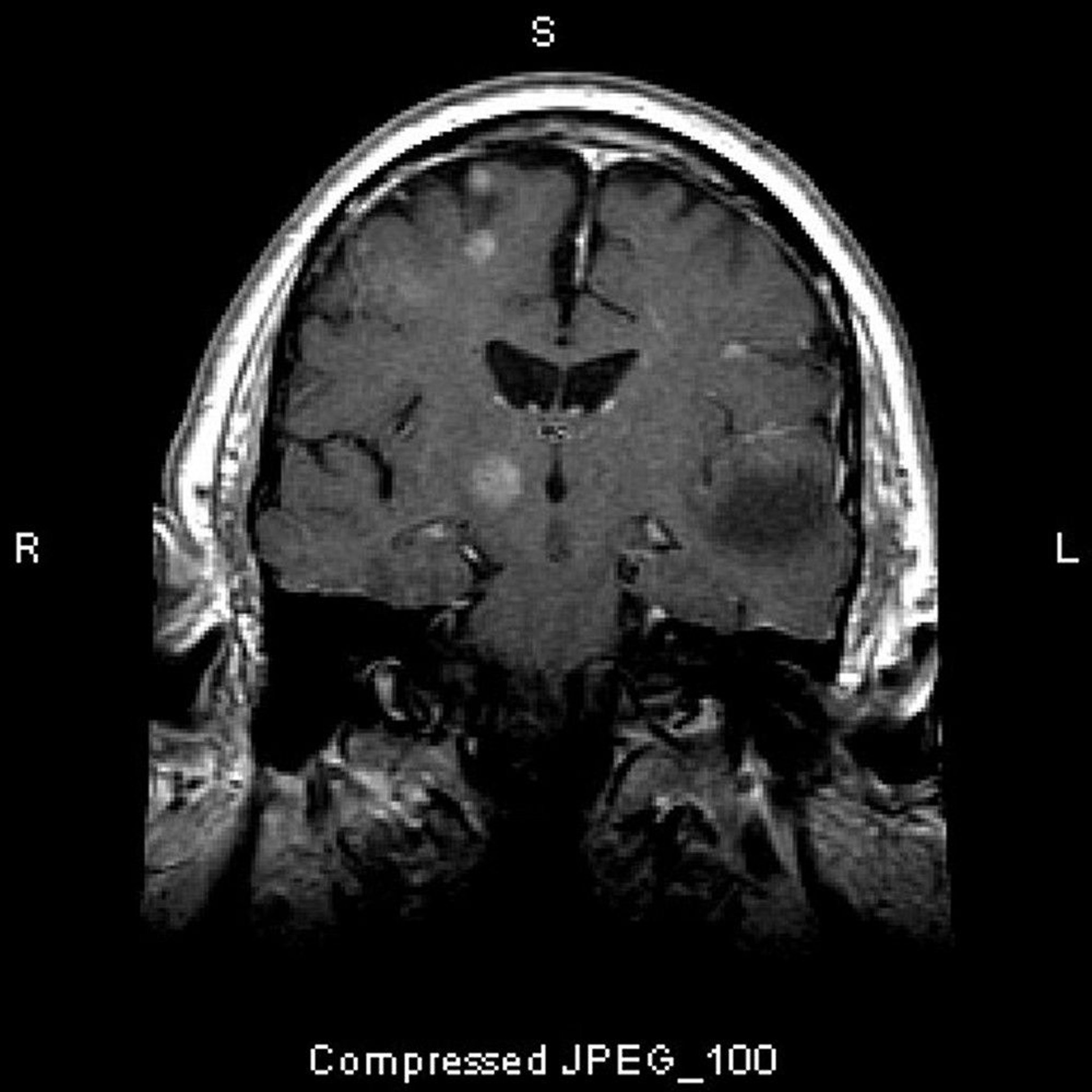
Image courtesy of William R. Shapiro, MD.
Type of tumor varies somewhat by site (see table Common Localizing Manifestations of Primary Brain Tumors) and patient age (see table Common Tumors by Age).
Pathophysiology of Intracranial Tumors
Neurologic dysfunction may result from the following:
Invasion and destruction of brain tissue by the tumor
Direct compression of adjacent tissue by the tumor
Increased intracranial pressure (because the tumor occupies space within the skull)
Bleeding within or outside the tumor
Cerebral edema
Obstruction of dural venous sinuses (especially by bone or extradural metastatic tumors)
Obstruction of cerebrospinal fluid (CSF) drainage (occurring early with 3rd-ventricle or posterior fossa tumors)
Obstruction of CSF absorption (eg, when leukemia or carcinoma involves the meninges)
Obstruction of arterial flow
Rarely, paraneoplastic syndromes
A malignant tumor can develop new internal blood vessels, which can bleed or become occluded, resulting in necrosis and neurologic dysfunction that mimics stroke. Bleeding as a complication of metastatic tumors is most likely to occur in patients with melanoma, renal cell carcinoma, choriocarcinoma, or thyroid, lung, or breast cancer.
Benign tumors grow slowly. They may become quite large before causing symptoms, partly because often there is no cerebral edema. Malignant primary tumors grow rapidly but rarely spread beyond the CNS. Death results from local tumor growth and/or tumor-related hemorrhage and thus can result from benign as well as malignant tumors.
Symptoms and Signs of Intracranial Tumors
Symptoms caused by primary tumors and metastatic tumors are the same. Many symptoms result from increased intracranial pressure:
Headache
Deterioration in mental status
Focal brain dysfunction
Headache is the most common symptom. Headache may be most intense when patients awake from deep nonrapid eye movement (non-REM) sleep (usually several hours after falling asleep) because hypoventilation, which increases cerebral blood flow and thus intracranial pressure, is usually maximal during non-REM sleep. Headache is also progressive and may be worsened by recumbency or the Valsalva maneuver. When intracranial pressure is very high, the headache may be accompanied by vomiting, sometimes with little nausea preceding it.
Papilledema develops in about 25% of patients with a brain tumor but may be absent even when intracranial pressure is increased. In infants and very young children, increased intracranial pressure may enlarge the head. If intracranial pressure increases sufficiently, brain herniation occurs.
Deterioration in mental status is the 2nd most common symptom. Manifestations include drowsiness, lethargy, personality changes, disordered conduct, and impaired cognition, particularly with malignant brain tumors. Airway reflexes may be impaired.
Focal brain dysfunction causes some symptoms. Focal neurologic deficits, endocrine dysfunction, or focal seizures (sometimes with secondary generalization) may develop depending on the tumor’s location (see table Common Localizing Manifestations of Brain Tumors). Focal deficits often suggest the tumor’s location. However, sometimes focal deficits do not correspond to the tumor’s location. Such deficits, called false localizing signs, include the following:
Unilateral or bilateral lateral rectus palsy (with paresis of eye abduction) due to increased intracranial pressure compressing the 6th cranial nerve
Ipsilateral hemiplegia due to compression of the contralateral cerebral peduncle against the tentorium (Kernohan notch)
Ipsilateral visual field defect due to ischemia in the contralateral occipital lobe
Generalized seizures may occur, more often with primary than metastatic brain tumors. Impaired consciousness can result from herniation, brain stem dysfunction, or diffuse bilateral cortical dysfunction.
Some tumors cause meningeal inflammation, resulting in subacute or chronic meningitis.
Diagnosis of Intracranial Tumors
T1-weighted MRI with gadolinium or CT with contrast
Sometimes biopsy
Early-stage brain tumors are often misdiagnosed. A brain tumor should be considered in patients with any of the following:
Progressive focal or global deficits of brain function
New-onset seizures
Persistent, unexplained, recent-onset headaches, particularly if worsened by sleep
Evidence of increased intracranial pressure (eg, papilledema, unexplained vomiting)
Pituitary or hypothalamic endocrinopathy
Similar findings can result from other intracranial masses (eg, abscess, aneurysm, arteriovenous malformation, intracerebral hemorrhage, subdural hematoma, granuloma, parasitic cysts such as neurocysticercosis) or ischemic stroke.
A complete neurologic examination, neuroimaging, and chest x-rays (for a source of metastases) should be performed. T1-weighted MRI with gadolinium is the study of choice. CT with contrast agent is an alternative. MRI usually detects low-grade astrocytomas and oligodendrogliomas earlier than CT and shows brain structures near bone (eg, the posterior fossa) more clearly. If whole-brain imaging does not show sufficient detail in the target area (eg, sella turcica, cerebellopontine angle, optic nerve), closely spaced images or other special views of the area are obtained. If neuroimaging is normal but increased intracranial pressure is suspected, idiopathic intracranial hypertension should be considered and lumbar puncture done.
Radiographic clues to the type of tumor, mainly location (see table Common Localizing Manifestations of Brain Tumors) and pattern of enhancement on MRI, may be inconclusive; brain biopsy, sometimes excisional biopsy, may be required.
Specialized tests (eg, molecular and genetic tumor markers in blood and cerebrospinal fluid [CSF]) can help in some cases. In patients with AIDS, Epstein-Barr virus titers in CSF typically increase as CNS lymphoma develops.
Treatment of Intracranial Tumors
Airway protection
Antiseizure medications for seizures
Definitive therapy with excision, radiation therapy, systemic cancer therapy (eg, chemotherapy, targeted therapy, immunotherapy), or a combination
Patients in a coma or with impaired airway reflexes require endotracheal intubation.
Treatment of the brain tumor depends on pathology and location. Surgical excision should be used for diagnosis (excisional biopsy) and symptom relief. It may cure benign tumors. For tumors infiltrating the brain parenchyma, treatment is multimodal. Radiation therapy is required, and chemotherapy, targeted therapy, and/or immunotherapy appears to benefit some patients.
Treatment of metastatic tumors includes radiation therapy and sometimes stereotactic radiosurgery. For patients with a single metastasis, surgical excision of the tumor before radiation therapy improves outcome.
End-of-life issues
If patients have an incurable tumor, end-of-life issues should be discussed, and palliative care consultation should be considered.
Cranial Radiation Therapy and Neurotoxicity
Radiation therapy may be directed at the whole head for diffuse or multicentric tumors or locally for well-demarcated tumors.
There are two types of localized brain radiation therapy; both aim to spare normal brain tissue:
Conformal: Using CT to create a 3-dimensional map of the tumor facilitates precise targeting of the tumor
Stereotactic: Using gamma knife or proton beam therapy to deliver multiple focused beams of high energy to the tumor
Gliomas are treated with conformal radiation therapy; a stereotactically directed gamma knife or proton beam therapy is useful for metastases. Current recommendations are to treat ≤ 4 metastatic lesions with stereotactic or other focal radiation interventions and to treat> 4 lesions with whole-brain radiation therapy (1, 2); however, new data may support stereotactic surgery for up to 10 metastatic lesions (3, 4). Giving radiation in smaller fractionated daily doses tends to maximize efficacy while minimizing neurotoxicity and damage to normal CNS tissue (see Radiation Exposure and Contamination).
Degree of neurotoxicity depends on
Cumulative radiation dose
Individual dose size
Duration of therapy
Volume of tissue irradiated
Individual susceptibility
Because susceptibility varies, prediction of radiation neurotoxicity is imprecise. Symptoms can develop in the first few days (acute) or months of treatment (early-delayed) or several months to years after treatment (late-delayed). Rarely, radiation causes gliomas, meningiomas, or peripheral nerve sheath tumors years after therapy.
Acute radiation neurotoxicity
Typically, acute neurotoxicity involves headache, nausea, vomiting, somnolence, and sometimes worsening focal neurologic signs in children and adults.
Acute neurotoxicity largely results from transient swelling and edema; thus, it is particularly likely if intracranial pressure is already high. Using corticosteroids to lower intracranial pressure can prevent or treat acute toxicity. Acute toxicity lessens with subsequent treatments.
Early-delayed neurotoxicity
In children or adults, early-delayed neurotoxicity can cause encephalopathy, which must be distinguished by MRI or CT from worsening or recurrent brain tumor. It may occur in children who have received prophylactic whole-brain radiation therapy for leukemia; they may develop somnolence, which lessens spontaneously over several days to weeks, possibly more rapidly if corticosteroids are used.
After radiation therapy to the neck or upper thorax, early-delayed neurotoxicity can result in a myelopathy, characterized by spinal symptoms such as Lhermitte sign (an electric shock-like sensation radiating down the back and into the legs when the neck is flexed). This early-delayed myelopathy typically resolves spontaneously.
Late-delayed neurotoxicity
After diffuse or whole-brain radiation therapy, many children and adults develop late-delayed neurotoxicity if they survive long enough. The most common cause in children is diffuse therapy given to prevent leukemia or to treat medulloblastoma. After diffuse therapy, the most common symptom is progressive dementia; adults may also develop an unsteady gait and focal neurologic symptoms. MRI or CT can show cerebral atrophy and often white matter loss.
After localized therapy, neurotoxicity more often involves focal neurologic deficits.
MRI or CT shows a mass that may be enhanced by contrast agent and that may be difficult to distinguish from recurrence of the primary tumor. Excisional biopsy of the mass is diagnostic and often ameliorates symptoms.
Late-delayed myelopathy can develop after radiation therapy for extraspinal tumors (eg, due to Hodgkin lymphoma). It is characterized by progressive paresis and sensory loss, often as a Brown-Séquard syndrome (ipsilateral paresis and proprioceptive sensory loss, with contralateral loss of pain and temperature sensation). Most patients eventually become paraplegic.
Treatment references
1. Gaspar L, Prabhu R, Hdeib A, et al: Congress of Neurological Surgeons systematic review and evidence-based guidelines on the role of whole brain radiation therapy in adults with newly diagnosed metastatic brain tumors. Neurosurgery 84 (3):E159–E162, 2019. doi: 10.1093/neuros/nyy541
2. Vogelbaum MA, Brown PD, Messersmith H, et al: Treatment for brain metastases: ASCO-SNO-Astro guideline. J Clin Oncol 40 (5):492–516, 2022. doi: 10.1200/JCO.21.02314 Epub 2021 Dec 21.
3. Long GV, Atkinson V, Lo S, et alLancet Oncol 19 (5):672–681, 2018. doi: 10.1016/S1470-2045(18)30139-6 Epub 2018 Mar 27.
4. Moss NS, Tosi U, Santomasso BD, et alCNS Oncol 11 (3):CNS90, 2022. doi: 10.2217/cns-2022-0010 Epub 2022 Jun 8.


