





Acute kidney injury is a rapid decrease in renal function over days to weeks, causing an accumulation of nitrogenous products in the blood (azotemia) with or without reduction in amount of urine output. It often results from inadequate renal perfusion due to severe trauma, illness, or surgery but is sometimes caused by a rapidly progressive, intrinsic renal disease. Symptoms may include anorexia, nausea, and vomiting. Seizures and coma may occur if the condition is untreated. Fluid, electrolyte, and acid-base disorders develop quickly. Diagnosis is based on laboratory tests of renal function, including serum creatinine. Urinary indices, urinary sediment examination, and often imaging and other tests (including sometimes a kidney biopsy) are needed to determine the cause. Treatment is directed at the cause but also includes fluid and electrolyte management and sometimes dialysis.
In all cases of acute kidney injury (AKI), creatinine and urea build up in the blood over several days, and fluid and electrolyte disorders develop. The most serious of these disorders are hyperkalemia and fluid overload (possibly causing pulmonary edema). Phosphate retention leads to hyperphosphatemia. Hypocalcemia is thought to occur because the impaired kidney no longer produces calcitriolAcidosis develops because hydrogen ions cannot be excreted. With significant uremia, coagulation may be impaired, and pericarditis may develop. Urine output varies with the type and cause of AKI.
Etiology of AKI
Causes of acute kidney injury (AKI; see table Major Causes of Acute Kidney Injury) can be classified as
Prerenal
Renal
Postrenal
Prerenal AKI is due to inadequate renal perfusion. The main causes are
Extracellular fluid volume depletion (eg, due to inadequate fluid intake, diarrheal illness, sepsis, severe trauma, surgery)
Cardiovascular disease (eg, heart failure, cardiogenic shock)
Decompensated liver disease
Prerenal conditions typically do not cause permanent kidney damage (and hence are potentially reversible) unless hypoperfusion is severe and/or prolonged. Hypoperfusion of an otherwise functioning kidney leads to enhanced reabsorption of sodium and water, resulting in oliguria (urine output < 500 mL/day) with high urine osmolality and low urine sodium.
Renal causes of AKI involve intrinsic kidney disease or damage. Disorders may involve the blood vessels, glomeruli, tubules, or interstitium. The most common causes are
Nephrotoxins (including prescription and over-the-counter medications—see Analgesic Nephropathy)
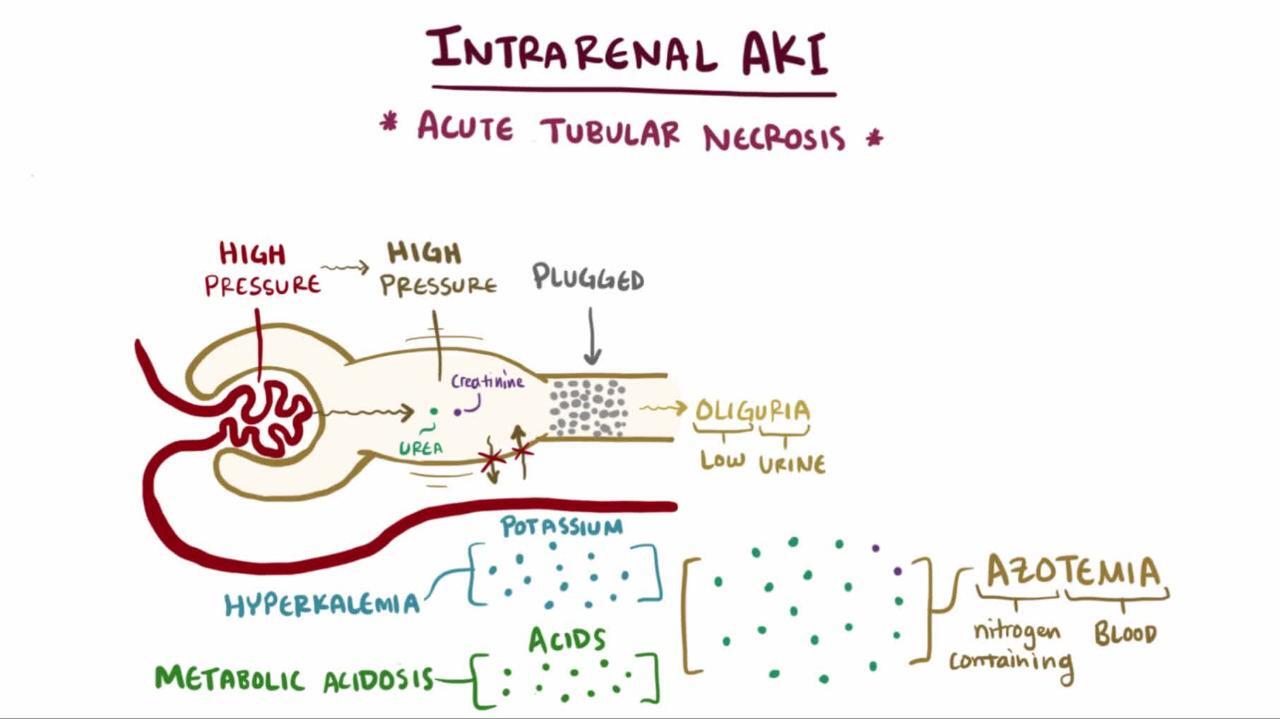
Glomerular disease reduces glomerular filtration rate (GFR) and increases glomerular capillary permeability to proteins and red blood cells; it may be inflammatory (glomerulonephritis) or the result of vascular damage due to ischemia or vasculitis.
Tubules also may be damaged by ischemia and may become obstructed by cellular debris, protein or crystal deposition, and cellular or interstitial edema.
Interstitial inflammation (nephritis) usually involves an immunologic or allergic phenomenon. These mechanisms of tubular damage are complex and interdependent, rendering the previously popular term acute tubular necrosis an inadequate description.
Postrenal AKI (obstructive nephropathy) is due to various types of obstruction in the voiding and collecting parts of the urinary system. Obstruction can also occur on the microscopic level within the tubules when crystalline or proteinaceous material precipitates.
Obstructed ultrafiltrate, in tubules or more distally, increases pressure in the urinary space of the glomerulus, reducing GFR. Obstruction also affects renal blood flow, initially increasing the flow and pressure in the glomerular capillary by reducing afferent arteriolar resistance. However, within 3 to 4 hours, the renal blood flow is reduced, and by 24 hours, it has fallen to < 50% of normal because of increased resistance of the renal vasculature. Renovascular resistance may take up to a week to return to normal after relief of a 24-hour obstruction.
To produce significant AKI, obstruction at the level of the ureter requires involvement of both ureters unless the patient has only a single functioning kidney.
Bladder outlet obstruction due to an enlarged prostate is probably the most common cause of sudden, and often total, cessation of urinary output in men.
Symptoms and Signs of AKI
Initially, weight gain and peripheral edema may be the only findings. Often, predominant symptoms are those of the underlying illness or those caused by the surgical complication that precipitated renal deterioration.
Symptoms of uremia may develop later as nitrogenous products accumulate. Such symptoms include
Anorexia
Nausea
Vomiting
Weakness
Myoclonic jerks
Seizures
Confusion
Coma
Asterixis and hyperreflexia may be present on examination. Chest pain (typically worse with inspiration or when recumbent), a pericardial friction rub, and findings of pericardial tamponade may occur if uremic pericarditis is present. Fluid accumulation in the lungs may cause dyspnea and crackles on auscultation.
Other findings depend on the cause. Urine may be cola-colored in glomerulonephritis or myoglobinuria. A palpable bladder may be present with outlet obstruction. The costovertebral angle may be tender if the kidney is acutely enlarged.
Changes in urine output
Amount of urine output during acute kidney injury (AKI) does not clearly differentiate between prerenal, renal, or postrenal causes.
In acute tubular injury, urine output may have 3 phases:
The prodromal phase usually has normal urine output and varies in duration depending on causative factors (eg, the amount of toxin ingested, the duration and severity of hypotension).
The oliguric phase has urine output typically between 50 and 500 mL/day. The duration of the oliguric phase is unpredictable, depending on etiology of AKI and time to treatment. However, many patients are never oliguric. Nonoliguric patients have lower mortality and morbidity and less need for dialysis.
In the postoliguric phase, urine output gradually returns to normal, but serum creatinine and urea levels may not fall for several more days. Tubular dysfunction may persist for a few days or weeks and is manifested by sodium wasting, polyuria (possibly massive) unresponsive to vasopressin, or hyperchloremic metabolic acidosis.
Diagnosis of AKI
Clinical evaluation, including review of prescription and over-the-counter medications and exposure to iodinated IV contrast
Serum creatinine
Urinary sediment
Urinary diagnostic indices
Urinalysis and assessment of urine protein
Postvoid residual bladder volume and/or renal ultrasonography if postrenal cause suspected
Acute kidney injury (AKI) is suspected when urine output falls or serum blood urea nitrogen (BUN) and creatinine rise.
Per the KDIGO (Kidney Disease: Improving Global Outcomes) Clinical Practice Guideline for Acute Kidney Injury (1), AKI is defined as any of the following:
Increase in the serum creatinine value of ≥ 0.3 mg/dL (26.52 micromol/L) in 48 hours
Increase in serum creatinine of ≥ 1.5 times baseline within the prior 7 days
Urine volume < 0.5 mL/kg/hour for 6 hours
Evaluation should determine the presence and type of AKI and seek a cause. Blood tests generally include complete blood count (CBC), BUN, creatinine, and electrolytes (including calcium and phosphate). Urine tests include sodium, urea, protein, and creatinine concentration; and microscopic analysis of sediment. Early detection and treatment increase the chances of reversing renal injury and, in some cases, preventing progression to the need for dialysis.
A progressive daily rise in serum creatinine is diagnostic of AKI. Serum creatinine can increase by as much as 2 mg/dL/day (180 micromol/L/day), depending on the amount of creatinine produced (which varies with lean body mass) and total body water.
Urea nitrogen may increase by 10 to 20 mg/dL/day (3.6 to 7.1 mmol urea/L/day), but BUN may be misleading because it is frequently elevated in response to increased protein catabolism resulting from surgery, trauma, corticosteroids, burns, transfusion reactions, parenteral nutrition, or gastrointestinal or other internal bleeding.
When creatinine is rising, 24-hour urine collection for creatinine clearance and the various formulas used to calculate creatinine clearance from serum creatinine are inaccurate and should not be used in estimating the glomerular filtration rate (eGFR), because the rise in serum creatinine concentration is a delayed function of GFR decline.
Other laboratory findings are
Progressive acidosis
Anemia
Acidosis is ordinarily moderate, with a plasma bicarbonate content of 15 to 20 mmol/L; however, acidosis may be severe if there is underlying sepsis or tissue ischemia.
Rise in serum potassium concentration depends on overall metabolism, dietary intake, medications, and potential tissue necrosis or cellular lysis.
Hyponatremia usually is moderate (serum sodium, 125 to 135 mmol/L) and correlates with a surplus of dietary or intravenous water intake.
Normochromic-normocytic anemia with a hematocrit of 25 to 30% is typical.
Hyperphosphatemia and hypocalcemia are common in AKI and may be profound in patients with rhabdomyolysis or tumor lysis syndrome. Profound hypocalcemia in rhabdomyolysis apparently results from the combined effects of calcium deposition in necrotic muscle, reduced calcitriolacute tubular necrosis, hypercalcemia may supervene as renal calcitriol production increases, the bone becomes responsive to PTH, and calcium deposits are mobilized from damaged tissue. Hypercalcemia during recovery from AKI is otherwise uncommon.
Determination of cause
Immediately reversible prerenal or postrenal causes of acute kidney injury must be excluded first. Extracellular fluid (ECF) volume depletion and obstruction are considered in all patients. The medication history must be accurately reviewed and all potentially renal toxic agents stopped. Urinary diagnostic indices (see table Urinary Diagnostic Indices in Prerenal AKI and Acute Tubular Injury) are helpful in distinguishing prerenal AKI from acute tubular injury, which are the most common causes of AKI in hospitalized patients.
Prerenal causes are often apparent clinically. If so, correction of an underlying hemodynamic abnormality should be attempted. For example, in hypovolemia, volume infusion can be tried; in heart failure (HF), diuretics and afterload-reducing medications can be tried. Abatement of AKI confirms a prerenal cause.
Postrenal causes should be sought in most cases of AKI. Immediately after the patient voids, bedside ultrasonography of the bladder is done (or, alternatively, a urinary catheter is placed) to determine the residual urine in the bladder. A postvoid residual urine volume > 200 mL suggests bladder outlet obstruction, although detrusor muscle weakness and neurogenic bladder may also cause residual volume of this amount. The catheter, if placed, may be kept in to accurately monitor urine output in response to therapies, but the catheter is removed in patients who are anuric (if bladder outlet obstruction is not present) to decrease the risk of infection.
Renal ultrasonography is then done to diagnose more proximal obstruction. However, sometimes ultrasonography may miss an obstructive pathology because the collecting system is not always dilated, especially when the condition is acute, the ureter is encased (eg, in retroperitoneal fibrosis or neoplasm), or the patient has concomitant hypovolemia. If obstruction is strongly suspected, noncontrast CT can establish the site of obstruction and guide therapy.
The urinary sediment may provide etiologic clues. A normal urine sediment occurs in prerenal AKI and sometimes in obstructive uropathy. With renal tubular injury, the sediment characteristically contains tubular cells, tubular cell casts, and many granular casts (often with brown pigmentation). Urinary eosinophils may indicate allergic tubulointerstitial nephritis, but the diagnostic accuracy of this finding is limited. Red blood cell (RBC) casts and dysmorphic RBCs indicate glomerulonephritis or vasculitis but rarely may occur in acute tubular necrosis.
Renal causes are sometimes suggested by clinical findings. Patients with glomerulonephritis often have edema, marked proteinuria (nephrotic syndrome), or signs of arteritis in the skin and retina, often without a history of intrinsic renal disease. Hemoptysis may result from granulomatosis with polyangiitis or anti-GBM disease (Goodpasture syndrome). Certain rashes (eg, erythema nodosum, cutaneous vasculitis, discoid lupus) may indicate cryoglobulinemia, systemic lupus erythematosus (SLE), or immunoglobulin A-associated vasculitis. Tubulointerstitial nephritis, drug allergy, and possibly microscopic polyangiitis are suggested by a history of drug ingestion and a maculopapular or purpuric rash.
To further differentiate renal causes, antistreptolysin-O and complement titers, antinuclear antibodies, and antineutrophil cytoplasmic antibodies are determined.
Renal biopsy may be done if the diagnosis remains elusive (see table Causes of Acute Kidney Injury Based on Laboratory Findings).
Imaging
In addition to renal ultrasonography, other imaging tests are occasionally of use. In evaluating for ureteral obstruction, noncontrast CT is preferred over antegrade and retrograde urography. In addition to its ability to delineate soft-tissue structures and calcium-containing calculi, CT can detect nonradiopaque calculi.
Iodinated contrast agents should be avoided if possible. However, renal arteriography or venography may sometimes be indicated if macrovascular causes are suggested clinically. Magnetic resonance angiography was increasingly being used for diagnosing renal artery stenosis as well as thrombosis of both arteries and veins because MRI used gadolinium, which was thought to have a lower risk of AKI than the iodinated contrast agents used in angiography and contrast-enhanced CT. However, recent evidence suggests that gadolinium may be involved in the pathogenesis of nephrogenic systemic fibrosis, a serious complication that occurs in patients with AKI as well as chronic kidney disease. Thus, gadolinium should be avoided if possible in patients with renal function below an estimated glomerular filtration rate (eGFR) of 30 mL/minute/1.73m2. If clinically indicated, then group II gadolinium agents should be used preferentially due to lower risk of nephrogenic systemic fibrosis (2).
Kidney size, as determined with imaging tests, is helpful to know because, a normal or enlarged kidney favors reversibility, whereas a small kidney suggests chronic renal insufficiency. However, some chronic kidney diseases tend to present with enlarged kidneys, including the following:
Staging of AKI
Once the patient's volume status is optimized and genitourinary obstruction is excluded, AKI can be classified into 3 stages based on serum creatinine level or the amount of urine output (see table Staging Criteria for Acute Kidney Injury [KDIGO 2012]).
Diagnosis references
1. KDIGO (Kidney Disease: Improving Global Outcomes) Acute Kidney Injury Work Group: KDIGO Clinical Practice Guideline for Acute Kidney Injury. Kidney Inter Suppl. 2:1-138, 2012.
2. ACR Manual on Contrast Media: Version 10.3. American College of Radiology Committee on Drugs and Contrast Media. 2021.
Treatment of AKI
Immediate treatment of pulmonary edema and hyperkalemia
Dialysis as needed to control hyperkalemia, pulmonary edema, metabolic acidosis, and uremic symptoms
Adjustment of medication regimen for degree of renal dysfunction
Usually restriction of water, sodium, phosphate, and potassium intake, but provision of adequate protein
Possibly phosphate binders (for hyperphosphatemia) and intestinal potassium binders (for hyperkalemia)
Emergency treatment
Life-threatening complications are addressed, preferably in a critical care unit. Pulmonary edemadialysis.
metabolic acidosis (pH <≤
Hemodialysis or hemofiltration is initiated when
Severe electrolyte abnormalities cannot otherwise be controlled (eg, potassium > 6 mmol/L)
Pulmonary edema persists despite treatment with medication
Metabolic acidosis is unresponsive to treatment
Uremic symptoms occur (eg, vomiting thought to be due to uremia, asterixis, encephalopathy, pericarditis, seizures)
Blood urea nitrogen (BUN) and creatinine levels are probably not the best guides for initiating dialysis in acute kidney injury (AKI). In asymptomatic patients who are not seriously ill, particularly those in whom return of renal function is considered likely, dialysis can be deferred until symptoms occur, thus avoiding placement of a central venous catheter with its attendant complications.
General measures
Daily water intake is restricted to a volume equal to the previous day’s urine output plus measured extrarenal losses (eg, vomitus) plus 500 to 1000 mL/day for insensible loss. Water intake can be further restricted for hyponatremia or increased for hypernatremia. Although weight gain indicates excess fluid, water intake is not decreased if serum sodium remains normal; instead, dietary sodium is restricted.
< 5.5 mg/dL (< 1.8 mmol/L).
If needed to help maintain serum potassium at < 6 mmol/L in the absence of dialysis
An indwelling bladder catheter is rarely needed and should be used only when necessary because of an increased risk of urinary tract infection and urosepsis.
In many patients, a brisk and even dramatic diuresis after relief of obstruction is a physiologic response to the expansion of extracellular fluid (ECF) during obstruction and does not compromise volume status. However, polyuria accompanied by the excretion of large amounts of sodium, potassium, magnesium, and other solutes may cause hypokalemia, hyponatremia, hypernatremia (if free water is not provided), hypomagnesemia, or marked contraction of ECF volume with peripheral vascular collapse. In this postoliguric phase, close attention to fluid and electrolyte balance is mandatory. Overzealous administration of salt and water after relief of obstruction can prolong diuresis. When postoliguric diuresis occurs, replacement of urine output with 0.45% saline at about 75% of urine output prevents volume depletion and the tendency for excessive free water loss while allowing the body to eliminate excessive volume if this is the cause of the polyuria.
Prognosis for AKI
Prognosis for recovery of renal function after acute kidney injury (AKI) correlates with premorbid kidney function. Patients with underlying chronic kidney disease (CKD) are at greater risk of developing AKI, requiring dialysis for treatment of AKI, and progressing to end-stage kidney disease (ESKD).
Prognosis of nonoliguric AKI (urine output > 500 mL/day) is better than oliguric or anuric AKI. Increase in urine output with or without aid of a diuretic suggests renal function recovery or less severe AKI. Recovery from AKI nevertheless is a risk factor for future CKD and ESRD. Overall in-hospital mortality among Medicare beneficiaries in the United States who were hospitalized in 2021 without AKI was 2.8% as compared to 9.7% in hospitalized patients with AKI not requiring dialysis, and 33.2% in those with AKI requiring dialysis. Overall, among patients hospitalized with AKI, less than a third were discharged to their home (1).
Prognosis reference
1. National Institute of Diabetes and Digestive and Kidney Diseases. Acute Kidney Injury: Accessed March 5, 2024.
Prevention of AKI
Acute kidney injury (AKI) can often be prevented by maintaining normal fluid balance, blood volume, and blood pressure in patients with trauma, burns, or severe hemorrhage and in those undergoing major surgery. Infusion of isotonic saline and blood may be helpful.
Use of iodinated contrast agents should be minimized, particularly in at-risk groups (eg, older patients and those with preexisting renal insufficiency, volume depletion, diabetes, or heart failure) for contrast nephropathymetabolic acidosis.
Key Points
Causes of AKI can be prerenal (eg, kidney hypoperfusion), renal (eg, direct effects on the kidney), or postrenal (eg, urinary tract obstruction distal to the kidneys).
With AKI, consider ECF volume depletion and nephrotoxins, obtain urinary diagnostic indices and measure bladder residual volume to identify obstruction.
Avoid or minimize use of iodinated IV contrast in imaging studies.
Initiate hemodialysis or hemofiltration as needed for pulmonary edema, hyperkalemia, metabolic acidosis, or uremic symptoms unresponsive to other treatments.
Minimize risk of AKI in patients at risk by maintaining normal fluid balance, avoiding nephrotoxins (including iodinated intravenous contrast agents) when possible, and taking precautions such as giving fluids or medications when contrast or cytolytic therapy is necessary.


