|
Tubulointerstitial
nephritis is primary injury to renal tubules and interstitium resulting
in decreased renal function. The acute form is most often due to
allergic drug reactions or to infections. The chronic form is associated
with a diverse array of diseases, including genetic, metabolic obstructive
uropathy, and chronic environmental toxins, or to certain drugs
and herbs. Diagnosis is suggested by history and urine and blood
tests and confirmed by biopsy. Treatment and prognosis vary by the
etiology and potential reversibility of the disorder at the time
of diagnosis.
Etiology
Tubulointerstitial nephritis can be primary or can be secondary to glomerular damage (see Glomerular Diseases) and renovascular disease (see Renovascular Disorders). Primary tubulointerstitial nephritis may be acute or chronic (see Table 2: Tubulointerstitial Diseases: Causes of Acute Tubulointerstitial Nephritis and
Table 3: Tubulointerstitial Diseases: Causes of Chronic Tubulointerstitial Nephritis ).
Acute
tubulointerstitial nephritis (ATIN) is associated with an inflammatory infiltrate and edema involving the renal interstitium that often develops over days to months. Over 95% of cases result from infection or an allergic drug reaction; a syndrome of ATIN associated with uveitis (renal-ocular syndrome) also occurs and is idiopathic. ATIN causes acute renal insufficiency or failure; severe cases, delayed therapy, or continuance of an offending drug can lead to permanent injury with chronic renal failure.
Chronic
tubulointerstitial nephritis (CTIN) arises when chronic tubular insults cause gradual interstitial infiltration and fibrosis, tubular atrophy and dysfunction, and a gradual deterioration of renal function, usually over years. Glomerular involvement (glomerulosclerosis) is much more common in CTIN than in ATIN. Causes of CTIN are myriad; immunologically mediated diseases are most important, followed by infections, reflux or obstructive nephropathy, drugs, and other diseases. CTIN due to toxins, metabolic diseases, hypertension, and inherited disorders results in symmetric and bilateral disease; with other causes, renal scarring may be unequal and involve only one kidney. Some well-characterized forms of CTIN (analgesic, metabolic, heavy metal, and reflux nephropathy and myeloma kidney) are discussed in Tubulointerstitial Diseases: Analgesic Abuse Nephropathy; hereditary cystic kidney diseases are discussed in Cystic Kidney Disease.
Symptoms and Signs
Symptoms and signs of ATIN include fever and urticarial rash, but the classically described triad of fever, rash, and eosinophilia is unreliable. Onset may be as long as several weeks after a 1st toxic exposure or as soon as 3 to 5 days after a 2nd exposure; extremes in latency range from 1 day with rifampin to 18 mo with an NSAID. Abdominal pain, weight loss, and bilateral renal masses (caused by interstitial edema) may also occur and with fever may mistakenly suggest renal malignancy or polycystic kidney disease. Many patients develop polyuria and nocturia (defect in concentration and Na reabsorption). Peripheral edema and hypertension are uncommon unless renal insufficiency or renal failure occurs.
Symptoms and signs are generally absent in CTIN. Edema usually is not present, and BP is normal or only mildly elevated in the early stages. Symptoms of tubular dysfunction are similar to those of ATIN.
Symptoms and signs of acute or chronic renal insufficiency or failure may develop if tubulointerstitial nephritis significantly impairs renal function.
Diagnosis
Diagnosis is based on history, physical examination, and laboratory and imaging tests.
In ATIN, an active urine sediment with WBCs, RBCs, and WBC casts is typical; marked hematuria and dysmorphic RBCs are uncommon. Eosinophiluria has a positive predictive value of 50% and a negative predictive value of 90% for ATIN; thus, the presence of urinary eosinophils is not diagnostic, but their absence significantly excludes disease. Proteinuria is usually minimal but may reach nephrotic range with combined ATIN-glomerular disease induced by NSAIDs, ampicillin , rifampin , interferon, or ranitidine . Blood test findings of tubular dysfunction include hyperkalemia (defect in K excretion) and metabolic acidosis (defect in acid excretion). The kidneys may be greatly enlarged and echogenic by ultrasound examination because of interstitial inflammatory cells and edema. They may also avidly take up radioactive gallium-67 or radionuclide-labeled WBCs on radionuclide scans; positive scans strongly suggest ATIN, but a negative scan does not exclude the diagnosis.
Findings of CTIN are generally similar to those of ATIN, though urinary RBCs and WBCs are uncommon. Because CTIN is insidious in onset and is associated with interstitial fibrosis, imaging tests may show small kidneys with evidence of scarring and asymmetry.
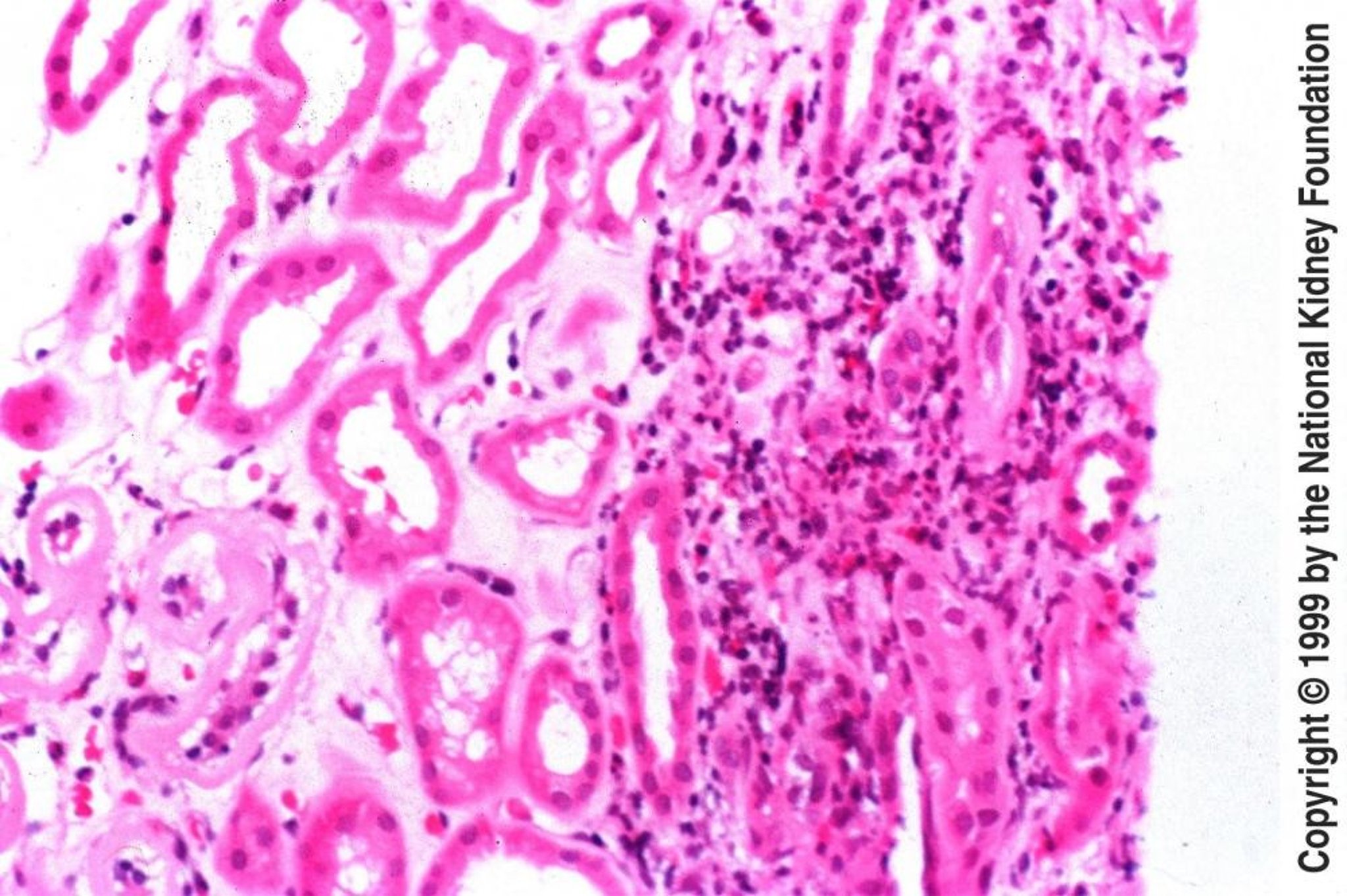
Renal biopsy is not often performed for diagnostic purposes but has helped characterize the nature and progression of tubulointerstitial disease. In ATIN, glomeruli usually are normal. The earliest finding is interstitial edema, typically followed by interstitial infiltration with lymphocytes, plasma cells, eosinophils, and a few PMNs. In severe cases, inflammatory cells can be seen invading the space between the cells lining the tubular basement membrane (tubulitis); in other specimens, granulomatous reactions secondary to methicillin, sulfonamides, mycobacteria, and fungus may be seen. The presence of noncaseating granulomas suggests sarcoidosis. Immunofluorescence or electron microscopy seldom reveals any pathognomonic changes.
In CTIN, glomeruli vary from normal to completely destroyed. Tubules may be absent or atrophied. Tubular lumina vary in diameter but may show marked dilation, with homogeneous casts. The interstitium contains varying degrees of inflammatory cells and fibrosis. Nonscarred areas appear almost normal. Grossly, the kidneys are small and atrophic.
Prognosis
In drug-induced ATIN, renal function usually recovers within 6 to 8 wk when the offending drug is withdrawn, although some residual scarring is common. Recovery may be incomplete, with persistent azotemia above baseline. When other factors cause ATIN, histologic changes usually are reversible if the cause is recognized and removed; however, some severe cases progress to fibrosis and renal failure. Regardless of cause, diffuse rather than patchy interstitial infiltrates, delayed response to prednisone , and persistent acute renal failure (> 3 wk) suggest irreversible injury.
In CTIN, prognosis depends on the cause and on the ability to recognize and stop the process before irreversible fibrosis occurs. Many genetic (cystic kidney disease), metabolic (cystinosis), and toxic (heavy metal) causes may not be modifiable, in which case CTIN usually evolves to end-stage renal disease.
Treatment
Treatment of both ATIN and CTIN is management of the underlying causes. For immunologically induced disease in ATIN and perhaps CTIN, corticosteroids (eg, prednisone 1 mg/kg po once/day for 3 days and decreased over the next 7 to 10 days) may accelerate recovery. Also in patients with CTIN and progressive renal insufficiency, ACE inhibitors or angiotensin receptor blockers may slow disease progression.
Analgesic
Abuse Nephropathy
Analgesic
abuse nephropathy (AAN) is CTIN caused by cumulative lifetime use
of large amounts (eg, ≥ 2
kg) of certain analgesics.
AAN was originally described in conjunction with overuse of combination analgesics containing phenacetin (typically with aspirin , acetaminophen , codeine , or caffeine). However, despite removal of phenacetin from the market, AAN continued to occur. Studies to identify the causal agent are equivocal, but acetaminophen , aspirin , and other NSAIDs have been implicated. Mechanism is unclear. Whether COX-2 inhibitors cause AAN is not known, but these drugs probably can cause ATIN and nephrotic syndrome due to minimal change disease or membranous nephropathy.
AAN predominates in women (peak incidence, 50 to 55 yr) and, in the US, is responsible for 3 to 5% of cases of end-stage renal disease (13 to 20% in Australia and South Africa).
Patients present with renal insufficiency, a bland urinary sediment, and non-nephrotic proteinuria. Hypertension and impaired urinary concentration are common. Flank pain and hematuria are signs of papillary necrosis that occur late in the course of disease. Chronic complaints of musculoskeletal pain, headache, malaise, and dyspepsia may be precipitants of long-term analgesic use rather than effects of AAN.
Diagnosis is based on history and noncontrast CT. CT signs of AAN are decreased renal size; “bumpy” contours, defined as at least 3 indentations in the normally convex outline of the kidney; and papillary calcifications, which have a sensitivity of 92% and a specificity of 100% for early diagnosis.
Renal function stabilizes when analgesics are stopped unless renal insufficiency is advanced, in which case it may progress to renal failure. Patients with AAN are at greater risk of transitional cell carcinomas of the urinary tract.
Metabolic
Nephropathies
Acute urate
nephropathy:
This is not a true form of ATIN but rather an intraluminal obstructive uropathy caused by uric acid crystal deposition within the lumen of renal tubules; acute oliguric or anuric renal failure results. It most commonly occurs from tumor lysis syndrome (see Principles of Cancer Therapy: Tumor Lysis Syndrome) after treatment of lymphoma, leukemia, or other myeloproliferative diseases, but it also occurs after seizures or treatment of solid tumors and with rare primary disorders of urate overproduction (hypoxanthine-guanine phosphoribosyltransferase deficiency) or overexcretion due to decreased proximal tubule reabsorption (Fanconi-like syndromes).
Diagnosis is suspected when acute renal failure (ARF) occurs with marked hyperuricemia (> 15 mg/dL). Typically, no symptoms are present. Urinalysis may be normal or may show urate crystals.
Prognosis for complete recovery of renal function is excellent if treatment is initiated rapidly. Treatment is supportive and may include hemodialysis to remove excess circulating urate in severe cases where diuresis cannot be induced with a loop diuretic and IV saline.
Prevention is by alkalinization of the urine to pH > 6.5 and use of allopurinol 300 mg bid to tid plus saline loading to maintain a urine output > 2.5 L/day before chemotherapy or radiation therapy. Urate oxidase ( rasburicase ), which catalyzes urate to a much more soluble compound, is also preventative but is not widely used because it must be given IV and can cause anaphylaxis, hemolysis, and other adverse effects.
Chronic
urate nephropathy:
This condition is CTIN caused by deposition of Na urate crystals in the medullary interstitium in the setting of chronic hyperuricemia. Sequelae are chronic inflammation and fibrosis, with ensuing chronic renal insufficiency and renal failure. Chronic urate nephropathy was once common in patients with tophaceous gout but is now rare because of treatment. A bland urine sediment and hyperuricemia disproportionate to the degree of renal insufficiency (eg, urate > 9 mg/dL with serum creatinine < 1.5 mg/dL, or > 10 mg/dL with serum creatinine 1.5 to 2 mg/dL, and > 12 mg/dL with more advanced renal failure) are suggestive but nonspecific; many causes of tubulointerstitial diseases may have these findings, lead nephropathy being the most common (see below). Treatment is that of hyperuricosuria (see Crystal-Induced Arthritides: Lowering the serum urate level).
Hyperoxaluria:
Hyperoxaluria is a cause of both acute and chronic tubulointerstitial nephritis. ATIN and ARF may develop in susceptible patients who ingest high-oxalate foods (eg, tea, chocolate, spinach, rhubarb, star fruit) or who are exposed to exogenous substances that are metabolized into oxalate (eg, ethylene glycol ingestion, methoxyflurane anesthesia, large doses of ascorbic acid). CTIN and progressive chronic renal failure develop in patients with inherited disorders of excessive oxalate production (types I and II primary hyperoxaluria) or acquired GI diseases (eg, short bowel syndrome with increased gut absorption). Oxalate is highly insoluble when combined with Ca, and urinary excretion of greater than normal amounts leads to Ca oxalate precipitation and subsequent nephrolithiasis, ARF, or tubulointerstitial damage. Symptoms and signs differ by form of disease and include hematuria and renal colic from oxalate calculi, UTI and pyuria, hypertension, and renal tubular acidosis.
Treatment involves correcting the underlying cause if possible. High-oxalate foods should be avoided, and fluid intake should be increased to increase urinary volume. Other interventions may include Ca carbonate (1 g po once/day to qid) to bind gut oxalate; pyridoxine supplements (3 to 3.5 mg/kg po once/day) to promote conversion of glyoxalate to glycine rather than to oxalate; neutral phosphate (orthophosphate—10 to 13 mg/kg tid) to increase the urinary excretion of pyrophosphate, an inhibitor of Ca precipitation (the extra oral phosphate can also modestly reduce urinary Ca excretion by binding dietary Ca in the intestinal lumen); K citrate (10 to 20 mEq tid with meals) to increase urinary Ca oxalate solubility; or thiazide diuretics to reduce urinary Ca excretion. Treatment when end-stage renal disease occurs due to an inherited disorder is combined liver and kidney transplantation.
Hypercalcemia:
Hypercalcemia (see Fluid and Electrolyte Metabolism: Hypercalcemia) causes nephropathy by 2 mechanisms. Severe (> 12 mg/dL) temporary hypercalcemia may cause reversible renal insufficiency by renal vasoconstriction and natriuresis-induced volume depletion. Long-standing hypercalcemia and hypercalciuria lead to CTIN with calcification and necrosis of tubular cells, interstitial fibrosis, and calcification (nephrocalcinosis). Diagnosis is based on presence of hypercalcemia and unexplained renal insufficiency; nephrocalcinosis can be detected by ultrasonography or noncontrast CT. Treatment is management of hypercalcemia. Nephrolithiasis, renal tubular acidosis, and nephrogenic diabetes insipidus are common associated findings.
Chronic
hypokalemia:
Chronic hypokalemia of a moderate to severe degree may produce nephropathy with impaired urinary concentration and vacuolation of proximal tubular cells and occasionally of distal tubular cells. Chronic interstitial inflammatory changes, fibrosis, and renal cysts have been found in renal biopsies of patients with hypokalemia of ≥ 1 mo. Treatment consists of correction of underlying causes and oral K supplements. Although the hypokalemia as well as the number and size of the cysts is reversible, the CTIN and renal insufficiency may be irreversible.
Heavy
Metal Nephropathy
Lead:
CTIN results as lead accumulates in proximal tubular cells. Short-term lead exposure causes proximal tubular dysfunction, including decreased urate secretion and hyperuricemia (the substrate for saturnine gout), aminoaciduria, and renal glucosuria. Chronic lead exposure (5 to 30 yr) causes progressive tubular atrophy, interstitial fibrosis, hypertension, and gout. Chronic low-level exposure may cause renal insufficiency and hypertension independent of tubulointerstitial disease. Children exposed to lead paint dust or chips, welders, battery workers, and drinkers of moonshine alcohol are most at risk. Diagnosis is usually made by whole blood lead levels. Alternatively, x-ray fluorescence may be used to detect increased bone lead concentrations, which reflect high cumulative lead exposure. Treatment with chelation therapy (see Poisoning: Treatment) can stabilize renal function, but recovery may be incomplete.
Cadmium:
Cadmium from contaminated water, food, and tobacco and from workplace exposures can cause nephropathy. Early manifestations are those of tubular dysfunction, including low mol wt tubular proteinuria (eg, β2-microglobulin), aminoaciduria, and renal glucosuria. Symptoms and signs, when they occur, are attributable to chronic renal insufficiency and failure. Renal disease follows a dose-response curve. Diagnosis is suggested by a history of occupational exposure, increased levels of urinary β2-microglobulin, and increased urinary cadmium levels (> 7 μg/g creatinine). Treatment is elimination of cadmium exposure; chelation with Na calcium edetate (EDTA) may increase cadmium nephrotoxicity. Tubular proteinuria usually is irreversible.
Other
heavy metals:
Those that are nephrotoxic include copper, gold, uranium, arsenic, iron, mercury, bismuth, and chromium. All cause tubular damage and dysfunction (eg, tubular proteinuria, aminoaciduria) as well as tubular necrosis, but glomerulopathies may predominate with some compounds (mercury, gold). Treatment involves removal of the patient from further exposure and chelating agents (copper, arsenic, bismuth) or dialysis (chromium, arsenic, bismuth).
Reflux
Nephropathy
Reflux
nephropathy is renal scarring induced by vesicoureteral reflux of
infected urine into the renal parenchyma.
Chronic pyelonephritis also may play a role, but UTI without intrarenal reflux is unlikely to cause nephropathy. Vesicoureteral reflux (VUR) affects about 1% of newborns and 30 to 45% of young children with a UTI (see Infections in Infants and Children: Urinary Tract Infection (UTI)); it is present in almost all children with renal scars and, for unknown reasons, is less common in black children. Children with gross reflux (up to the renal pelvis plus ureteral dilatation) are at highest risk of scarring.
Reflux requires incompetent ureterovesical valves or mechanical obstruction in the lower urinary tract.Young children with concave papillary tips are most susceptible because the papillary collecting duct orifices are normally wide open at the upper and lower poles; normal growth usually results in spontaneous cessation of intrarenal and vesicoureteral reflux by age 5. New scars in children > 5 yr are unusual but may occur after acute pyelonephritis.
Few symptoms and signs are present in young children, and the diagnosis is often overlooked until adolescence, when patients present with proteinuria, hypertension, and/or renal insufficiency.
Diagnosis
Diagnosis and staging of reflux is made by a voiding cystourethrogram (VCUG), which can demonstrate the degree of ureteral dilatation; radionuclide cystography can be used to diagnose but not to stage the condition. Renal scarring is diagnosed with 99m-technetium dimercaptosuccinic acid (DMSA) radionuclide scanning or with IVU, which is less sensitive. In older children in whom reflux is no longer active, a VCUG may not show reflux, although the DMSA scan shows scarring; cystoscopy can demonstrate evidence of previous reflux at ureteral orifices. Renal biopsy at this late stage shows CTIN and focal glomerulosclerosis, the cause of mild (1 to 1.5 g/day) to nephrotic range proteinuria.
Treatment
Many children require no treatment. Children with low-grade reflux are usually given antibiotics because they are at low risk of developing severe renal disease. However, drug therapy is associated with a higher incidence of new episodes of acute pyelonephritis; incidence of new renal scars is similar in surgical and drug treatment groups. Patients with severe reflux can be given antibiotic prophylaxis or undergo surgical interventions, including ureteral reimplantation or endoscopic injection of materials behind the ureter to prevent reflux (bladder contraction during voiding compresses the ureter between the bladder and the material).
Reflux spontaneously resolves in about 80% of young children within 5 yr. Persistent VUR may cause slowly progressive renal failure.
Myeloma-Related
Kidney Disease
Patients
with multiple myeloma overproduce monoclonal Ig light chains (Bence
Jones proteins); these light chains are filtered by glomeruli, are
nephrotoxic, and can damage virtually all areas of the kidney parenchyma.
The mechanisms of nephrotoxicity are unknown. Tubulointerstitial and glomerular damage are most common.
Tubulointerstitial
disease:
Light chains saturate the reabsorptive capacity of the proximal tubule, reach the distal nephron, and combine with filtered proteins and Tamm-Horsfall mucoprotein (secreted by the thick ascending limb cells) to form obstructive casts. The term myeloma kidney generally refers to renal insufficiency caused by the tubulointerstitial damage that results. Factors that predispose to cast formation include low urine flow, elevation of luminal NaCl concentration (eg, due to a loop diuretic), radiocontrast agents, and increased intratubular Ca from the hypercalcemia frequently occurring from bone lysis in multiple myeloma.
Other types of tubulointerstitial lesions associated with Bence Jones proteinuria include proximal tubular transport dysfunction producing Fanconi syndrome and light chain interstitial deposition with inflammatory infiltrates and active tubular damage.
Glomerulopathies:
Myeloma glomerulopathy has 2 common mechanisms: AL amyloidosis (see also Amyloidosis: Primary amyloidosis (AL)) and glomerular light chain deposition. AL amyloidosis results in mesangial and/or subepithelial glomerular deposition of AL amyloid, randomly oriented, nonbranching fibrils composed of the variable regions of λ light chains. Light chain deposition disease (LCDD), which also can occur with lymphoma and Waldenström's macroglobulinemia, is glomerular deposition of nonpolymerized light chains, generally the constant regions of κ chains.
Less commonly, a nonproliferative, noninflammatory glomerulopathy that causes nephrotic range proteinuria can develop in advanced myeloma-related renal disease, and a proliferative glomerulonephritis occasionally develops as an early form of LCDD with progression to membranoproliferative glomerulonephritis and nodular glomerulopathy reminiscent of diabetic nephropathy.
Symptoms,
Signs, and Diagnosis
Symptoms and signs are predominantly those of the myeloma (skeletal pain, pathologic fractures, diffuse osteoporosis) and a normochromic-normocytic anemia.
Diagnosis of myeloma-related kidney disease is suggested by findings of renal insufficiency, usually accompanied by bland urine sediment and a negative or trace-positive dipstick for protein (unless urine albumin is elevated in a patient with an accompanying nephrotic syndrome). Diagnosis of light chain tubulointerstitial disease is confirmed by a markedly positive urine sulfosalicylic acid test suggesting significant nonalbumin proteins and/or urine protein electrophoresis (UPEP). Diagnosis of glomerulopathy is confirmed by renal biopsy. Renal biopsy may demonstrate light chain deposition in 30 to 50% of patients despite the absence of detectable serum or urine paraproteins by immunoelectrophoresis.
Prognosis
and Treatment
Prognosis is good for patients with tubulointerstitial and glomerular LCDD who receive treatment. Prognosis is worse for patients with AL amyloidosis, in whom amyloid deposition continues and progresses to renal failure in most cases. In either form without treatment, virtually all renal lesions progress to renal failure.
Treatment is management of multiple myeloma (see Plasma Cell Disorders: Treatment) combined with prevention of volume depletion and maintenance of a high urine flow rate. Alkalinization of the urine helps change the net charge of the light chain and reduces charge interaction with Tamm-Horsfall mucoprotein, making the light chains more soluble. Colchicine decreases Tamm-Horsfall mucoprotein secretion into the lumen and decreases the interaction with light chains, thus decreasing toxicity. Avoidance of loop diuretics prevents volume depletion and high distal Na concentrations that can worsen myeloma-related kidney disease.
Last full review/revision November 2005
Content last modified November 2005
|