





Reye syndrome is a rare form of acute encephalopathy and fatty infiltration of the liver that occurs almost exclusively in children < 18 years old. It tends to occur after certain viral infections, especially varicella or influenza A or B, and particularly when salicylates are used. Diagnosis is clinical. Treatment is supportive.
The cause of Reye syndrome is unknown, but many cases seem to follow infection with influenza A or B or varicella. Using salicylates (generally aspirin) during such illness increases the risk by as much as 20-fold (1). This finding has led to a marked decrease in salicylate use in the United States in children and adolescents since the mid-1980s (except when specifically indicated, such as in Kawasaki disease) and a corresponding decrease in the incidence of Reye syndrome from several hundred annual cases to about 2 (2).
The syndrome occurs almost exclusively in children < 18 years. In the United States, most cases occur in late fall and winter.
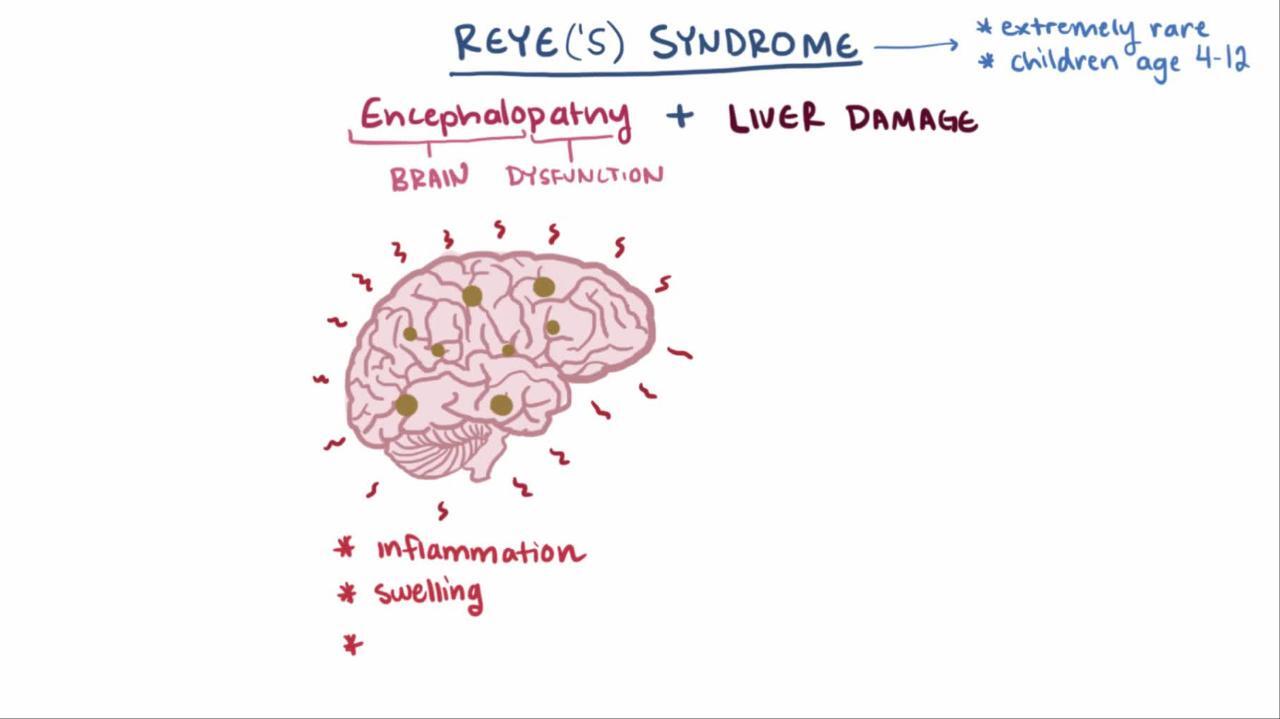
The disease affects mitochondrial function, causing disturbance in fatty acid and carnitine metabolism. Pathophysiology and clinical manifestations are similar to a number of inherited metabolic disorders of fatty acid transport and mitochondrial oxidation (see Introduction to Inherited Disorders of Metabolism).
References
1. Forsyth BW, Horwitz RI, Acampora D, et al: New epidemiologic evidence confirming that bias does not explain the aspirin/Reye’s syndrome association. JAMA 261:2517–2524, 1989.
2. Belay ED, Bresee JS, Holman RC, et al: Reye's syndrome in the United States from 1981 through 1997. N Engl J Med 340(18):1377–1382, 1993. doi: 10.1056/NEJM199905063401801
Symptoms and Signs of Reye Syndrome
The disease varies greatly in severity but is characteristically biphasic.
Initial viral symptoms (upper respiratory infection or sometimes chickenpox) are followed in 5 to 7 days by pernicious nausea and vomiting and a sudden change in mental status. The changes in mental status may vary from a mild amnesia, weakness, vision and hearing changes, and lethargy to intermittent episodes of disorientation and agitation, which can progress rapidly to deepening stages of coma manifested by
Progressive unresponsiveness
Decorticate and decerebrate posturing
Seizures
Flaccidity
Fixed dilated pupils
Respiratory arrest
Focal neurologic findings usually are not present.
Hepatomegaly occurs in about 40% of cases, but jaundice is absent.
Complications of Reye syndrome
Complications include
Increased intracranial pressure
Hypotension
Bleeding diatheses (especially gastrointestinal)
Respiratory insufficiency
Hyperammonemia
Poor temperature regulation
Uncal herniation and death
Diagnosis of Reye Syndrome
History and physical examination consistent with encephalopathy and hepatic dysfunction
Blood tests for liver function, electrolytes, and ammonia level
Head CT or MRI, sometimes cerebral spinal fluid evaluation
Liver biopsy
Reye syndrome should be suspected in any child exhibiting the acute onset of an encephalopathy (without known heavy metal or toxin exposure) and pernicious vomiting associated with hepatic dysfunction.
Liver biopsy provides the definitive diagnosis, showing microvesicular, fatty changes, and is especially useful in sporadic cases and in children < 2 years.
The diagnosis may also be made when the typical clinical findings and history are associated with the following laboratory findings: increased liver transaminases (aspartate aminotransferase, alanine aminotransferase > 3 times normal), normal bilirubin, increased blood ammonia level, and prolonged prothrombin time.
Head CT or MRI is done as for any child with encephalopathy.
If head CT or MRI is normal, a lumbar puncture can be done. Cerebrospinal fluid (CSF) examination usually shows increased pressure, < 8 to 10 white blood cells/mcL, and normal protein levels; the CSF glutamine level may be elevated. Hypoglycemia and hypoglycorrhachia (a very low concentration of CSF glucose) occur in 15% of cases, especially in children < 4 years; they should be screened for metabolic disease.
Signs of metabolic derangement include elevated serum amino acid levels, acid-base disturbances (usually with hyperventilation, mixed respiratory alkalosis–metabolic acidosis), osmolar changes, hypernatremia, hypokalemia, and hypophosphatemia.
The condition is staged from I to V according to severity of symptoms (1).
Differential diagnosis
The differential diagnosis of coma and liver dysfunction includes
Sepsis or hyperthermia (especially in infants)
Potentially treatable (eg, ornithine transcarbamylase deficiency) or fatty acid oxidation (eg, systemic carnitine deficiency, medium chain acyl-CoA dehydrogenase deficiency)
Acute encephalopathy caused by salicylism, other drugs (eg, valproate), or poisons; viral encephalitis or meningoencephalitis
Diagnosis reference
1. Kliegman R, St. Geme J: Nelson Textbook of Pediatrics, ed. 21. Philadelphia, Elsevier, 2020.
Treatment of Reye Syndrome
Support measures, including measures to lower increased intracranial pressure
Usually treatment of coagulopathy
Treatment of Reye syndrome is supportive, with particular attention paid to control of increased intracranial pressure and blood glucose because glycogen depletion is common.
Treatment of elevated increased intracranial pressure includes intubation, hyperventilation, fluid restriction of 1500 mL/m2/day, elevating the head of the bed, osmotic diuretics, direct increased intracranial pressure monitoring, and decompressing craniotomy.
Coagulopathy may require fresh frozen plasma or vitamin K.
Other treatments (eg, exchange transfusion, hemodialysis, barbiturate-induced deep coma) have not been proved effective but are sometimes used.
Prognosis for Reye Syndrome
Outcome is related to the duration of cerebral dysfunction, severity and rate of progression of coma, severity of increased intracranial pressure, and degree of blood ammonia elevation. Progression from stage I to higher stages is likely when the initial blood ammonia level is > 100 mcg/dL (> 60 mcmol/L) and the prothrombin time is ≥ 3 seconds longer than that of the control.
In fatal cases, the mean time from hospitalization to death is 4 days. Fatality rates average 21% but range from < 2% among patients in stage I to > 80% among patients in stage IV or V.
Prognosis for survivors usually is good, and recurrences are rare. However, the incidence of neurologic sequelae (eg, intellectual disability, seizure disorders, cranial nerve palsies, motor dysfunction) is as high as 30% among survivors who developed seizures or decerebrate posturing during illness.
Key Points
Reye syndrome is a rare form of acute encephalopathy and hepatic dysfunction that occurs almost exclusively in children < 18 years old, typically occurring after viral infection, especially varicella or influenza A or B (particularly with salicylate use).
Diagnosis is by exclusion of similarly manifesting infectious, toxic, and metabolic disorders; liver biopsy may help confirm it.
Treatment is supportive, particularly with measures to lower increased intracranial pressure.


