|
Rare anomalies include scrotal agenesis, hypoplasia, ectopia, or hemangioma; penoscrotal transposition; and bifid scrotum. More commonly, boys are born with congenital hydrocele or undescended testes (cryptorchidism). For testicular torsion, see Penile and Scrotal Disorders: Testicular Torsion.
Congenital
hydrocele:
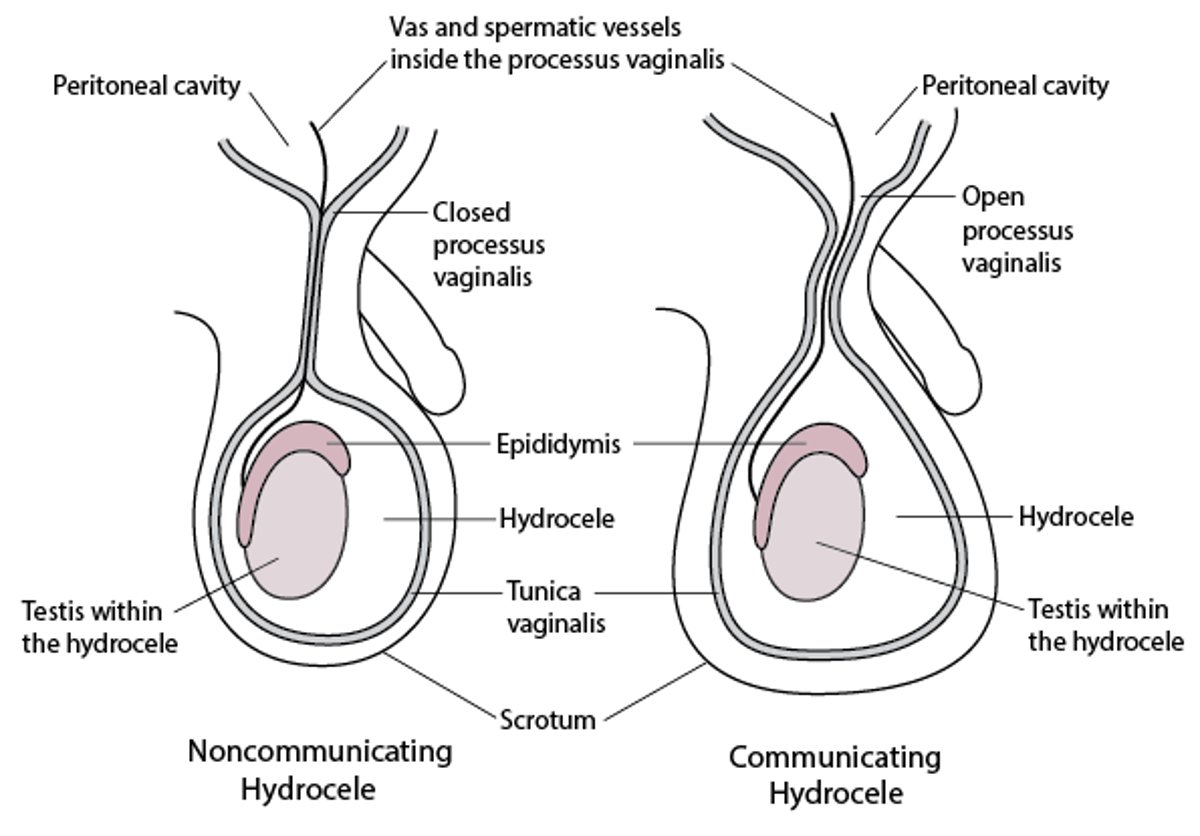
A congenital hydrocele is a collection of fluid in the scrotum. It may be isolated or may communicate with the abdominal cavity through a patent processus vaginalis, a potential hernia space. Hydrocele manifests as a painless, enlarged scrotum. The condition may resolve spontaneously but usually requires repair if it persists after 6 to 9 mo or if it enlarges.
Cryptorchidism:
Failure of 1 or both testes to descend into the scrotum affects about 3% of term infants and up to 30% of preterm infants; 2⁄3 of undescended testes will spontaneously descend within the 1st 4 mo of life. Normally, the testes develop at 7 to 8 wk gestation and remain cephalad to the internal inguinal ring until about 28 wk, when they begin their descent into the scrotum guided by condensed mesenchyma (the gubernaculum). Onset of descent is mediated by hormonal (eg, androgens, müllerian-inhibiting factor), physical (eg, gubernacular regression, intra-abdominal pressure), and environmental (eg, maternal exposure to estrogenic or antiandrogenic substances) factors, but undescended testes are almost always idiopathic. About 10% of cases are bilateral; suspicion should be high for female virilization from congenital adrenal hyperplasia in phenotypic boys with bilateral, nonpalpable, undescended testes at birth (especially if associated with hypospadias).
Undescended testes may cause subfertility and are associated with testicular carcinoma, mainly in the undescended testis and particularly with intra-abdominal malposition. However, in patients with one undescended testis, 10% of cancers develop on the normal side. In untreated cases of intra-abdominal testes, testicular torsion may occur, manifesting as an acute abdomen. Almost all who present with an undescended testis at birth also have an inguinal hernia (patent processus).
In about 80% of cases, the scrotum is empty at birth; in the remainder of cases, a testis is palpable in the scrotum at birth but appears to ascend with linear growth because of an ectopic gubernacular attachment that restrains it from following the normal “descent” of the scrotum. A true undescended testis remains in the inguinal canal along the path of descent or is less commonly present in the abdominal cavity or retroperitoneum. An ectopic testis lies outside the normal course of descent (eg, suprapubically, in the superficial inguinal pouch, within the perineum, or along the inner aspect of the thigh). Undescended and ectopic testes must be distinguished from hypermobile (retractile) testes, which are pres-ent in the scrotum but easily retract into the inguinal canal.
Diagnosis is by physical examination; a warm environment, warm examiner's hands, and a relaxed patient are important to avoid stimulating testicular retraction. In those with a unilateral nonpalpable testis, a descended testis that is larger than expected suggests an atrophic undescended testis; confirmation requires abdominal laparoscopy. For bilateral nonpalpable testes, a human chorionic gonadotropin (hCG) stimulation test is done. Patients receive injections of hCG 2000 IU IM once/day for 3 to 4 days; blood levels of testosterone , luteinizing hormone (LH), and follicle-stimulating hormone (FSH) are obtained before and testosterone levels within 24 h of the final injection. Those with bilateral cryptorchidism should respond by producing testosterone , whereas those without testes (including genotypic females) produce none. In addition, basal levels of FSH and possibly LH are elevated.
In 2⁄3 of boys, the testis spontaneously descends by 3 to 4 mo, resulting in prevalence of about 0.8% requiring treatment.
For a palpable undescended testis, treatment is surgical orchiopexy, in which the testis is brought into the scrotum and sutured into place; the associated inguinal hernia also is repaired. For nonpalpable undescended testis, abdominal laparoscopy is done; if the testis is located, it is surgically fixed in place, or if it is atrophic, the tissue is removed. Surgery should be done at about 6 mo of age because early intervention improves fertility potential and may reduce cancer risk. Atrophic undescended testes are likely the result of prenatal testicular torsion.
hCG 250 to 1000 IU IM 2 or 3 times/wk for up to 6 wk may stimulate local testosterone production and precipitate testicular descent, either complete or enough to make the testis palpable, increase its blood supply, or both, making surgery easier.
No intervention is needed for a retractile testis as long as the spermatic cord length is sufficient to allow the testis to rest in a dependent scrotal position without traction when the cremasteric reflex is not stimulated. Hypermobility usually resolves without treatment by puberty when increased testicular size makes retraction more difficult.
Last full review/revision November 2005
Content last modified November 2005
|  |