





Attention-deficit/hyperactivity disorder (ADHD) is a syndrome of inattention, hyperactivity, and impulsivity. The 3 types of ADHD are predominantly inattentive, predominantly hyperactive/impulsive, and combined. Diagnosis is made by clinical criteria. Treatment usually includes drug therapy with stimulant drugs, behavioral therapy, and educational interventions.
Attention-deficit/hyperactivity disorder (ADHD) is considered a neurodevelopmental disorder. Neurodevelopmental disorders are neurologically based conditions that appear early in childhood, typically before school entry, and impair development of personal, social, academic, and/or occupational functioning. They typically involve difficulties with the acquisition, retention, or application of specific skills or sets of information. Neurodevelopmental disorders may involve dysfunction in one or more of the following: attention, memory, perception, language, problem-solving, or social interaction. Other common neurodevelopmental disorders include autism spectrum disorders, learning disorders (eg, dyslexia), and intellectual disability.
Some experts previously considered ADHD a behavior disorder, probably because children typically exhibit inattentive, impulsive, and overly active behavior, and because comorbid behavior disorders, particularly oppositional-defiant disorder and conduct disorder, are common. However, ADHD has well-established neurologic underpinnings and is not simply "misbehavior."
ADHD affects an estimated 5 to 15% of children (1). However, many experts think ADHD is overdiagnosed, largely because criteria are applied inaccurately. According to the Diagnostic and Statistical Manual of Mental Disorders, Fifth Edition (DSM-5), there are 3 types:
Predominantly inattentive
Predominantly hyperactive/impulsive
Combined
Overall, ADHD is about twice as common in boys, although the ratios vary by type. The predominantly hyperactive/impulsive type occurs 2 to 9 times more frequently in boys; the predominantly inattentive type occurs with about equal frequency in both sexes. ADHD tends to run in families.
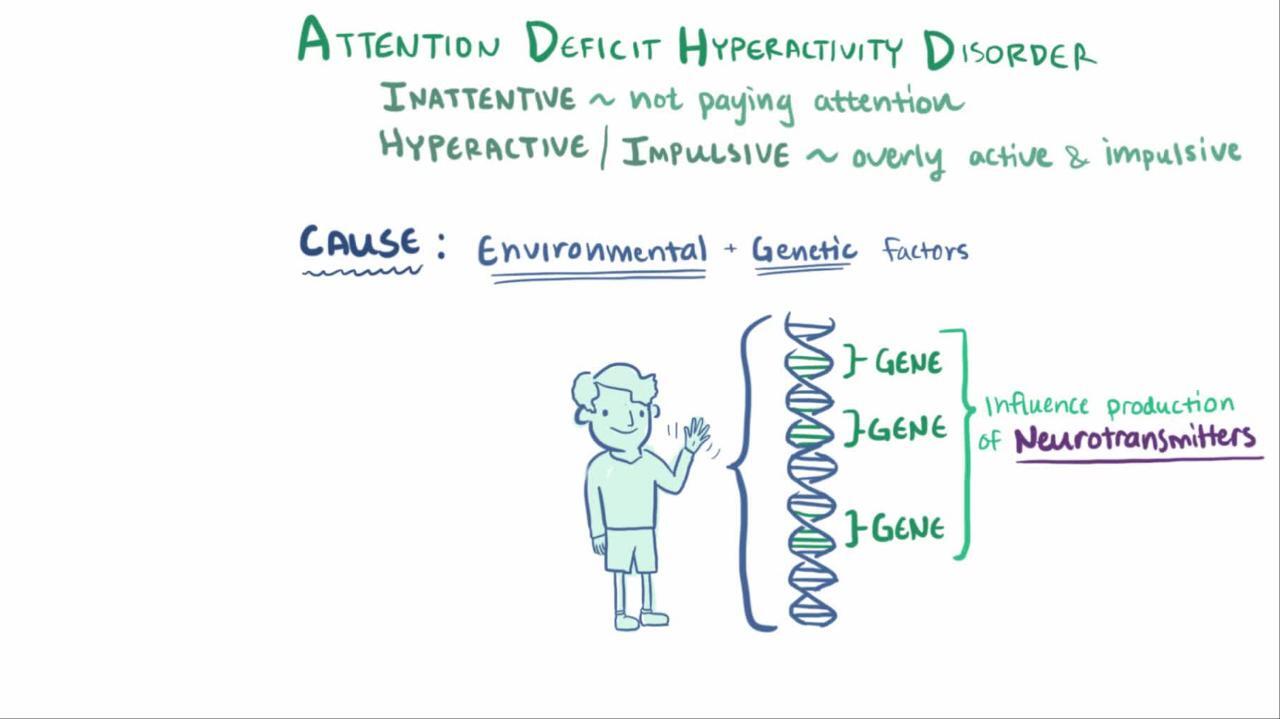
ADHD has no known single, specific cause. Potential causes of ADHD include genetic, biochemical, sensorimotor, physiologic, and behavioral factors. Some risk factors include birth weight < 1500 g, head trauma, iron deficiency, obstructive sleep apnea, and lead exposure, as well as . ADHD also is associated with adverse childhood experiences (ACEs; 2). Fewer than 5% of children with ADHD have evidence of neurologic injury. Increasing evidence implicates differences in dopaminergic and noradrenergic systems with decreased activity or stimulation in upper brain stem and frontal-midbrain tracts.
General references
1. Boznovik K, McLamb F, O'Connell K, et al: U.S. national, regional, and state‑specific socioeconomic factors correlate with child and adolescent ADHD diagnoses. Sci Rep 11:22008, 2021. doi: 10.1038/s41598-021-01233-2
2. Brown N, Brown S, Briggs R, et al: Associations between adverse childhood experiences and ADHD diagnosis and severity. Acad Pediatr 17(4):349–355, 2017. doi: 10.1016/j.acap.2016.08.013
ADHD in adults
Although ADHD is considered a disorder of children and always starts during childhood, the underlying neurophysiologic differences persist into adult life, and behavioral symptoms continue to be evident in adulthood in about half of cases. Although the diagnosis occasionally may not be recognized until adolescence or adulthood, some manifestations should have been present before age 12.
In adults, symptoms include
Difficulty concentrating
Difficulty completing tasks (executive function impairments)
Mood swings
Impatience
Difficulty in maintaining relationships
Hyperactivity in adults usually manifests as restlessness and fidgetiness rather than the overt motor hyperactivity that occurs in young children. Adults with ADHD tend to be at higher risk of unemployment, reduced educational achievement, and increased rates of substance abuse and criminality. Motor vehicle crashes and violations are more common.
ADHD can be more difficult to diagnose during adulthood. Symptoms may be similar to those of mood disorders, anxiety disorders, and substance use disorders. Because self-reporting of childhood symptoms may be unreliable, clinicians may need to review school records or interview family members to confirm existence of manifestations before age 12.
Adults with ADHD may benefit from the same types of stimulant drugs that children with ADHD take. They may also benefit from counseling to improve time management and other coping skills.
Symptoms and Signs of ADHD
Onset often occurs before age 4 and invariably before age 12. The peak age for diagnosis is between ages 8 and 10; however, patients with the predominantly inattentive type may not be diagnosed until after adolescence.
Core symptoms and signs of ADHD involve
Inattention
Impulsivity
Hyperactivity
Inattention tends to appear when a child is involved in tasks that require vigilance, rapid reaction time, visual and perceptual search, and systematic and sustained listening.
Impulsivity refers to hasty actions that have the potential for a negative outcome (eg, in children, running across a street without looking; in adolescents and adults, suddenly quitting school or a job without thought for the consequences).
Hyperactivity involves excessive motor activity. Children, particularly younger ones, may have trouble sitting quietly when expected to (eg, in school or church). Older patients may simply be fidgety, restless, or talkative—sometimes to the extent that others feel worn out watching them.
Inattention and impulsivity impede development of academic skills and thinking and reasoning strategies, motivation for school, and adjustment to social demands. Children who have predominantly inattentive ADHD tend to be hands-on learners who have difficulty in passive learning situations that require continuous performance and task completion.
Overall, about 20 to 60% of children with ADHD have learning disabilities, but some school dysfunction occurs in most children with ADHD due to inattention (resulting in missed details) and impulsivity (resulting in responding without thinking through the question).
Behavioral history can reveal low frustration tolerance, opposition, temper tantrums, aggressiveness, poor social skills and peer relationships, sleep disturbances, anxiety, dysphoria, depression, and mood swings.
Although there are no specific physical examination or laboratory findings associated with ADHD, signs can include
Motor incoordination or clumsiness
Nonlocalized, “soft” neurologic findings
Perceptual-motor dysfunctions
Diagnosis of ADHD
Clinical criteria based on the DSM-5
Diagnosis of ADHD is clinical and is based on comprehensive medical, developmental, educational, and psychologic evaluations (see also the American Academy of Pediatrics' 2019 clinical practice guideline for the diagnosis, evaluation, and treatment of attention-deficit/hyperactivity disorder in children and adolescents).
DSM-5 diagnostic criteria for ADHD
DSM-5 diagnostic criteria include 9 symptoms and signs of inattention and 9 of hyperactivity and impulsivity. Diagnosis using these criteria requires ≥ 6 symptoms and signs from one or each group. Also, the symptoms need to
Be present often for ≥ 6 months
Be more pronounced than expected for the child’s developmental level
Occur in at least 2 situations (eg, home and school)
Be present before age 12 (at least some symptoms)
Interfere with functioning at home, school, or work
Inattention symptoms:
Does not pay attention to details or makes careless mistakes in schoolwork or with other activities
Has difficulty sustaining attention on tasks at school or during play
Does not seem to listen when spoken to directly
Does not follow through on instructions or finish tasks
Has difficulty organizing tasks and activities
Avoids, dislikes, or is reluctant to engage in tasks that require sustained mental effort over a long period of time
Often loses things necessary for school tasks or activities
Is easily distracted
Is forgetful in daily activities
Hyperactivity and impulsivity symptoms:
Often fidgets with hands or feet or squirms
Often leaves seat in classroom or elsewhere
Often runs about or climbs excessively where such activity is inappropriate
Has difficulty playing quietly
Often on the go, acting as if driven by a motor
Often talks excessively
Often blurts out answers before questions are completed
Often has difficulty awaiting turn
Often interrupts or intrudes on others
Diagnosis of the predominantly inattentive type requires ≥ 6 symptoms and signs of inattention. Diagnosis of the hyperactive/impulsive type requires ≥ 6 symptoms and signs of hyperactivity and impulsivity. Diagnosis of the combined type requires ≥ 6 symptoms and signs each of inattention and hyperactivity/impulsivity.
Other diagnostic considerations
Differentiating between ADHD and other conditions can be challenging. Overdiagnosis must be avoided, and other conditions must be accurately identified. Many ADHD signs expressed during the preschool years could also indicate communication problems that can occur in other neurodevelopmental disorders (eg, autism spectrum disorders) or in certain learning disorders, anxiety, depression, or behavioral disorders (eg, conduct disorder).
Clinicians should consider whether the child is distracted by external factors (ie, environmental input) or by internal factors (ie, thoughts, anxieties, worries). However, during later childhood, ADHD signs become more qualitatively distinct; children with the hyperactive/impulsive type or combined type often exhibit continuous movement of the lower extremities, motor impersistence (eg, purposeless movement, fidgeting of hands), impulsive talking, and a seeming lack of awareness of their environment. Children with the predominantly inattentive type may have no physical signs.
Medical assessment is focused on identifying potentially treatable conditions that may contribute to or worsen symptoms and signs. Assessment should include seeking a history of prenatal exposures (eg, drugs, alcohol, tobacco), perinatal complications or infections, central nervous system infections, traumatic brain injury, cardiac disease, sleep-disordered breathing, poor appetite and/or picky eating, and a family history of ADHD.
Developmental assessment is focused on determining the onset and course of symptoms and signs. The assessment includes checking developmental milestones, particularly language milestones, and the use of ADHD-specific rating scales (eg, the Vanderbilt Assessment Scale, the Conners Comprehensive Behavior Rating Scale, the ADHD Rating Scale-V). Versions of these scales are available for both families and school staff, allowing assessment across different situations as required by DSM-5 criteria. Note that scales should not be used alone to make a diagnosis.
Educational assessment is focused on documenting core symptoms and signs; it may involve reviewing educational records and using rating scales or checklists. However, rating scales and checklists alone often cannot distinguish ADHD from other developmental disorders or from behavioral disorders.
Prognosis for ADHD
Although hyperactivity symptoms and signs tend to diminish with age, adolescents and adults may display residual difficulties. Predictors of poor outcomes in adolescence and adulthood include
Coexisting low intelligence
Aggressiveness
Social and interpersonal problems
Parental psychopathology
Problems in adolescence and adulthood manifest predominantly as academic failure, low self-esteem, and difficulty learning appropriate social behavior. Adolescents and adults who have predominantly impulsive ADHD may have an increased incidence of personality trait disorders and antisocial behavior; many continue to display impulsivity, restlessness, and poor social skills. People with ADHD seem to adjust better to work than to academic and home situations, particularly if they can find jobs that do not require intense attention to perform.
Treatment of ADHD
Behavioral therapy
Randomized, controlled studies show behavioral therapy alone is less effective than therapy with stimulant drugs alone for school-aged children, but behavioral or combination therapy is recommended for younger children. Although correction of the underlying neurophysiologic differences of patients with ADHD does not occur with drug therapy, drugs are effective in alleviating ADHD symptoms and they permit participation in activities previously inaccessible because of poor attention and impulsivity. Drugs often interrupt the cycle of inappropriate behavior, enhancing behavioral and academic interventions, motivation, and self-esteem.
Treatment of ADHD in adults follows similar principles, but drug selection and dosing are determined on an individual basis, depending on other medical conditions.
Stimulant drugs
methylphenidate is the active moiety and is available for prescription at one half the dose.
Dosing schedules of stimulant drugs can be adjusted to cover specific days and times (eg, during school hours, while doing homework). Drug holidays may be tried on weekends, on holidays, or during summer vacations. Placebo periods (for 5 to 10 school days to ensure reliability of observations) are recommended to determine whether the drugs are still needed.
Common adverse effects of stimulant drugs include
Sleep disturbances (eg, insomnia)
Headache
Stomachache
Appetite suppression
Elevated heart rate and blood pressure
Depression is a less common adverse effect and may often represent an inability to easily shift focus (overfocusing). This can manifest as a dulled demeanor (sometimes described by families as being zombie-like) rather than actual clinical childhood depression. In fact, stimulant drugs are sometimes used as adjunctive treatment for depression. A dulled demeanor can sometimes be addressed by cutting the stimulant drug dose or trying a different drug.
Studies have shown growth in height slows over 2 years of stimulant drug use, and slowing apparently persists into adulthood with ongoing chronic stimulant drug use.
Nonstimulant drugs
norepinephrine reuptake inhibitor, is also used. The drug is effective, but data are mixed regarding its efficacy compared with stimulant drugs. Some children have nausea, sedation, irritability, and temper tantrums; rarely, liver toxicity and suicidal ideation occur. A typical starting dose is 0.5 mg/kg orally once a day, titrated weekly to 1.2 to 1.4 mg/kg once a day. The long half-life allows once-a-day dosing but requires continuous use to be effective. The maximum recommended daily dosage is 100 mg.
Adverse drug interactions are a concern with ADHD treatment. Drugs that inhibit the metabolic enzyme CYP2D6, including certain selective serotonin reuptake inhibitors (SSRIs) that are sometimes used in patients with ADHD, can increase the effect of stimulant drugs. Review of potential drug interactions (typically using a computerized program) is an important part of pharmacologic management of ADHD patients.
Behavioral management
Counseling, including cognitive-behavioral therapy (eg, goal-setting, self-monitoring, modeling, role-playing), is often effective and helps children understand ADHD and how to cope with it. Structure and routines are essential.
Classroom behavior is often improved by environmental control of noise and visual stimulation, appropriate task length, novelty, coaching, and teacher proximity.
When difficulties persist at home, parents should be encouraged to seek additional professional assistance and training in behavioral management techniques. Adding incentives and token rewards reinforces behavioral management and is often effective. Children with ADHD in whom hyperactivity and poor impulse control predominate are often helped at home when structure, consistent parenting techniques, and well-defined limits are established.
Elimination diets, megavitamin treatments, use of antioxidants or other compounds, and nutritional and biochemical interventions have had the least consistent effects. Biofeedback can be helpful in some cases but is not recommended for routine use because evidence of sustained benefit is lacking.
Key Points
ADHD involves inattention, hyperactivity/impulsivity, or a combination; it typically appears before age 12, including in preschoolers.
Cause is unknown, but there are numerous suspected risk factors.
Diagnose using clinical criteria, and be alert for other disorders that may initially manifest similarly (eg, autism spectrum disorders, certain learning or behavioral disorders, anxiety, depression).
Manifestations tend to diminish with age, but adolescents and adults may have residual difficulties.
Treat with stimulant drugs and cognitive-behavioral therapy; behavioral therapy alone may be appropriate for preschool-aged children.
More Information
The following are English-language resources that may be useful. Please note that THE MANUAL is not responsible for the content of these resources.
American Academy of Pediatrics: Clinical Practice Guideline for the Diagnosis, Evaluation, and Treatment of Attention-Deficit/Hyperactivity Disorder in Children and Adolescents (2019)
National Institute for Children's Health Quality: Vanderbilt Assessment Scale (used for diagnosing ADHD)
Attention Deficit Disorder Association (ADDA): An organization providing resources for adults with ADHD
Children and Adults with Attention-Deficit/Hyperactivity Disorder (CHADD): An organization providing educational, support, and treatment resources for all people with ADHD
Learning Disabilities Association of America (LDA): An organization providing educational, support, and advocacy resources for people with learning disabilities


