





Alcohol (ethanol) is a depressant (it slows down brain and nervous system functioning). Consuming large amounts rapidly or regularly can cause health problems, including organ damage, coma, and death.
Genetics and personal characteristics may play a part in the development of alcohol-related disorders.
Drinking too much alcohol may make people sleepy or aggressive, impair coordination and mental function, and interfere with work, family relations, and other activities.
Drinking too much alcohol for a long time can make people dependent on alcohol and damage the liver, brain, and heart.
Doctors may use questionnaires or determine the blood alcohol level to help identify people with an alcohol-related disorder.
Immediate treatment for overdose may include assistance with breathing, fluids, thiamin and sometimes other vitamins (to correct chronic alcohol-related deficiencies), and, for withdrawal, benzodiazepines.
Detoxification and rehabilitation programs can help people with severe alcohol-related disorders.
(See also Drug Use and Abuse.)
About half of adults in the United States drink alcohol, 20% are former drinkers, and 30 to 35% are lifetime abstainers. Drinking large amounts of alcohol (more than 2 to 6 drinks per day) for extended periods can damage a number of organs, especially the liver, heart, and brain. However, drinking a moderate amount of alcohol may reduce the risk of death from heart and blood vessel (cardiovascular) disorders. Nonetheless, drinking alcohol for this purpose is not recommended, especially when other safer, more effective preventive measures are available.
Alcohol-related disorders
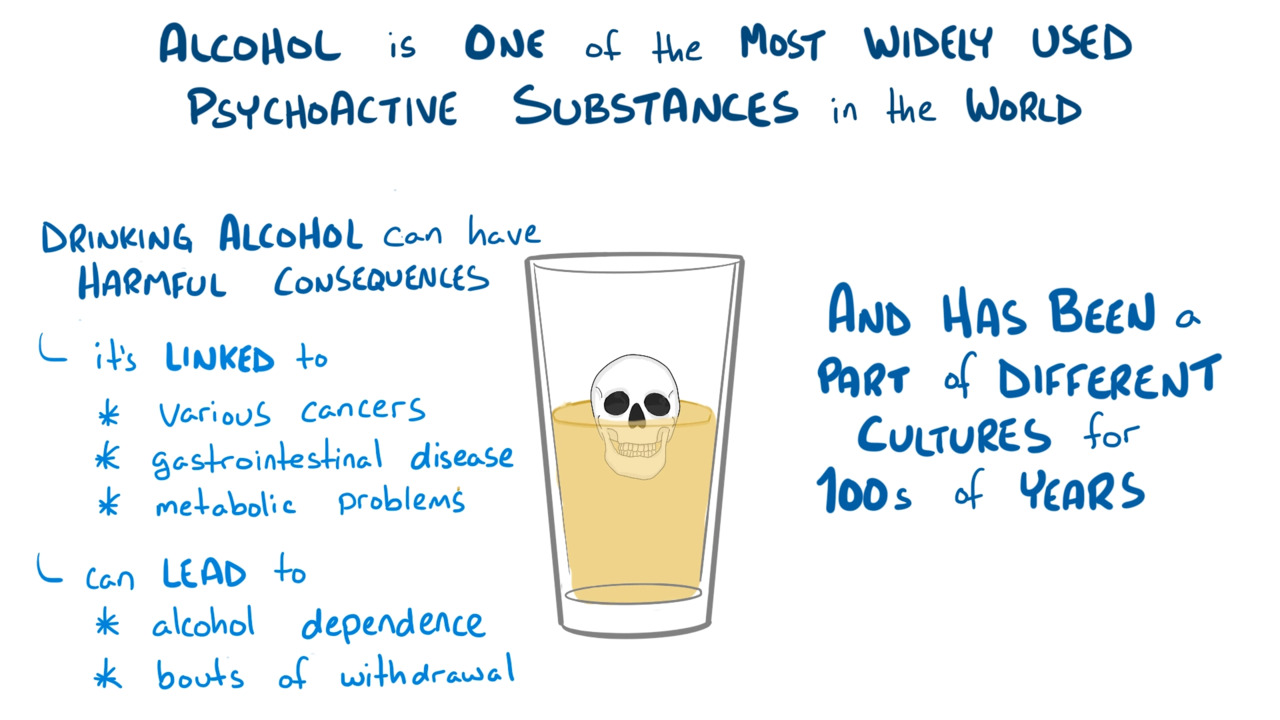
Most people do not consume enough alcohol or consume it often enough to impair their health or interfere with their activities. However, approximately 14% of adults in the United States have a problem with alcohol use (alcohol use disorder, also known as alcoholism). Men are 2 to 4 times more likely than women to develop alcohol use disorder. Alcohol and other substance use disorders involve people continuing to use a substance even though they have problems caused by its use.
Did You Know...
|
Alcohol use can lead to many destructive behaviors and effects:
Drunk driving
Physical injury from falls, fights, or motor vehicle accidents
Violence, including domestic violence
Drunkenness may disrupt family and social relationships. The divorce rate is 50% higher when one spouse is a heavy drinker. Extreme absenteeism from work can lead to unemployment.
Special populations
Very young children who drink alcohol (typically accidentally) are at significant risk of very low blood sugar and coma.
Women may be more sensitive to the effects of alcohol than men, even on a per-weight basis.
Older people may be more sensitive to the effects of alcohol than younger adults.
Women who drink during pregnancy have an increased risk of giving birth to a baby with fetal alcohol syndrome.
Although sensitivity to the effects of alcohol may vary with age, people of all ages are susceptible to alcohol use disorders. Increasingly, drug and substance use and abuse among adolescents has been linked with especially disastrous consequences. Those who start drinking at an early age (particularly the preteen years) are much more likely to become dependent on alcohol as adults.
Causes of Alcohol Use Disorder
Alcohol use disorder involves heredity to some extent. Blood relatives of people with alcohol use disorder are more likely to have alcohol use disorder than people in the general population, and alcohol use disorder is more likely to develop in biologic children of people with alcohol use disorder than in adopted children.
Some research suggests that people at risk of alcohol use disorder are less easily intoxicated than people who are not problem drinkers. That is, their brains are less sensitive to the effects of alcohol. Blood relatives of people with alcohol use disorder may have this trait.
Certain factors and personality traits may predispose people to alcohol use disorder. People with alcohol use disorder tend to feel isolated, lonely, shy, depressed, or hostile. They may act self-destructively. Whether such traits are the cause of alcohol use disorder or the result is not certain.
Symptoms of Alcohol Use Disorder
Alcohol causes three basic types of problems:
Those that occur immediately when people drink too much at a particular time (intoxication and overdose)
Those that occur over a long period of time when people regularly consume excessive amounts
Those that occur when heavy, long-term use is stopped suddenly (withdrawal)
Immediate effects
Alcohol has almost immediate effects because it is absorbed faster than it is processed (metabolized) and eliminated from the body. As a result, alcohol levels in the blood rise rapidly. Effects can occur within a few minutes of drinking.


Effects vary greatly from person to person. For example, people who drink regularly (2 or more drinks per day) are less affected by a given amount of alcohol than those who normally do not drink or drink only socially, a phenomenon termed tolerance. People who have developed tolerance to alcohol may also be tolerant to other drugs that slow brain function, such as barbiturates and benzodiazepines.
Effects vary depending on the level of alcohol in the bloodstream, which is usually expressed in the United States in terms of milligrams per deciliter (1/10 liter of blood), abbreviated mg/dL and in other parts of the world as millimoles per liter abbreviated mmol/L. Actual blood levels required to produce given symptoms vary greatly with tolerance, but in typical users who have not developed tolerance, the following symptoms are typical:
20 to 50 mg/dL (4.3 to 10.9 mmol/L): Tranquility, mild drowsiness, some decrease in fine motor coordination, and some impairment of driving ability
50 to 100 mg/dL (10.9 to 21.7 mmol/L): Impaired judgment and a further decrease in coordination
100 to 150 mg/dL (21.7 to 32.6 mmol/L): Unsteady gait, slurred speech, loss of behavioral inhibitions, and memory impairment
150 to 300 mg/dL (32.6 to 65.1 mmol/L): Delirium and lethargy (likely)
300 to 400 mg/dL (65.1 to 86.8 mmol/L): Often unconsciousness
≥ 400 mg/dL (≥86.8 mmol/L): Possibly fatal
Vomiting is common with moderate to severe alcohol intoxication. Because people may be very drowsy, vomited material may enter the lungs (be aspirated), sometimes leading to pneumonia and death.
In the United States, all states define driving with a blood alcohol content (BAC) at or above 80 mg/dL (17.4 mmol/L; 0.08%) as a crime, but specific state laws and penalties vary.
Overdose
In people who do not drink regularly, a blood alcohol level of 300 to 400 mg/dL (65.1 to 86.8 mmol/L) often causes unconsciousness, and a blood alcohol level of ≥ 400 mg/dL (≥ 86.8 mmol/L) can be fatal. Death can occur due to impaired breathing or abnormal heart rhythms (arrhythmia), especially when large quantities are drunk rapidly. Low blood pressure and low blood sugar levels can be caused by drinking large amounts of alcohol.
The effects of a particular blood level differ in chronic drinkers. Many seem unaffected and appear to function normally with relatively high levels, such as 300 to 400 mg/dL (65.1 to 86.8 mmol/L).
Alcohol, even in moderate doses, interferes with short-term memory formation which may cause blackouts. The intoxicated individual may seem gregarious and loquacious but will have limited memory of the blackout period.
Long-term effects
Prolonged use of excessive amounts of alcohol damages many organs of the body, particularly the liver (alcohol-related liver disease). Because people may not eat an adequate diet, they may also develop severe vitamin and other nutritional deficiencies.
Alcohol-related liver disease includes liver inflammation (hepatitis), fatty liver, and liver scarring (cirrhosis). An alcohol-damaged liver is less able to rid the body of toxic waste products, which can cause brain dysfunction (hepatic encephalopathy). People developing hepatic encephalopathy become dull, sleepy, stuporous, and confused and may lapse into a coma. Hepatic coma is life threatening and needs to be treated immediately.
Usually, people with liver failure also have liver flap (asterixis). When the arms and hands are outstretched, the hands suddenly drop, then resume their original position. Liver flap resembles but is not a tremor.
Cirrhosis of the liver causes pressure to build up in the blood vessels around the liver (portal hypertension). Built up pressure in these blood vessels can cause swelling of blood vessels in the stomach and esophagus (varices). These swollen vessels can rupture and bleed heavily, causing people to vomit blood. This bleeding is a particular problem because the damaged liver does not produce enough of the substances that make blood clot.
Inflammation of the pancreas (pancreatitis) can be caused by excessive alcohol use. People develop severe abdominal pain with vomiting.
Damage to the nerves and parts of the brain also can be caused by excessive alcohol use. When the nerves to the arms and legs (peripheral nerves) are affected, people may have loss of sensation or feel pins and needles in their hands and feet. People may develop a chronic tremor. Damage to the part of the brain that coordinates movement (cerebellum) can lead to poorly controlled movement of the arms and legs and affect balance. Heavy long-term alcohol use can result in irreversible brain damage and psychosis. It can also damage the lining (myelin sheath) of nerves in the brain, resulting in a rare disorder called Marchiafava-Bignami disease. People with this disorder become agitated, confused, and demented. Some develop seizures and go into a coma before dying.
A severe deficiency of thiamin, a B vitamin, can be caused by heavy long-term use of alcohol. This deficiency can lead to Wernicke encephalopathy (a condition characterized by confusion, inability to coordinate while walking, or difficulty coordinating movement of the eyes), which, if not promptly treated, may result in Korsakoff syndrome, coma, or even death.
Existing depression may be worsened by drinking alcohol, and people with alcohol use disorder are more likely to become depressed than people who are not problem drinkers. Because alcohol-related disorders, especially binge drinking, often causes deep feelings of remorse during dry periods, people with alcohol use disorder are prone to suicide even when they are not drinking.
Severe problems in the developing fetus, including low birth weight, short body length, small head size, heart damage, muscle damage, and low intelligence or intellectual disability, can be caused by alcohol use in pregnant women. These effects are called the fetal alcohol syndrome. Avoidance of alcohol is therefore recommended during pregnancy.
Withdrawal symptoms
If people who drink continually for a period of time suddenly stop drinking, withdrawal symptoms are likely. For example, withdrawal can occur during hospitalization (for example, for elective surgery) because drinkers are unable to obtain alcohol.
Withdrawal symptoms vary from mild to severe. Severe untreated alcohol withdrawal can be fatal.
Mild to moderate withdrawal usually begins within 6 hours after drinking stops. Mild symptoms include tremor, headache, weakness, sweating, and nausea. Some people have seizures (called alcohol-related epilepsy or rum fits).
Alcohol-related hallucinosis
Delirium tremens (DTs) is the most serious group of withdrawal symptoms. Usually, delirium tremens does not begin immediately. Rather, it appears about 48 to 72 hours after the drinking stops. People are initially anxious. Later, they become increasingly confused, do not sleep well, have frightening nightmares, sweat excessively, and become very depressed. The pulse rate speeds up and the blood pressure rises. Fever typically develops. The episode may escalate to include fleeting hallucinations, illusions that arouse fear and restlessness, and disorientation with visual hallucinations that may be terrifying. Objects seen in dim light may be particularly terrifying, and the people become extremely confused. Their balance is impaired, sometimes making them think the floor is moving, the walls are falling, or the room is rotating. As the delirium progresses, a persistent tremor develops in the hands and sometimes extends to the head and body. Most people become severely uncoordinated. Delirium tremens can be fatal, particularly when untreated.
Screening for Alcohol Use Disorder
Some people may not know that their amount of drinking could be a problem. Others know but do not want to admit that they have an alcohol problem. Therefore, health care practitioners do not wait for people to ask for help. They may suspect alcohol use disorder in people whose behavior changes inexplicably or whose behavior becomes self-destructive. They may also suspect alcohol use disorder when medical problems, such as high blood pressure or stomach inflammation (gastritis), do not respond to usual treatment.
Many practitioners periodically screen people for alcohol-related problems by asking about their use of alcohol. Questions may include the following:
On average, how many days per week do you drink alcohol?
On a typical day when you drink, how many drinks do you have?
What is the maximum number of drinks you had on any given occasion in the past month?
If doctors suspect alcohol use disorder, they may ask more specific questions about consequences of drinking, such as the following:
Have you ever felt you should cut down on your drinking?
Does criticism of your drinking annoy you?
Have you ever felt guilty about drinking?
Have you ever had an “eye opener” (a drink first thing in the morning) to steady your nerves or to get rid of a hangover?
Two or more “yes” answers to these questions indicate a probable alcohol use disorder.
Diagnosis of Alcohol Use Disorder
Self-reports of alcohol intoxication
Blood tests
Screening questionnaires
Acute alcohol intoxication is usually apparent based on what people or their friends tell the doctor and on results of the physical examination. If it is not clear why a person is acting abnormally, doctors may do tests to rule out other possible causes of symptoms, such as low blood sugar or head injury.
Tests may include blood tests to determine the amount of alcohol in the blood and the blood sugar level, urine tests for certain toxic substances, and computed tomography (CT) of the head. Doctors do not assume that simply because people have alcohol on their breath that nothing else could be wrong.
For legal purposes (for example, when people are in vehicle crashes or are acting abnormally at work), alcohol levels can be measured in the blood or estimated by measuring the amount in a sample of exhaled breath.
In people with long-term alcohol use, blood tests may be done to check for abnormalities in liver function and evidence of other organ damage. If symptoms are very severe, an imaging test such as CT may be done to rule out a brain injury or infection.
Treatment of Alcohol Use Disorder
Treatment may involve the following situations:
People are brought in because they have symptoms related to high blood alcohol levels.
People come because they have intolerable withdrawal symptoms. However, people who develop alcohol withdrawal symptoms usually treat themselves by drinking.
People come because they do not want to continue drinking.
Emergency treatment
Emergency treatment is needed when very large amounts of alcohol consumed or alcohol withdrawal causes moderate to severe symptoms.
There is no specific antidote for acute intoxication:
Observation and monitoring until the person is sober
Coffee and other home remedies do not reverse the effects of alcohol.
If people are in a coma or their breathing is suppressed, they may need to have a tube inserted in their airway to keep them from choking on vomit and secretions and to help them breathe.
Fluids are given intravenously if needed to prevent or treat dehydration or low blood pressure.
Suspected chronic alcohol drinkers are given thiamin to prevent Wernicke encephalopathy. Often, doctors also add magnesium (which helps the body process thiamin) and multivitamins (for possible vitamin deficiencies) to the fluids.
Did You Know...
|
For alcohol withdrawal symptoms, doctors often prescribe a benzodiazepine (a mild sedative) for a few days. It reduces agitation and helps prevent some withdrawal symptoms, seizures, and delirium tremens. Because people can become dependent on benzodiazepines, these medications are used for only a short time. Antipsychotic medications are sometimes given to people with alcohol-related hallucinosis.
Delirium tremens can be life threatening and is treated aggressively to control the high fever and severe agitation. People are treated in an intensive care unit if possible. Treatment usually includes the following:
High doses of benzodiazepines and barbiturates, given intravenously
High doses of vitamins (especially thiamin)
Fluids given intravenously
External cooling measures such as cooling blanket
Medications that control heart rate and blood pressure
Treatment of complications (such as pancreatitis, pneumonia, and seizures)
With such treatment, delirium tremens usually begins to clear within 12 to 24 hours of its beginning, but severe cases may last for 5 to 7 days. Most people do not remember events during severe withdrawal after it resolves.
After any urgent medical problems are resolved, further treatment depends on the severity of alcohol use and the person's other medical and mental health disorders. If people have not become dependent on alcohol, doctors may discuss the serious consequences of alcohol use with them, recommend ways to reduce or stop their drinking, and schedule follow-up visits to check on how well they are doing.
For people with more severe alcohol use, particularly those who have coexisting medical and mental health disorders, a detoxification and rehabilitation program may be recommended.
Detoxification and rehabilitation
In the first phase of detoxification and rehabilitation, alcohol is completely withdrawn, and any withdrawal symptoms are treated. Then people with alcohol use disorder have to learn ways to modify their behavior. Without help, most problem drinkers relapse within a few days or weeks. Rehabilitation programs, which combine psychotherapy with medical supervision, can help. People are warned about how difficult stopping is. They are also taught ways to enhance the motivation to stop and to avoid situations that are likely to trigger drinking. Treatment is tailored to the individual. These programs also enlist the support of family members and friends. Self-help groups, such as Alcoholics Anonymous, can also help.
Facial flushing
A throbbing headache
A rapid heart rate
Rapid breathing
Sweating
Nausea and vomiting may follow 30 to 60 minutes later. These uncomfortable and potentially dangerous reactions last 1 to 3 hours.
Pregnant women
People who have a serious illness such as heart failure
Older people
hepatitis or certain other liver disorders.
is a drug that affects certain parts of the brain and is typically used for high blood pressure but can help relieve some of the effects of alcohol withdrawal.
Alcoholics Anonymous: A Path to Recovery
No approach has benefited so many people with alcohol use disorder as effectively as Alcoholics Anonymous (AA). AA is an international fellowship of people who want to stop drinking. There are no dues or fees. The program operates on the basis of the “Twelve Steps,” which offers problem drinkers a new way of living without alcohol. Members of the fellowship typically work with a sponsor—a fellow member who is abstaining from alcohol use—who offers guidance and support. AA operates within a spiritual context but is not affiliated with any specific ideology or religious doctrine. However, alternative organizations, such as LifeRing Recovery (Secular Organizations for Sobriety), exist for those seeking a more secular approach. AA helps its members in other ways as well. It provides a place where people recovering can socialize away from alcohol and with friends who do not drink and who are always available for support when the urge to start drinking again becomes strong. In meetings, people with alcohol use disorder hear other people relate—to the entire group—how they are struggling every day to avoid taking a drink. By providing a means to help others, AA builds self-esteem and confidence formerly found only in drinking alcohol. Most metropolitan areas have many AA meetings available day and night, 7 days a week. People with alcohol use disorder are encouraged to try several different meetings and to attend those at which they feel most comfortable. |
More Information
The following English-language resources may be useful. Please note that THE MANUAL is not responsible for the content of these resources.
Al-Anon Family Groups: Support services for adults who abuse alcohol, adults who grew up with an alcohol use disorder, and teens affected by someone else's problematic use of alcohol.
Alcoholics Anonymous: International fellowship of people with a drinking problem that pioneered the 12-step approach to help its members overcome their addiction to alcohol and help others to do the same.
LifeRing: Support for people with drug and alcohol use problems by facilitating sharing of practical experiences and sobriety support as an alternative to traditional 12-step programs.
National Institute on Alcohol Abuse and Alcoholism (NIAAA): Supports and conducts research on how alcohol use impacts human health and well-being.


