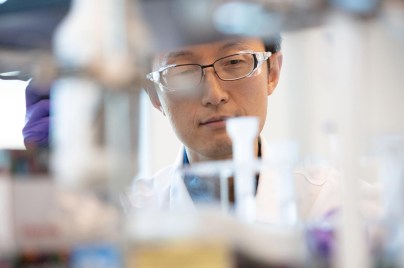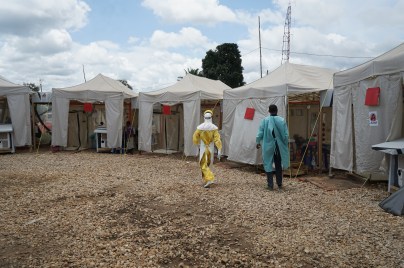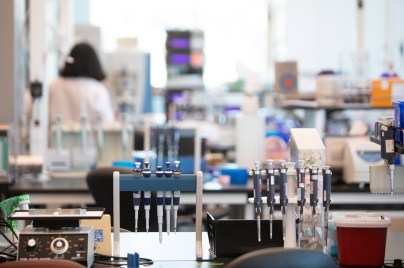
Merck scientists use green chemistry principles to reduce the environmental footprint of our manufacturing processes. We also carry out environmental tests on our products to evaluate and mitigate any potential for environmental impacts due to discharges from our pilot plant and manufacturing facilities as well as to evaluate potential impacts resulting from normal patient use. In addition, we strive to reduce the amount of packaging material and waste associated with our products and to ensure that our suppliers also have responsible practices.
Green Chemistry
Merck believes that green chemistry is fundamentally good for business. We apply green chemistry to both our research activities and our manufacturing operations.
In research, Merck scientists were the first to design micro-column chromatography applications for pharmaceutical discovery. This technology, which employs supercritical fluids to produce new compounds for research, avoids the creation of thousands of gallons of solvent waste. Merck scientists have published this research in the scientific literature where it is available to researchers in the pharmaceutical and other industries.
For manufacturing applications, Merck scientists and process engineers perform early stage process analysis to identify opportunities for waste minimization, recycling of process constituents and process streamlining. This has resulted in chemistry innovations including catalysis chemistry that significantly reduces the use of raw materials, the generation of both hazardous and non-hazardous waste, and reduces the use of energy and water in pharmaceutical production.
Merck has also begun tracking the Process Mass Index (PMI) — a measure of the amount of materials used to produce a certain amount of product as an indicator of process efficiency. The calculation is first done during process development where it is used as a metric to influence process selection. Later, during manufacturing, it is beginning to be used to prioritize implementation of identified opportunities and drive continuous improvement.
Merck is a founding member of the American Chemical Society's Green Chemistry Institute® ACS GCI Pharmaceutical Roundtable which is a partnership between the ACS GCI and member pharmaceutical companies. Roundtable members work together to create green chemistry tools and to support research related to the application of green chemistry to pharmaceutical discovery and production processes. Merck has received several awards in the United States and the European Union for its green chemistry efforts.
Environmental Risk Assessments
In many countries around the world, an Environmental Risk Assessment must be conducted and submitted to regulatory authorities as part of either the official marketing approval or the new substance notification processes. Because Merck markets products globally, this means that when new products are introduced, they have been assessed in a manner consistent with the most-conservative regulatory requirements.
To carry out these assessments, Merck puts our medicines through a battery of environmental fate and effects tests that are appropriate for evaluating potential environmental impacts from pharmaceutical residues in the environment. All tests are performed in independent research laboratories officially accredited to perform regulatory testing. Tests are carried out following protocols issued by the Organization for Economic Co-operation and Development (OECD) and in full compliance with Good Laboratory Practice regulations. Environmental risk assessments carried out to date indicate that our products do not pose an unacceptable risk to human health or the environment.
The European Medicines Agency (EMEA) publishes detailed information on the drug products it assessed in a European Public Assessment Report (EPAR), which now includes the results of the Environmental Risk Assessments that are performed.
Merck scientists also are collaborating with other pharmaceutical companies, governmental agencies and universities to foster greater awareness and use of the scientific methods used to assess the potential impacts of pharmaceuticals in the environment and to increase the understanding of such impacts. For example:
- Merck joined with representatives from other pharmaceutical companies, Swedish stakeholders with environmental interests, and the Swedish Association of the Pharmaceutical Industry in establishing an environmental classification system for pharmaceuticals in Sweden. Merck voluntarily provides environmental risk data on our products to the Swedish system, which is publicly available online at www.fass.se.
- Merck scientists are working with governmental agency and university scientists from Canada on the Canadian Environmental Impact initiative. This initiative is developing environmental assessment regulations aimed at addressing risks to the environment and to human health posed by products regulated under the Canadian Food and Drug Act.
Pharmaceuticals in the Environment
Studies have demonstrated that trace concentrations of ingredients found in pharmaceuticals and other consumer products used by the general public are present in waters in Europe and North America. The low levels of medicines that have been detected come primarily from patient use because a portion of medicines may pass through the human body without being completely metabolized. These compounds then make their way into municipal wastewater treatment systems ("WWT"); a portion may pass through WWT without being fully degraded, and therefore be discharged to the environment in very small concentrations. To date, scientists have found no evidence of adverse human health effects from the trace levels of pharmaceuticals detected in the environment.
In November 2007, Merck adopted a formal public policy position on Pharmaceuticals in the Environment (PIE) (
PDF*). This position describes our efforts to work with government agencies, the scientific community and other stakeholders to understand and appropriately respond to the issue. Merck participates in many stakeholder collaborations aimed at developing and implementing a science-based approach to evaluating and setting policy related to pharmaceuticals in the environment. In addition:
- Merck scientists have presented at several scientific workshops focused on pharmaceuticals in the environment, including the annual meetings of the Society of Toxicology and Environmental Chemistry and the Water Environment Federation.
- Through our association with the Graham Environmental Sustainability Institute, Merck is collaborating with researchers at the University of Michigan and with the Pharmaceutical Research and Manufacturers of America (PhRMA) to assess the environmental footprints associated with methods of disposal of unused medicines.
- Merck is also a sponsor of the Water Environment Research Foundation (WERF), where the significance of trace constituents of consumer products, including pharmaceuticals in the environment, has been identified as a critical knowledge area and is the subject of numerous research projects, including research on new wastewater treatment technologies to improve the removal of trace amounts of pharmaceuticals from wastewater discharges.
Although not a major source of pharmaceuticals in the environment, proper disposal of unused medicines is an important aspect of addressing this issue given that flushing of medicines contributes to the trace concentrations detected in the environment. Merck, through its membership in the PhRMA PIE Task Force, has worked to develop and implement the SMARxT Disposal Program, designed to provide the general public with information on proper disposal of medicines.
Use of Nanotechnology at Merck
Merck supports the use of nanotechnology to develop innovative drugs and vaccines that address unmet medical needs. Nanotechnology broadly describes the use of very small materials ranging from extreme size reduction of normal materials to unique substances such as carbon nanotubes, and other exotic materials.
Merck follows advances in nanotechnology because we are always looking for better ways to improve patient care as well as protect the environment and the health and safety of our employees. The testing required for all drugs will ensure that nano-based pharmaceuticals are safe and effective for patient use. Based on our current knowledge of nanoparticles, our existing methods for assessing risks to workers and the environment are valid and our existing controls are well-suited for controlling employee exposures to nanomaterials.
Merck is actively pursuing nanotechnology through internal research and development efforts and external collaborations with academia, biotechnology companies and companies that support various platforms for drug discovery and development of novel therapeutics. Potential areas of application of nanotechnology include therapeutic targets, identification of biomarkers, development of analytical tests, enhancing drug delivery to specific tissues and tissue compartments, molecular imaging to monitor the fate of therapeutic agents, and development of novel therapeutic approaches and molecules.
One of Merck's products, EMEND®, uses a nanoscale milling approach to make the granules very small so they are more easily absorbed in the digestive tract. Merck also packages a new class of experimental drugs (siRNAs) by coating them with lipids for efficient delivery to the inside of cells where they are active.
Other Product Stewardship Initiatives
Supplier Management: Merck was one of the initial companies to support the Pharmaceutical Industry Principles for Responsible Supply Chain Management, designed to ensure that working conditions in the pharmaceutical supply chain are safe, that workers are treated with respect and dignity and that their manufacturing processes are safe and environmentally responsible.
Product Packaging: The packaging we use for our finished products and for our in-process materials must preserve the sterility, purity and efficacy of our products. Many of our finished products must also be child safe and tamper-evident. Without compromising these factors, we are working to eliminate packaging waste by consolidating on fewer unique product images worldwide and by reducing packaging scrap. We anticipate developing criteria that will be used in the selection of packaging material to reduce our packaging footprint.
The content on this page was last modified on September 15, 2009.
Merck & Co., Inc., Whitehouse Station, NJ, USA, and Schering-Plough Corporation, Kenilworth, NJ, USA, are now one company. We have combined our global operations under the name Merck & Co., Inc. We are working to update our corporate responsibility Web site to reflect our new, combined, global organization.